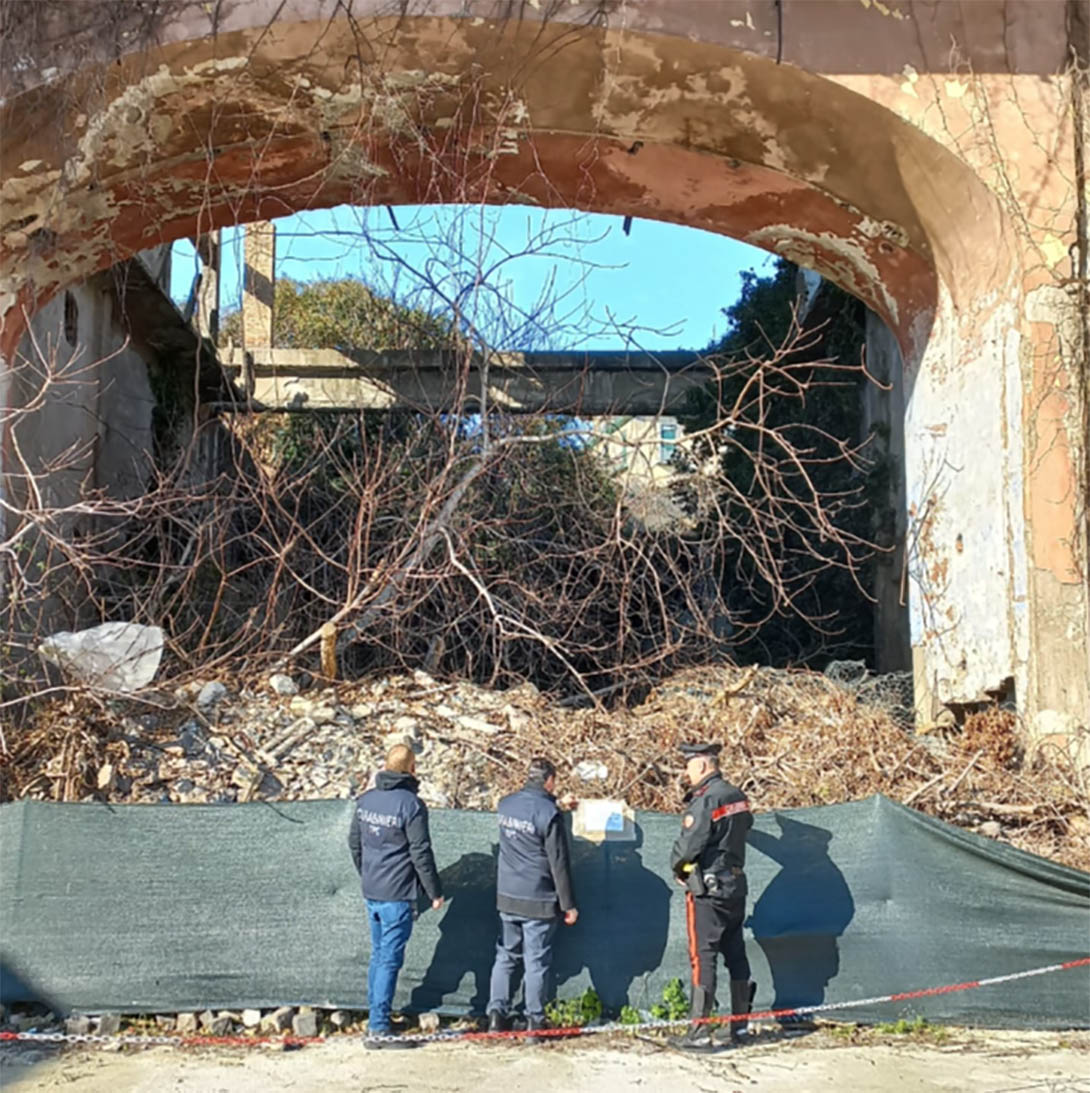
The old Bayard railway station in Naples, the starting point of the first railway in Italy, the Naples- Portici line, inaugurated in 1834, has been seized. It had become a parking lot.
The structure was seized by the Carabinieri of the Cultural Heritage Protection Unit of Naples on behalf of the Naples Public Prosecutor's Office in execution of a decree issued by the investigating judge for the crimes of invasion of land and buildings, failure to carry out work on buildings that threaten ruin, destruction, dispersion, deterioration, defacement, soiling and illicit use of cultural assets, damage to the national archaeological, historical or artistic heritage.
The seizure - ordered by the preliminary investigations judge who shared the Public Prosecutor's view regarding the existence of the crimes of invasion of land and buildings (art.633 of the Criminal Code), failure to carry out work on buildings that threaten ruin (art.677 of the Criminal Code), destruction, dispersion, deterioration, defacement, soiling and illicit use of cultural assets (517 duodedecies of the Criminal Code), 733 of the Criminal Code (damage to the national archaeological, historical or artistic heritage) - is motivated by the state of degradation and prolonged abandonment of the aforementioned cultural asset of historical-architectural interest which, moreover, has been found to be partly the object of illegal occupation by third parties and partly at risk of collapse due to the failure to carry out safety maintenance interventions for public safety.
It should be noted on this occasion that the criminal protection of cultural heritage has for several years been a matter for which the Naples Public Prosecutor's Office, in the organizational structures it has established over time, has reserved specialized treatment, most recently by establishing an autonomous intersectional group competent for all proceedings concerning the conduct supplementing the types of crime relating to the matter and provided for by various provisions of law.
More recently, the Office, based on the experience of the various cases reported over time, has started a more general survey which, by ascertaining the state of conservation and the intended use of the individual properties, aimed at identifying the
situations of greater exposure to the risks of further damage to the integrity or to the function of the asset itself.
In this more general operational perspective, a memorandum of understanding was signed with the Federico II University, Department of Architecture – Chair of Restoration, aimed at obtaining, between State institutions, an exchange of skills, knowledge and information functional to the respective institutional activities and consequent operational synergies.
The targeted investigative investigations followed as a consequence, also through the appointment of specialized consultants, and in implementation of the aforementioned protocol, we proceeded, in agreement with the Department of Architecture and the Superintendency, to checks on the state of several identified properties.
The investigations started and still in progress, with the inspections, the photographic surveys and the analytical filings on the historical, artistic and architectural importance of the individual properties viewed so far, have made it possible to highlight for each of them, the reasons for the historical-artistic importance for the purposes of the protection required by law, the state of conservation, the maintenance interventions missed over time and in any case necessary at present to restore the integrity as well as the more general safety conditions which, in addition to threatening in several cases the material integrity and the very possibility of survival of the property, exposed and still expose public safety to risk.