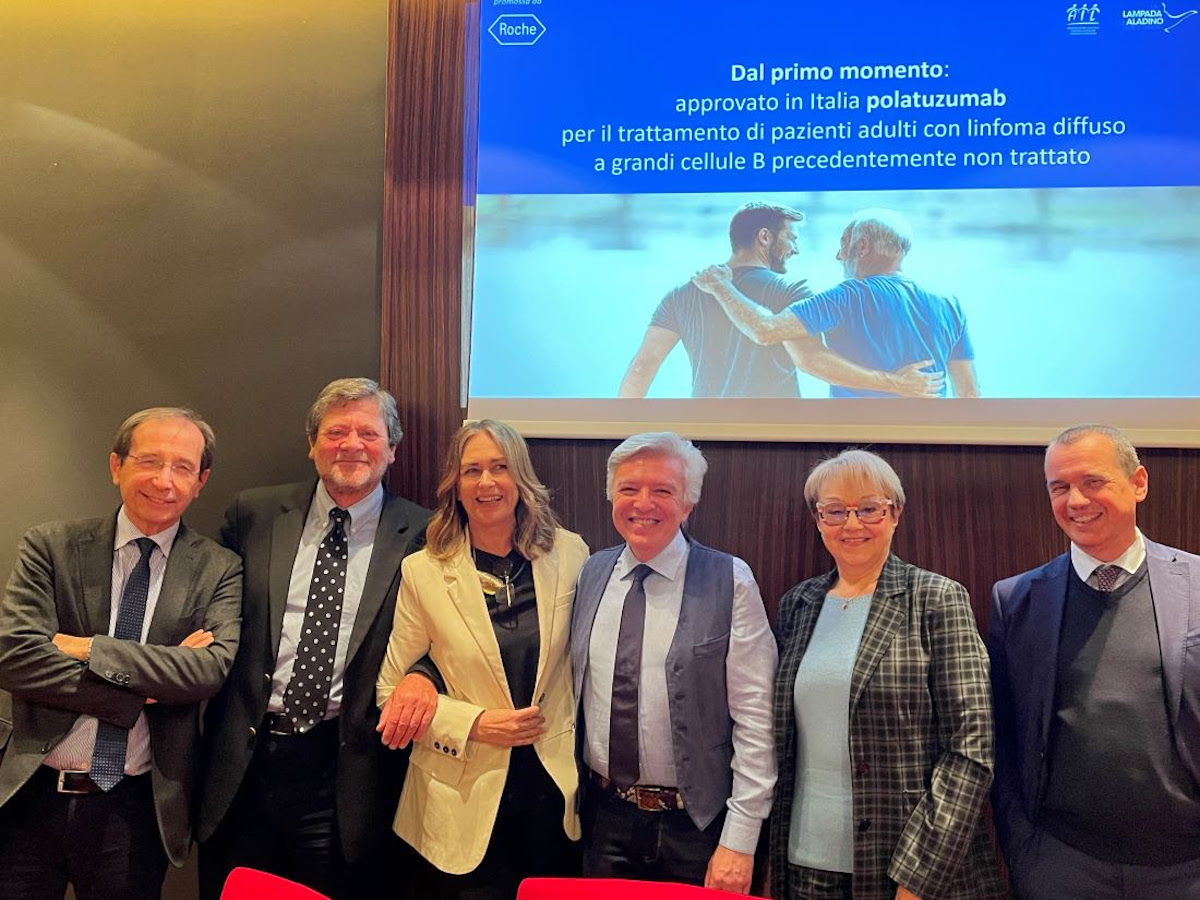
Polatuzumab vedotin may be administered to adult patients in combination with rituximab, cyclophosphamide, doxorubicin and prednisone, abbreviated as R-Chp.
For the first time in the last twenty years, the Italian Medicines Agency has given its approval to an innovative therapy for the first-line treatment of patients with diffuse large B-cell lymphoma, the most common type of aggressive cancer affecting the lymphatic system. With 500 new diagnoses per year worldwide – just over 13 cases in Italy alone, especially among those over 65, but patients over 40 are not uncommon – finding a drug to counteract the progression of the disease had long been one of the goals of research. Now the AIFA has approved it.
This is polatuzumab vedotin, which can be administered to adult patients in combination with rituximab, cyclophosphamide, doxorubicin and prednisone, synthesized in the acronym R-Chp. The approval of the AIFA came after the Polarix study – brought to our country by Roche Italia – demonstrated that the combination of polatuzumab and R-Chp reduces the risk of disease progression, relapse or death by 27%.
Although diffuse large B-cell lymphoma is well contained by initial treatments in many cases, nearly 40% of those affected experience a second, aggressive phase of the disease. With the administration of the new polatuzumab-based therapy, this percentage is set to decrease, as emerged from the phase three Polarix study, which involved 879 patients.
What exactly is polatuzumab? Dr. Antonello Pinto, medical director of the Institute of Cancer of Naples, Fondazione 'G. Pascale', explains: “It is a drug injected into the patient's vein that is based on the use of an antibody that recognizes an antigen, a protein expressed by lymphoma B cells.
Once the antibody has bound to the antigen, it releases a toxin, vedotin, into the cells, which inhibits the construction of microtubules during cell reproduction and prevents the replication of the diseased cell. This is a therapeutic modality that, in addition to being innovative, contributes to preserving and improving the quality of life of patients,” emphasized Dr. Pinto.
Professor Maurizio Martelli, director of Hematology at the Policlinico Umberto I in Rome, also agreed with his colleague. “We are celebrating an important step forward in the fight against diffuse large B-cell lymphoma. The decision by AIFA opens the doors to a new era of treatment for recently diagnosed patients,” he said.
Although in Italy there are thousands of lymphoma diagnoses every year, few are able to precisely define what this pathology consists of. According to a survey conducted by Elma Research on behalf of Roche Italia, out of a sample of a thousand interviewees, almost 20% do not know that it is a tumor of the lymphatic system that arises from the degeneration of B cells, responsible for the production of antibodies.
The consequence is that it increases the possibility of turning to the wrong specialists and not to the reference ones, who are hematologists and oncologists. The evident confusion on the topic and the lack of specific knowledge have acted as a push for the launch of the campaign 'From the first moment', which Roche Italia presented in conjunction with Lymphoma Awareness Day.
Two patient associations, Ail and 'La Lampada di Aladino', have also supported the pharmaceutical company's cause, both of which were present at the conference announcing the approval of polatuzumab.
"Our commitment is realized by being close to those who develop this disease, also following the caregivers in the path of managing the pathology. The emotional and psychological aspect plays a fundamental role - said Rosalba Barbieri, vice president of Ail Nazionale and head of the Novara section - The other big theme is that of raising awareness and promoting correct information about the disease: in this case, the involvement concerns the entire Italian population".
The president of 'La Lampada di Aladino', Davide Petruzzelli, shared the same opinion and underlined how central cooperation between institutions and patient associations is: “Our slogan, In our association we do not treat cancer, but the people who experience cancer, is focused on the help we want to give to the person.
We offer technical and scientific support, but also assistance, from accompaniment to chats between patients for an exchange of experiences. Psychological support is essential. We are increasingly witnessing the chronicity of the disease and from this arises the need for emotional assistance.
The priority of the healthcare system should be to guarantee each individual also the maximum psychological support: to do this, it is important to be able to count on an efficient healthcare organization in collaboration with patient associations and institutions. In this way, we can address the impact that diseases such as non-Hodgkin lymphomas also have in terms of medical times and care assistance”.
Innovations in the field of medical and pharmaceutical research are a further tool that allows improving the quality of life of patients, in addition to making increasingly targeted and effective therapies available. The AIFA approval of polatuzumab is proof of this and Federico Pantellini, Medical Affairs Chapter Lead Roche Pharma, explained with satisfaction the importance of the approval of the drug: “It is a result that is the fruit of years of research.
It is important to underline how being able to work in an experimental field over time helps the scientific community and not only to better understand the potential of the product, obviously studied very carefully. For this reason our commitment to oncohematological research continues.
In the treatment of tumors such as diffuse large cell lymphoma, for example, we are working to combine drug-conjugated antibodies with new specific B drugs. We are also working on the front of follicular lymphomas. In fact, we believe that these particularly aggressive forms of disease must find new ways of approaching them. Being able to guarantee opportunities for experimentation along all lines of treatment of hematological neoplasms such as in the case of lymphomas can represent a benefit for the system, for patients and for those who take care of those affected by these diseases”.