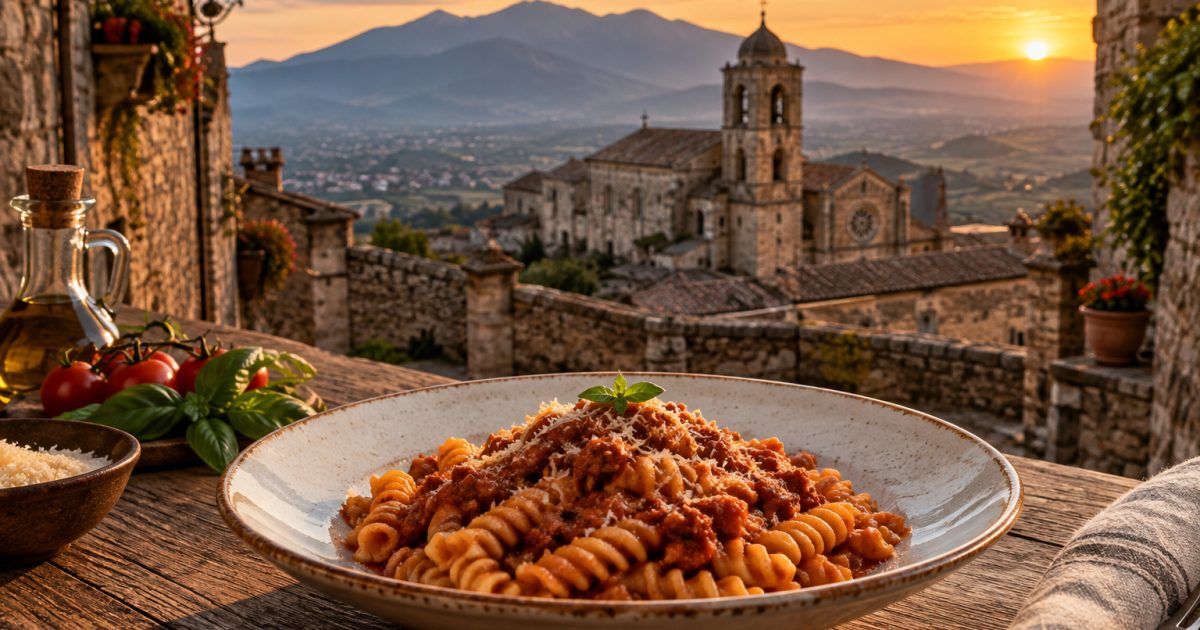
Between steep alleys, stone arches, and the profile of the Tifatini Mountains, Casertavecchia offers a cozy backdrop to a pasta dish that traverses Campania: fusilli cilentani al ragù.
The village and the inland table
Casertavecchia is reached by leaving the more urban part of Caserta behind and climbing towards the medieval village, nestled on the slopes of the Tifatini mountains. The road climbs through curves and vegetation, while the view opens up over the Caserta plain. On clear days, the view reaches Vesuvius and, to the south, reveals the uninterrupted Campanian landscape: fields, towns, hills, and roads connecting regions with diverse gastronomic traditions.
The heart of the town preserves the Cathedral of San Michele Arcangelo, with its sober façade and distinctive bell tower, along with the remains of the castle and the stone houses. Here, the visit invites you to slow down. Not only to admire the architecture, but also to understand a cuisine born in contexts where the pantry had to be practical, seasonal, and capable of transforming a few ingredients into hearty dishes.
Fusilli cilentani are a traditional dish from Cilento, in the southern part of the region, but they could also find a natural home in a village in the Caserta hinterland. The handmade pasta, rough and firm, holds the sauce; the slow-cooked ragù brings the flavor of family Sundays and peasant tables to the dish. The connection isn't a recipe born in Casertavecchia, but rather a fusion of neighboring regional languages: the manual skill of rolling and shaping the pasta, tomato, meat, aromatic herbs, and patient cooking.
The shape of the fusilli holds the ragù
Fusillo Cilento is a long, twisted pasta, made by wrapping a small cord of dough around a thin iron or a special stick. Its surface isn't smooth and regular like that of industrially made pasta: it features grooves, twists, and varying thicknesses, details that become precious when it's served with ragù.
To make the dough at home, you'll need re-milled durum wheat semolina, warm water, and a pinch of salt. Some families add an egg, but the version made with just semolina and water produces a particularly firm consistency, suitable for manual work. The dough should be firm and not sticky; after resting for at least thirty minutes, covered, it is formed into thin ropes and wound around the iron, carefully unwinding them before letting them dry.