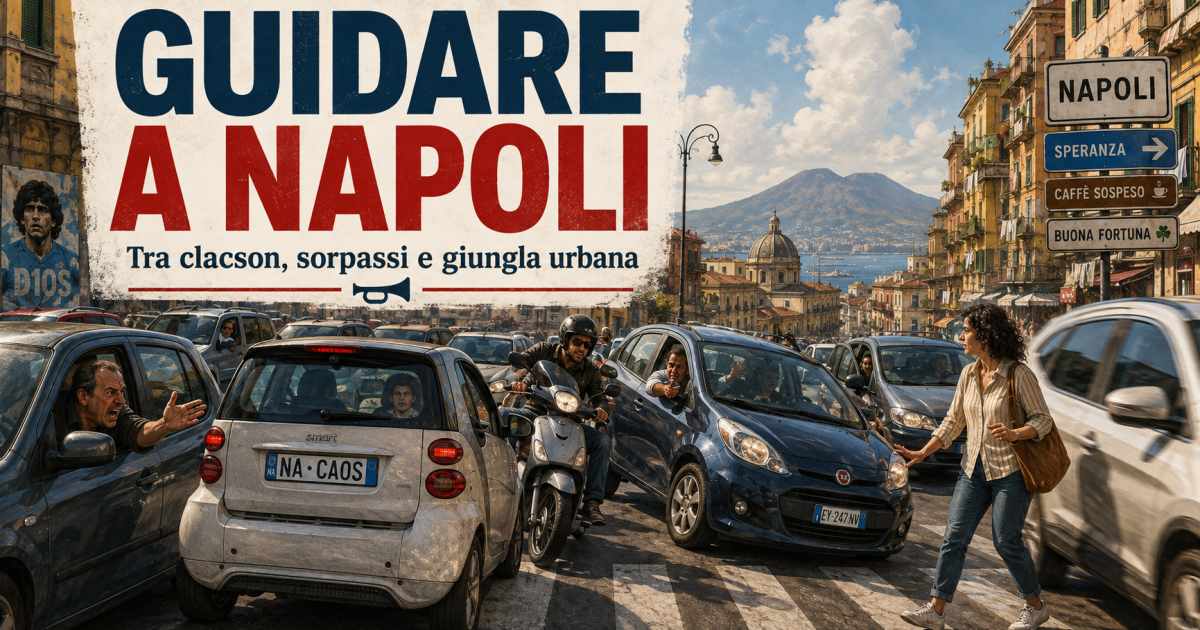
There was a time when driving in Naples and its province was considered complicated. Today, however, it almost feels like participating in an unofficial Guinness World Record for patience every day.
It's not because the streets have suddenly become narrower or because the traffic lights have decided to rebel. The problem, much more simply, is that some basic common-sense rules seem to have become optional.
Indeed, sometimes one almost gets the impression that certain drivers have been issued with a roadway ownership certificate along with their driving license.
The pedestrian on the crosswalk? An opponent.
Let's start with a very simple scene.
A pedestrian arrives at the crosswalk.
What does a normal person do?
Slow down.
A driver belonging to the category of “tricksters”, however, applies a completely different strategy: he accelerates.
The goal seems to be to convince the pedestrian, through a sophisticated form of psychological pressure, that crossing is not so urgent after all.
The pedestrian steps on the crosswalk, the car speeds up, and a sort of silent duel ensues.
“Are you coming by?”
“No, you go.”
“No, look, I'll come over.”
And finally the car passes.
Naturally.
The stop and the accelerator theory
Another great classic.
There's a car stopped at the stop sign, politely waiting for the right moment to enter.
Another car arrives from far away.
Logic would suggest maintaining a normal speed.
But no.
As soon as someone catches sight of the driver at the stop sign, they suddenly feel the need to step on the gas.
It doesn't matter if just two seconds ago it was easily traveling at thirty miles an hour.
The presence of someone who wants to enter immediately transforms the road into the final straight of Monza.
Why?
Mystery.
Maybe there is an unwritten rule:
“Never let anyone get in front of you.”
Even if there is a red light a hundred meters later.
The Pacifier Race
And here we come to a very popular discipline: the so-called pacifier race.
It works like this.
A driver speeds off, overtakes one car, then another, changes lane, flashes his lights, accelerates, squeezes into a thirty-centimeter gap, and proudly conquers twenty-five meters of road.
Then he arrives at the traffic light.
Red.
And right next to him, with absolute calm, arrives the very car he had overtaken three minutes earlier.
The result?
Same traffic light.
Same time.
More gasoline consumed.
More nervousness.
But above all, the moral satisfaction of having arrived first… at the red light.
Those who are always in a hurry
Then there is another fascinating category: those who are always in a hurry.
It is not known where they are supposed to go.
Maybe they're saving the world.
Maybe they're going to defuse a bomb.
Maybe they have a meeting with the President of the Republic.
The fact is that they have to overcome.
To the right.
Left.
Between two cars.
At the crossroads.
On the roundabouts.
Anywhere there is theoretically enough space for a body to pass through.
Then, every now and then, fate presents the bill.
Maybe a few hundred meters later you find that same driver stopped.
In front of a patrol.
And at that moment you discover that all that haste was perfectly compatible with ten minutes of conversation with the police.
The horn as a philosophical instrument
Then there is the driver who communicates exclusively through the horn.
Is there a car ahead that's moving slowly?
BEEEEEP.
Why is it going slow?
It does not matter.
You have to play.
Then the overtaking attempt begins.
The driver moves, accelerates, looks ahead…
and discovers that a few meters further on there are the Carabinieri.
Suddenly the horn goes silent.
The speed drops.
Driving becomes flawless.
The hands return strictly to ten past ten.
Miracles of the uniform.
And then come the scooters
But the truly special chapter of urban mobility is represented by scooters.
Attention: not from the scooters themselves.
The scooter is a very comfortable vehicle.
The problem arises when someone forgets that riding a two-wheeler requires even more attention, caution, and responsibility than driving a car.
And instead you sometimes see boys, girls, and adults darting between cars as if they were participating in a slalom race.
Right.
Left.
Sidewalk.
Space between two machines.
Against traffic for ten meters.
Crossing an intersection with an almost religious confidence that others will stop.
Some scooters seem to materialize out of nowhere.
You check the mirror: nothing.
Put the indicator on.
Double check.
You move five centimeters.
Suddenly a scooter appears.
And of course the driver looks at you indignantly as if you were the one invading his personal lane.
What if something happens?
The paradox arises when reckless behavior causes a dangerous situation.
Because at that moment one of the oldest Italian automotive traditions can be triggered:
be right anyway.
“But I was passing by.”
“But you had to see me.”
“But I was already there.”
Where exactly that “there” was often remains a matter of philosophical interpretation.
The road is not ours
Beyond the irony, however, the problem exists.
Driving has become more stressful because that small form of cooperation that makes circulation possible is often missing.
Letting a pawn pass does not mean losing a battle.
Letting a car enter doesn't mean you're any less smart.
Not overtaking when unnecessary does not mean you are unfit to drive.
And above all, arriving thirty seconds late almost never changes anyone's life.
The street is one of the few places where people who don't know each other must necessarily trust each other.
When someone decides that the rules only apply to others, everything becomes more difficult.
Naples and its province already have enough traffic, complicated intersections, narrow streets, and creative parking.
Perhaps there's no need to add a permanent race to see who gets to the next red light first.
Because in the end, true driving skill isn't about managing to squeeze into an impossible space.
It's getting to your destination without turning the journey into an episode of Fast & Furious: Naples Ring Road.
 Chronicles of Campania
Naples, shock on Via Foria: elderly woman hit by scooter on pedestrian crossing
A new and very serious traffic accident has once again bloodied the arteries of central Naples, bringing the spotlight back to a now daily emergency:…