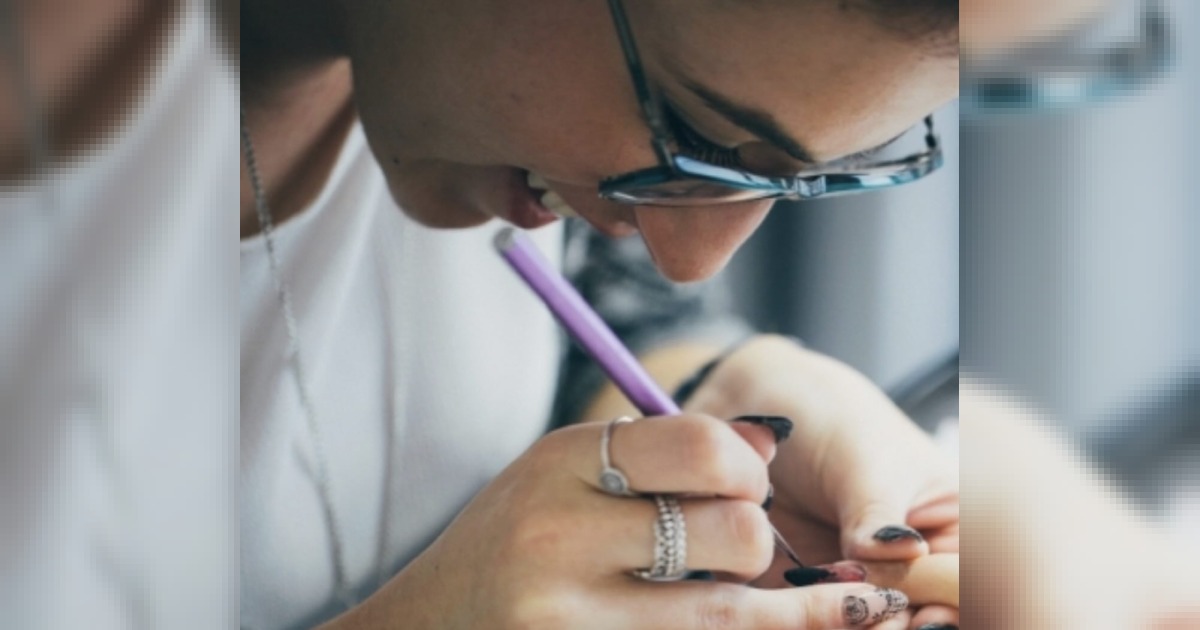
Learning to be a nail technician isn't just about understanding a technique: it's about making it repeatable, clean, and safe. And when fine motor skills are involved—such as filing, product handling, use of the drill, and trimming cuticles—the course format can significantly impact the learning experience.
Basic structure of the two formats
In the in-person course, the implicit promise is simple: you start working immediately, often from the very first lessons, on models or props, with the instructor just inches from your hand. It's an almost artisanal approach: someone observes the gesture as it emerges and can correct it before a mistake becomes a habit.
In the online course, the technique is taught through modular video lessons, such as those on natural nail preparation, shaping, filing, and finishing. These can be supplemented with downloadable materials, exercises, and remote support.
What changes above all is the time between explanation, execution and correction.
How learning manual skills changes
In the classroom, manual dexterity improves thanks to immediate corrections: posture at the workstation, pressure of the brush or file, amount of product and sequence of movements.
The benefit lies not only in performing an exercise well, but also in avoiding repeating the same mistake. If the teacher intervenes promptly, an incorrect hand position or an imprecise movement can be corrected before it becomes automatic.
Online, the dynamic changes. The quality of the result depends more on the ability to independently organize practice, workstation, materials, and models, using the video lessons as a reference.
Reviewing a step several times can be very helpful in memorizing sequences and technical timing. However, transforming an observed procedure into a truly mastered gesture requires constant practice.
Manual skill, in this case, does not happen automatically: it must be built through repetition.
Recognition and regulatory aspects
Then there is a level that deserves attention: that of the professional objective.
In Italy, nail technicians are not uniformly regulated as independent professions throughout the country. Available courses may therefore have different characteristics, duration, certifications, and objectives.
This means that the choice should not depend solely on the preference between online and in-person.
If your goal is to work professionally, open a business, or operate in a context subject to specific administrative requirements, it's a good idea to check the applicable regulations in your region and the actual value of the qualification or certificate issued by your chosen program.
The question to ask yourself, therefore, is not only: "Do I prefer studying online or in the classroom?", but also: "Is this path compatible with what I want to do professionally after the course?"
Advantages and limitations of online nail technician courses when learning a manual technique
Online learning has become popular because it solves a real problem: not everyone can attend an academy according to a set schedule and calendar.
However, when it comes to learning a manual technique, flexibility must be accompanied by well-organized practice.
Strengths of online for a manual technique
The first advantage is flexibility. You can study when you have time, without necessarily having to adapt your entire routine to pre-established days and times.
For those who work, have children, or live far from specialized schools, distance learning can represent a concrete opportunity to get started without delaying for months.
Then there is an advantage that the classroom can hardly replicate in the same way: the possibility of reviewing a demonstration multiple times.
Pausing, going back, and repeatedly looking at a draft, a refinement, or a specific sequence allows you to analyze each step more calmly.
This doesn't replace practical exercises, but it can make them more organized. Before you begin, know what you need to do, in what sequence, and what details to observe.
Many online courses also offer materials that can be consulted after class: handouts, fact sheets, checklists, and video content. This can be useful when you need to review a protocol or quickly review a passage before practicing.
Limitations of online learning in the construction of manual skills
The main limitation is the lack of immediate feedback.
Even when it is possible to send photos or videos to a teacher, correction usually occurs after the exercise.
In the meantime, you may have repeated the same micro-mistake several times: an incorrect angle of the file, too much pressure near the cuticle, or a seemingly adequate but technically imprecise distribution of the product.
Then there is the whole organizational part of the practice.
You need to find models, set up an ergonomic workstation, have adequate lighting, and procure a lamp, files, cutters, bits, and suitable products.
Online works best when it stops being just “study when I can” and becomes a regular workout program.
Consistency is not optional.
Another missing element is the classroom context. Observing different hands, recurring errors, and alternative solutions allows for the rapid construction of a sort of visual archive of real-life situations.
Online, this wealth of experience must be reconstructed through practice, comparison, and guided observation.
Advantages and limitations of in-person courses to learn a manual technique
When it comes to manual skills, the classroom retains an important advantage: it reduces the distance between gesture, error, and correction.
This doesn't mean that an in-person course is automatically better overall, but the format lends itself particularly well to hands-on learning.
Strengths of the classroom on manual skills
Real-time correction can have a huge impact on the learning process.
The teacher can intervene on the grip of the tools, the angle, the quantity of product, posture and technical times.
Most importantly, it can directly link a defect to the gesture that caused it.
If the thickness is too thick, it can reveal where too much product has been applied. If the cuticle area is imprecise, you can adjust the pressure or the trajectory of the movement.
Furthermore, the work is generally carried out in an environment designed for training, with workstations, tools and materials already organised.
This eliminates some of the logistical effort and allows you to focus more on execution.
Seeing movement live and from different angles can also help you understand details that may be less obvious on video, such as small wrist rotations, changes in pressure, or the positioning of the client's fingers.
Limitations of the classroom compared to online
Even the classroom has its limits.
The first is simple: it is not always possible to review a demonstration.
If the school doesn't provide videos or detailed materials, homework revision depends on notes taken during class, which rarely provide the precision of manual gestures.
Then there are pre-established times and calendars.
For those who work shifts or live far from the office, attending regularly can become complicated.
Indirect expenses may also be added to the cost of the course: transportation, meals, any overnight stays and days not worked.
Finally, practice outside the classroom remains necessary.
Attending an in-person course can help guide your progress, but consistency in results only comes through repetition between lessons.
How to choose or combine online and in-person learning to learn manual skills well
The best choice doesn’t necessarily have to be “online or in person.”
More useful is to understand what is needed at the current stage of your journey and what might be needed after a few months of practice.
When to choose an online course
An online course can make sense when the main goal is to acquire a solid theoretical foundation and follow a clear protocol.
Anatomy, hygiene, product characteristics, and operating sequences are topics that lend themselves well to distance learning.
It can be an effective solution even when there are time or distance constraints.
Online learning can also be particularly useful for those who already have basic manual skills and want to delve deeper into specific techniques, such as shapes, refills, or nail art, without interrupting their work routine.
It can also represent a first step: it allows you to acquire terminology, mental order and a general map of the work, before moving on to a more intense practical path.
When to focus on the classroom
If you're just starting out, the classroom can help you avoid weeks of unstructured trial and error.
It's especially useful when you need to build hand-eye coordination, familiarity with tools and products, and the ability to immediately recognize technical errors.
In these cases, it may be useful to compare more structured and continuous courses, such as those offered by Accademia Liliana Paduano , to understand specifically how theory, classroom practice, and workshops can be distributed throughout the year.
If your goal also includes professional requirements or qualifications, it's still important to check which discipline is applicable in the region where you intend to work and what exact value the qualification awarded by each course has.
Advantages of the hybrid model: more online presence
The hybrid model can represent an effective compromise.
The theory and demonstrations can be studied online, with the ability to pause and review each step. Practice can then be consolidated through in-person modules dedicated to gesture correction.
In this way, the online method is used for memorization and revision, while the classroom is used to address the most difficult aspects to self-correct: architecture, thicknesses, curves, filing, and precision work in the cuticular area.
The result can be a journey with fewer trips, but without completely giving up direct comparison on a technique that, by its nature, is learned above all by doing.