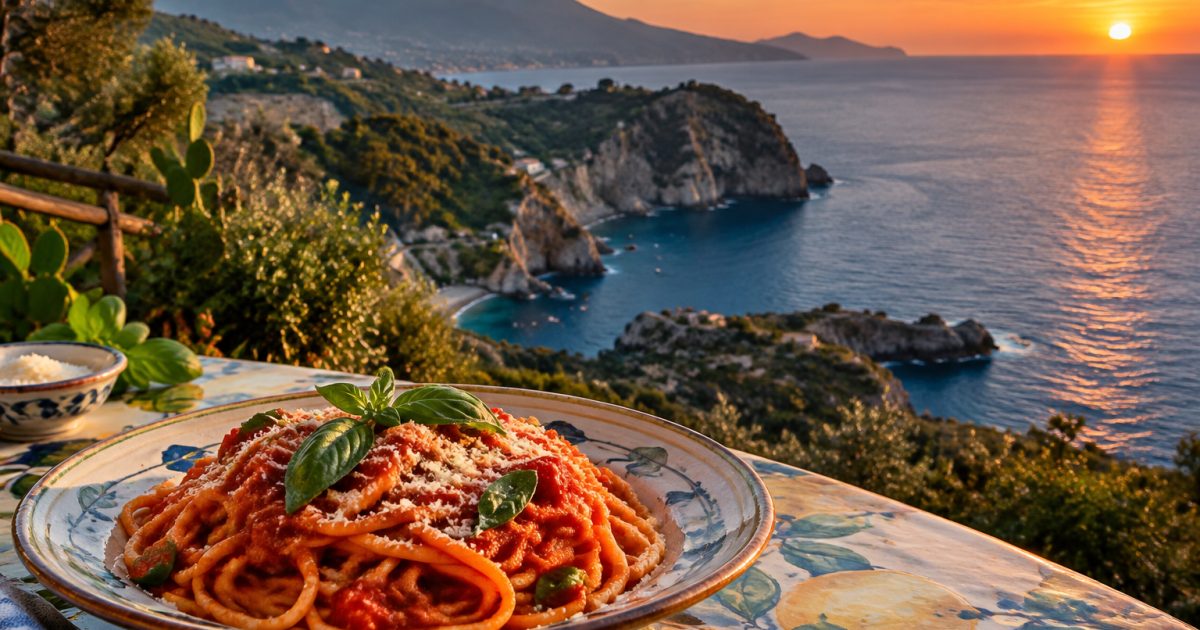
In Palinuro, the landscape enters the kitchen: between the blue of the Tyrrhenian Sea and the Cilento scrub, the scarpariello brings the direct flavor of Campania to the table.
Cape Palinuro juts out into the sea like a natural backdrop, with rocky cliffs, inlets, and panoramic viewpoints from which the coast appears in constant motion. The color of the water changes with the light: deeper offshore, clearer near the coves, punctuated by the reflections of the rocks and Mediterranean vegetation. Here, the relationship with food isn't born from a quest for elaborate dishes, but from the ability to showcase familiar ingredients, carefully selected and cooked without overpowering them.
It's in this balance between land and sea that scarpariello finds its natural place. It's not a fish dish, and for this very reason, it can be surprising in a coastal location: its identity belongs to the home-style cuisine of Campania, that of quick sauces, pasta creamed off the heat, and grated cheeses added for texture. In Palinuro, it can be the ideal dish after a morning spent along the promontory or a day on the Cilento beaches, when you're looking for something warm, fragrant, and satisfying.
Cape Palinuro, among rocks, trails, and Mediterranean cuisine
The promontory is explored slowly. From the harbor and the landing stages, the coast reveals its marine side, with cliffs shaped by wind and water; from the scenic routes, however, the view extends to the gulf and the hills of the Cilento hinterland. The sea caves and grottos along the coast are part of Palinuro's imagery, but the place's character can also be felt in the most mundane details: the scent of the vegetation, the salt on your skin, the sound of boats returning.
The kitchen follows the same path. Tomato, extra virgin olive oil, garlic, chili pepper, basil, and aged cheeses are ingredients capable of building a complete dish starting with a basic pantry. In Campania, where food traditions vary from coast to coast and from cities to inland areas, scarpariello expresses a form of domestic convenience: a quick sauce, prepared while the pasta is cooking, with the creaminess provided by the cooking water and cheese.
Its appeal also lies in its texture. The tomato must remain vibrant and fragrant, the oil must bind without covering, and the cheese must melt, creating a smooth sauce. The result is not a heavy sauce, but a dish with a distinct flavor, with the green note of basil and a possible hint of spiciness. It's a dish that lends itself to everyday cooking, but requires a few precise steps to avoid becoming dry or overly salty.
Scarpariello: few ingredients, precise creaming
For four people, you can use 320 grams of spaghetti, vermicelli, or other long pasta; about 500 grams of peeled tomatoes or tomato purée; two cloves of garlic; four tablespoons of extra virgin olive oil; chili pepper to taste; a handful of basil; 60 grams of grated pecorino cheese; and 40 grams of a hard cheese, such as grated provolone del Monaco, in equal parts. You'll also need salt and cooking water.
Start by heating the oil in a large pan with the garlic and, if desired, chili pepper. The garlic should be fragrant without burning: too much color can make the sauce bitter. Add the tomato, adjust the salt, and cook over medium heat for about fifteen minutes, until the sauce is concentrated but still runny. You can add the basil partly during cooking and partly at the end, to preserve different flavors.
Meanwhile, boil the pasta in salted water and drain it al dente. Before draining, it's important to save at least a cup of the pasta cooking water: the starch will be crucial in binding the sauce. Transfer the pasta directly to the pan with the tomato sauce and sauté for a minute or two. If it seems dry, add a little water at a time.
The most delicate stage comes with the heat turned off. Add the grated cheeses, stirring vigorously and adding a few more tablespoons of water if necessary. The mixture should be creamy, not stringy or grainy; for this reason, the cheese should not be poured over a boiling, dry sauce. A final drizzle of oil, a few basil leaves, and, if desired, a light sprinkling of chili pepper complete the dish.
The pasta you choose depends on your desired consistency. Spaghetti holds the sauce well and makes the sauce more visible; a short, ridged pasta holds the tomato sauce better and can be more practical in a casual setting. In any case, the sauce should complement the pasta, without turning into an overly rich, cheesy cream.
A dish to be savored while gazing at the Tyrrhenian Sea
Scarpariello doesn't require complex accompaniments. It can be preceded by grilled vegetables, a tomato salad, or seasonal greens, while bread is used to mop up any remaining sauce. The table setting should also reflect the setting: recognizable ingredients, balanced portions, and enough time to let the scenery become part of the experience.
In Palinuro, the flavor of the dish is thus tied to geography. The tomato brings the warmth of the hinterland, the oil recalls the olive trees of Cilento, the basil recalls the summer vegetable gardens, and the cheese adds depth to a recipe constructed with minimal ingredients. Facing the waters of Cape Palinuro, between a stroll on the promontory and a break in the shade of the Mediterranean scrub, scarpariello conveys a tangible Campania: one that can transform a simple pantry into a moment of pleasure, without straying from its landscapes.
Key points about Scarpariello and the context of Palinuro
Here's a summary of the main aspects of scarpariello and its preparation, as they relate to the Palinuro area.
- Main ingredients: Pasta, tomato, extra virgin olive oil, garlic, chili pepper, basil, and cheese.
- Preparation: It requires precise mixing to obtain a creamy consistency without overloading the dish.
- Characteristics of the dish: Clean taste and Mediterranean aromas, ideal after a day at the beach.
- Geographical context: Palinuro offers a landscape that enriches the culinary experience, with fresh, local ingredients.
- Recommended accompaniments: Grilled vegetables, tomato salad, or bread to soak up the sauce.