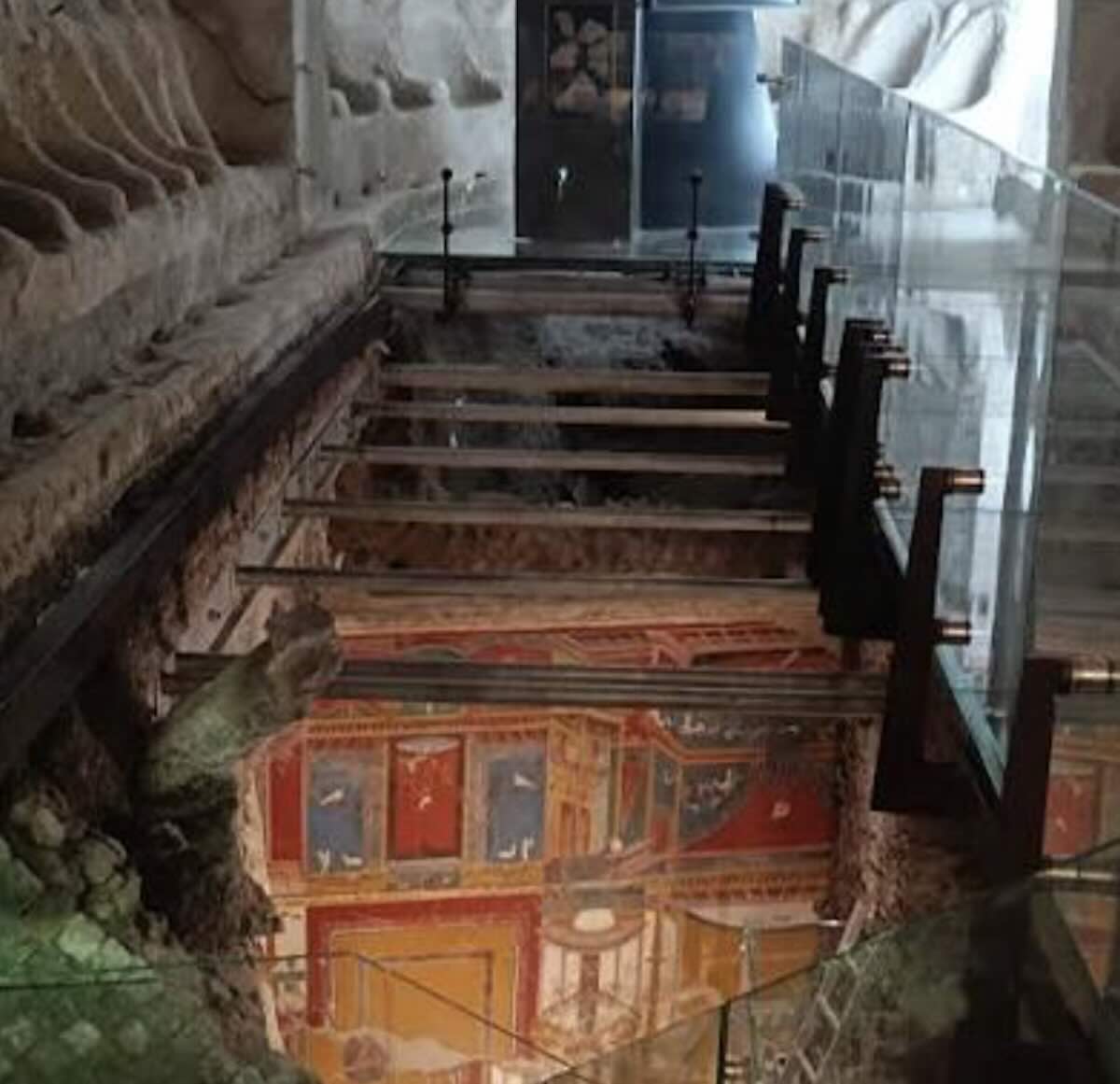
The archaeological site of the Roman Villa of Positano is preparing for a new phase of public access. Thanks to funding from the Ministry of Culture, the recently begun excavation work will be accessible to visitors starting at the end of September, adopting the "transparent construction site" approach.
The announcement was made during the 54th edition of the 'Léonide Massine' Dance Award, an event that combines art and culture, highlighting the value of the site buried by the eruption of Vesuvius in 79 AD. This luxury villa, known for its Fourth Style frescoes and the presence of medieval remains, is part of the Roman Archaeological Museum managed by the Municipality of Positano.
The new excavation campaigns will enrich the exhibition with artifacts that will be progressively displayed to visitors. Among the most interesting discoveries is a section of wall built using the opus mixtum technique, characterized by the vertical arrangement of bricks, a peculiarity that has already attracted the attention of scholars.
The villa, located beneath the oratory of the Church of SS. Maria Assunta and rediscovered in 2003 during construction work, was first described in 1758 by Karl Weber. One of the most intriguing hypotheses attributes the residence to Posides Claudi Caesaris, a freedman of Emperor Claudius known for building luxurious residences. The Roman Archaeological Museum of Positano is the result of a collaboration between the Superintendency of Archaeological Heritage of Salerno and Avellino, the Municipality, and the Episcopal Curia.
Previous excavation campaigns (2004/2006 and 2015/2016) had already brought to light significant elements, including the triclinium, a dining room overlooking the bay directly via a porticoed peristyle, mosaic floors and wall paintings.
The cultural event that hosted the announcement also celebrated the integration of dance and archaeology with awards to prominent figures in the world of art and cultural communication, strengthening the link between past and present.
Key Points on the Roman Villa of Positano
Here is a summary of the most relevant information regarding the new excavation of the Roman Villa in Positano.
- Accessibility: The site will be open to the public by the end of September.
- Transparent construction site: The excavation works are carried out with an approach that allows visitors to observe the process.
- Significant discoveries: Among the finds that emerged, a wall in 'opus mixtum' aroused particular interest.
- Institutional collaboration: The project is the result of a synergy between the Ministry of Culture, the Municipality of Positano, and the Superintendency.
- History of the villa: The villa, buried by the eruption of Vesuvius in 79 AD, was rediscovered in 2003.