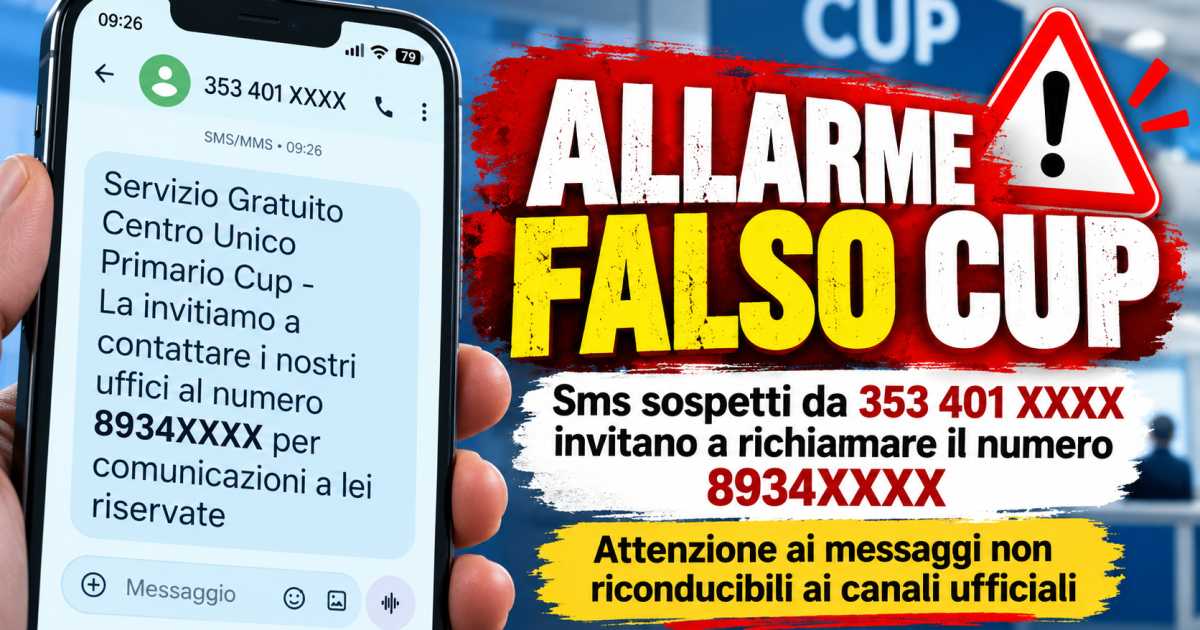
Several readers have reported messages inviting them to contact supposedly Central Reservations offices. Initial checks raise doubts about the authenticity of the communications: the numbers do not appear to be traced back to official health service channels.
For several days now, several readers of our newspaper have been reporting receiving suspicious text messages, apparently sent from the CUP, the Single Healthcare Booking Center.
The messages refer to supposedly urgent communications and invite the recipient to contact a telephone number indicated in the text. This wording could easily mislead, especially those waiting for a medical appointment, a diagnostic test, or information regarding a healthcare appointment.
What makes the communication suspicious is above all the origin of the message: the reported SMS messages appear to be sent from mobile phone numbers, while the contact number to be called does not appear to have any connection with the official CUP channels.
Checking telephone numbers
Initial checks carried out on the numbers reported by readers reveal elements that call for maximum caution.
Neither the number used to send the message nor the one reported in the text message appear, at the moment of the checks, to be traceable to the institutional contact details of the Single Booking Center.
A further concern arises when consulting some online services dedicated to identifying unknown telephone numbers. In some cases, the information published by users appears to link certain numbers to commercial or advertising communications, including those related to the energy market.
Of course, this information doesn't allow us to definitively identify the person responsible for the text messages, nor to determine the actual destination of the calls. However, this information contributes to raising doubts about the authenticity of the communications received.
The false sense of urgency
The mechanism used is particularly insidious because it exploits the reference to a health service known to millions of citizens.
Anyone who receives a message that talks about urgent communications from the CUP might think it is a changed appointment, a test to be confirmed or an administrative issue relating to their health.
It is precisely this sense of urgency that represents one of the main alarm bells.
The communication does not necessarily provide accurate information about the alleged healthcare practice, but it encourages the recipient to make a phone call to find out more.
The risk is that of coming into contact with individuals outside the healthcare system, receiving further commercial solicitations, or, in the most serious cases, being involved in fraudulent schemes.
Fake CUP SMS messages, cases already reported in Italy
The phenomenon is not isolated. Throughout 2026, several health authorities and regional administrations published warnings regarding fake CUP messages.
The Liguria Region, for example, reported text messages last January asking people to call back premium rate numbers for alleged personal communications. The Lombardy Region and several health authorities have also reported similar attempts.

More recently, on August 28, 2026, the Piacenza Local Health Authority reported messages that even used a reference to a supposed toll-free number, urging citizens not to contact the indicated number.
In some documented cases, the scam involves tricking the victim into calling premium rate numbers, with the risk of high charges. However, it's impossible to confirm that this is also the mechanism behind the SMS messages received by our readers, given the lack of further technical information on the numbers involved.
How to recognize a suspicious message
The advice is not to automatically trust a communication just because it contains the acronym CUP or refers to a supposed health office.
Before making any phone call, it is advisable to carefully check both the sender's number and any number included in the message.
An unknown mobile number, a generic text message about an emergency without providing details, and a request to call back from an unverifiable number are all signs that should prompt caution.
It should also be remembered that the number displayed as the sender, in itself, is not always a guarantee of authenticity, since there are techniques that allow the originating identifier to be falsified.
What to do if you receive suspicious text messages from the CUP
Here are some practical tips for dealing with potentially fraudulent SMS messages.
- Verify the sender: Always check the sender's number and compare it with the official numbers published on the local health authority websites.
- Don't call back right away: Avoid contacting the number provided in the message without first verifying its authenticity.
- Contact your local health authority: If you have any doubts, call your local health authority directly using the official numbers.
- Do not share personal data: Do not provide personal or banking information to unverified numbers.
- Report any scams: If you have any suspicions, report the message to the Postal Police, keeping a screenshot.
 Chronicles of Campania
Elderly scams: Carabinieri appeal to family members: "An extra phone call can save your loved ones."
During the hottest weeks of the year, with cities emptying for the summer holidays and the heat wave that doesn't…