


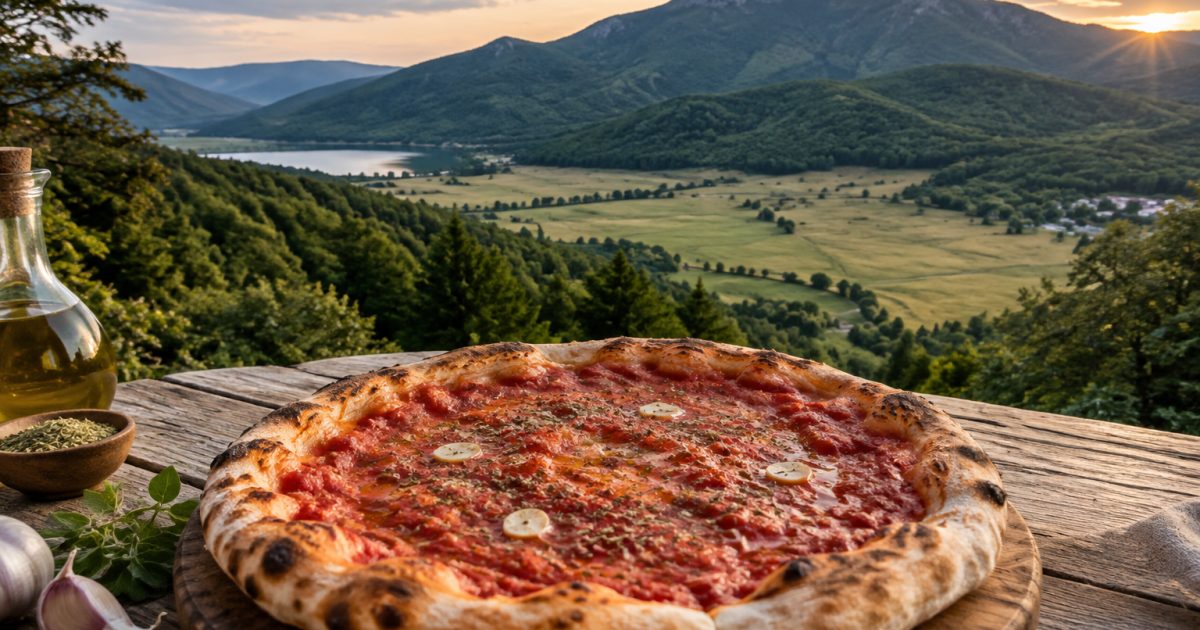


Between the beech forests of Laceno and the Picentini mountains, pizza marinara tells the story of a high-altitude Campania made of simple ingredients, careful cooking, and open views.
The Laceno plateau and the breath of the Picentini
Laceno is located in the Bagnoli Irpino area, in the province of Avellino, within the Monti Picentini Regional Park. Its landscape changes with the seasons: in spring, greenery extends along the trails and along the edges of the plateau; in summer, the altitude softens the warmth of the days; and autumn illuminates the beech forests with coppery hues. In winter, when snow covers the hills, the plateau takes on a secluded and silent aspect.
Here, the relationship with food stems from the character of the land. The woods evoke the moist scents of leaves and wood, the fresh air invites warm dishes, while Irpinia cuisine maintains a predilection for distinctive dishes based on a few carefully crafted ingredients. Even a marinara pizza can become a reflection of the landscape: tomatoes bring the color and sunshine of the Campania countryside, oregano recalls the aromatic notes of the Mediterranean scrub, garlic adds depth, and olive oil ties everything together with an essential smoothness.
The distance from the sea doesn't erase the Campanian identity of the marinara. On the contrary, on the plateau, this pizza creates a dialogue between two regional environments: on one hand, the Neapolitan pizza tradition, on the other, the mountainous dimension of Irpinia, with its temperatures, rhythms, and local cuisine. It's a humble dish only in appearance, because it requires balance at every stage.
The marinara, essential and precise
Marinara pizza doesn't include mozzarella. Its structure relies on the dough and a minimal topping: tomato, garlic, oregano, extra virgin olive oil, and salt. The absence of cheese highlights the quality of the base and dictates that you don't overdo it with the toppings.
For four round pizzas, you'll need about 600 grams of soft wheat flour, 390 milliliters of water, 18 grams of salt, 2 grams of fresh brewer's yeast, and a tablespoon of extra virgin olive oil (optional in the dough). To complete the pizza dough, you'll need 500 grams of peeled tomatoes or tomato passata, two cloves of garlic, dried oregano, extra virgin olive oil, and a pinch of salt. The tomato sauce should be smooth but not watery: if it seems too liquidy, it's best to let it drain for a few minutes.
Start by dissolving the yeast in the water, then gradually incorporate the flour. Add the salt once the dough has formed, so it can be distributed without hindering the yeast's initial work. After about ten minutes of kneading, the dough should be elastic and smooth. Let it rest in a covered container, preferably at room temperature, for an hour, then transfer to the refrigerator for a slower maturation, from 12 to 24 hours.
On the day of baking, divide the dough into four parts and shape them into even loaves. After resting for at least two hours in the refrigerator, roll them out with your fingertips from the center outward, leaving a slightly thicker edge. This movement shouldn't completely squash the air incorporated during the rising process: that extra lightness will help shape the crust.