Naples at dawn: freedom shared between the insurrection and the Allies
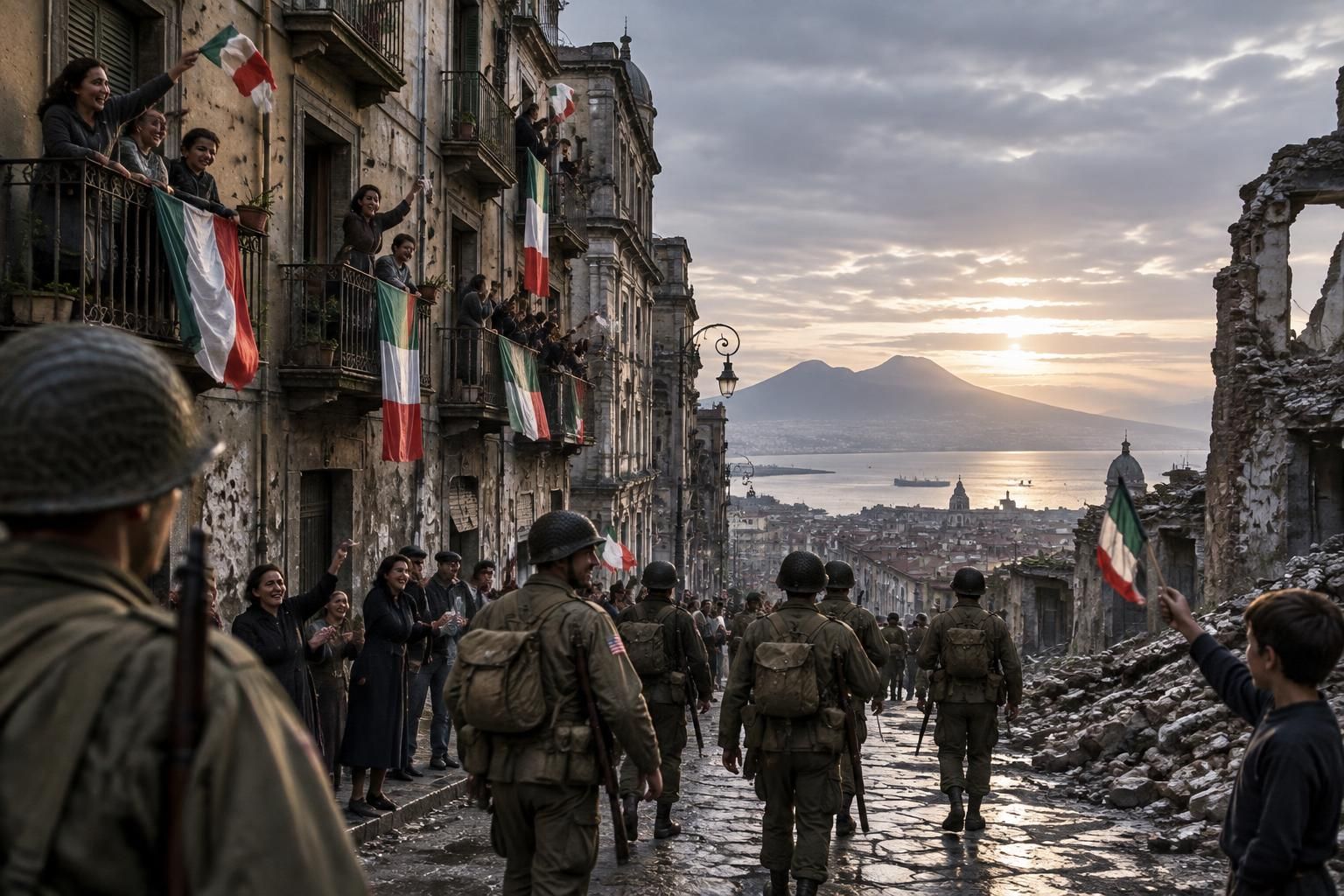
At dawn on October 1, 1943, Naples welcomed the Allies, but the city was already largely free thanks to the popular insurrection.
Event date: October 1, 1943
At dawn in Naples, October 1, 1943, a cold wind blows through the alleys; tired faces peer out of the windows, and a distant voice promises something different.
That morning, Naples was no longer just an occupied city: the streets had begun to speak for themselves. Some doors were open, shops that had closed weeks earlier were reopening, and the alleys seemed to breathe with a new slowness. In many squares, children ran among the sacks of wood salvaged for makeshift repairs to their homes; elderly people counted the days and rediscovered hidden memories in the face of a normality that seemed to be re-emerging. In some courtyards, small groups gathered, amid serious voices and outstretched hands, to coordinate aid for the wounded, to share bread and newspapers, to exchange news: a network of discreet gestures that spoke of a freedom that was newborn but already tangible. The air was filled with anticipation, but also with a hope that seemed unwavering.
The heavy silence of the previous weeks was broken, replaced by a timid enthusiasm. The signs that had been extinguished the night before shone again, not with the promise of a distant peace, but with the immediacy of those who know they can count on each other. A collective confession could be felt, through the alleys and rooftops: a city that had learned, through grief, to take care of itself and to ask others to walk alongside it. It wasn't just the announcement of political change: it was confirmation that Naples' dignity had also been earned through gestures of solidarity, through the embrace of those who offered hospitality to those who had lost their homes, through the choice not to give in to resentment.
The crossroads, however, was not merely a matter of civil courage: it was the geopolitical position of a turning point. The popular uprising, fueled in the preceding hours by the Four Days of Naples, had already opened up avenues and made possible the entry of the troops of the Fifth Army led by General Mark Clark. Naples had entered a new logic of freedom, not as an object of conquest but as a partner in a shared liberation. The arrival of the Allies was not seen as an imposition from above, but as a necessary accompaniment for a city that, though wounded, had decided to resist and rely on its own strength to reclaim spaces essential to daily life: hospitals, markets, schools, and work rhythms.
The central streets, which have always served as the skeleton of a metropolis, immediately filled with a different kind of noise: footsteps, voices, cars finding a new purpose, makeshift tents to care for the wounded, carts carrying food and linens. In that contact between present and past, a page of reconstruction was being written: not an abstract promise, but a shared promise to remain united, not to celebrate victory but to restore normalcy to daily life. Naples was not just a scene of liberation; it was a scene of rebirth, a story that was beginning to become history in the present.
With the arrival of the Allies, wartime measures were transformed into tools of reconstruction. The streets, often scarred by ruins, began to welcome threads of light and daily life once again: shops reopened, markets filled with goods, hospitals resumed operations, and schools reopened to once again be places of learning and exchange between children, youth, and adults. Naples became not only the scene of liberation, but a laboratory for economic and civic rebirth: a city that, together with the Allies, revived its productive capacity, its network of solidarity, its desire for the future. Southern Italy seemed to be opening a window onto the whole of Italy, offering a model for revitalization that could inspire even places far from the great capitals of the time.
Today, looking back at that day from the present, it bears witness to a city that has learned to demand its place in the collective narrative. The Four Days of Naples, though they occurred before the entry of Allied troops, are more than just a page in the news: they are proof that civic dignity can be born from common action. The streets still speak of encounters, healing wounds, and concrete gestures of solidarity; the places of memory remind us how a city can transform suffering into shared responsibility. And so, on that October day, Naples entered a new era: not only as a liberated city, but as an experiment in possible rebirth, capable of offering the rest of the country a lesson in participation and courage. For this reason, that dawn lives on, not only in the news, but in the memories and hands of those who grew up with the understanding that freedom is built, day by day, from the bottom up.
Breaking News
Biagio Antonacci in Pompeii, the Teatro Grande prepares for his final concerts.
Biagio Antonacci in Pompeii has now entered the final phase. After the first seven dates... Read more
Rolexes, cars, and homes thanks to the stationery scam: seizure triggered
Naples - A complex tax evasion system designed to eliminate tax debts and… Read more
Campania Libri Festival 2026: the program, guests, and unmissable events
The Campania Libri Festival 2026 returns to Naples from October 1st to 4th with four days… Read more
Pisa prison riot streamed live on TikTok
Moments of intense tension have occurred at the Don Bosco prison in Pisa, where for several hours… Read more
Vittorio Sgarbi is hospitalized at Gemelli Hospital in Rome: he is in serious condition
Vittorio Sgarbi is once again hospitalized at the Agostino Gemelli Polyclinic in Rome. Confirmation has arrived… Read more
- Judicial Chronicle
- Naples News
- Flash NEWS
- Fork
- Live
- live,
- Neighborhoods Naples
- Socials
- Stories
- Breaking News
- zoom meeting
'Michele's not here now, I'm here': the unscrupulous charisma of boss Giuseppe Del Prete and the map of power rediscovered in Forcella.
Naples - "Michele isn't here now, I'm here," Giuseppe Del Prete responded… Read more

National Newspaper
Registration No. 1301 of 2016 – ROC 030531
Director: Giuseppe Del Gaudio
To contact the editorial staff click HERE |
Download our Official ANDROID APP
