Campi Flegrei: The caldera continues to rise, but the volcanic landscape remains stable.

Phlegraean Fields, the caldera rises further
Pozzuoli – An energy never recorded by digital instruments before and a sudden seismic acceleration have refocused attention on the Campi Flegrei caldera. On July 31, 2026, at 19:46 PM Italian time (17:46 UTC), the earth shook with a magnitude of 4.7 (Mw 4.4), marking the highest energy release since the current bradyseismic phase began in 2005 and exceeding every seismic event detected in the area since instrumental measurements began.
Despite the severity of the earthquake and the dramatic increase in earthquakes—a total of 456 in the week from July 27 to August 2—the Vesuvius Observatory (INGV) maintains a rigorous scientific approach: the current picture of volcanic activity does not reveal any evidence to suggest significant short-term developments.
Seismology: The July 31st Swarm and the Maximum Energy Event
Seismicity has sharply increased compared to the previous week, when earthquakes with a magnitude equal to or greater than zero had reached only 34 events. During the period covered by the latest bulletin, INGV stations preliminarily located 245 earthquakes with Md ≥ 0.0, bringing the total count (including negative-magnitude microearthquakes) to 456 events.
The seismic swarm that began in the late afternoon of July 31st served as a watershed moment. Beginning at 17:46 PM UTC, 217 tremors occurred, concentrated in the quadrant between Solfatara, Pisciarelli, Agnano-Olibano, the Air Force Academy, and the Gulf of Pozzuoli. The 19:46 PM event is the most powerful earthquake ever recorded in the Campi Flegrei.
Bradyseism: The ground rises 10 mm per month, exceeding the 80s crisis by 75 cm.
On the ground deformation front, the permanent GNSS network — composed of 39 stations (after the decommissioning of the Solfatara site on the demolished “A. Trincone” complex) — continues to record the upward thrust of the ground.
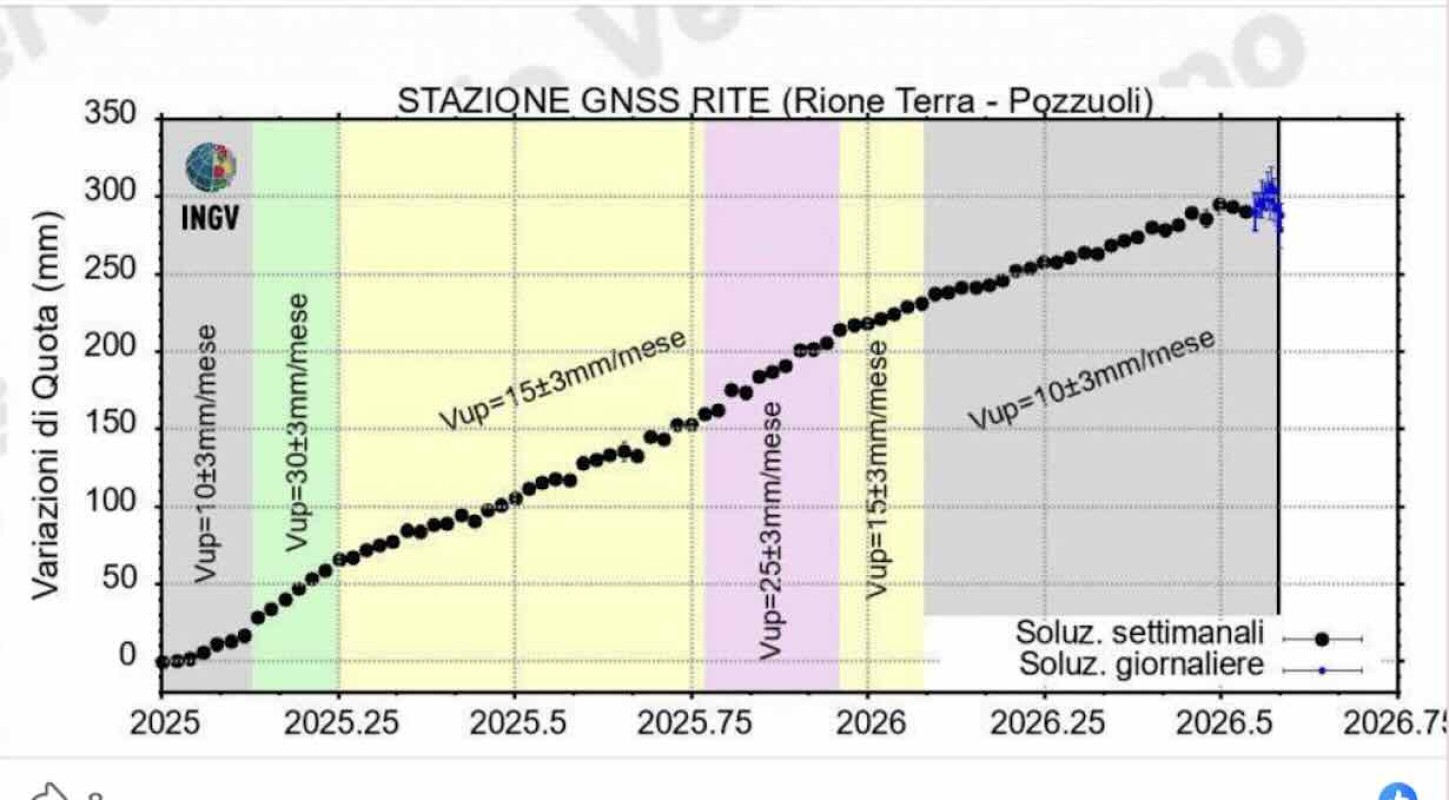
Since early February 2026, the average monthly uplift velocity in the maximum deformation zone has stabilized at approximately 10 ± 3 mm/month (after a peak of 15 mm/month recorded between mid-December 2025 and January 2026).
The data collected at the key station of Rione Terra (RITE) paint an impressive picture:
From January 2025: +30 cm of cumulative rise (slightly up from the 29,5 cm of the two previous bulletins).
From January 2024: +48,5 cm.
From November 2005 to today: total lift reaches approximately 167,5 cm.
This value exceeds by 75,5 cm the maximum level reached during the previous bradyseismic crisis of 1982-1984. The INGV also reports that coinciding with the Md 4.7 earthquake of July 31, some GNSS stations in the central area showed small discontinuities in the time series, which are currently being investigated in detail.
Geochemistry: Temperatures and flows confirm multi-year trend
The data provided by the geochemical monitoring network remain consistent with the long-term trend characterized by the heating and pressurization of the hydrothermal system:
Solfatara Crater: The temperature of the BG fumarole (measured by stations V11 and FLXOV5) remains at a stable average value of around 172-173 °C, confirming the marked increase recorded in recent years in correlation with the increase in diffuse gas flows.
Pisciarelli Area: The average temperature of fumarolic emissions remained at ~95°C (close to condensation), while CO₂ fluxes from the ground showed no abnormal changes, although they remained within the multi-year growth trend. Variations in the pool showed increasing influence from seasonal meteorological factors.
Breaking News
"We disarm": cell phones turned off like drug traffickers and euros counted in cars. All the details of the political trafficking ring in Castel Volturno.
Castel Volturno - A widespread, pervasive, and brazen system, where public affairs have been… Read more
Prevention in Campania, the challenge is to reach those who continue to put it off.
Receiving an invitation doesn't necessarily mean you'll arrive at the appointment. There may be a delay between the ASL notification and the test... Read more
- Caserta and Province
- Judicial Chronicle
- Chain drive
- Flash NEWS
- Live
- live,
- Socials
- Stories
- Breaking News
- zoom meeting
Costantino Russo's mystery: secrets, regrets, and unanswered questions: why wasn't there video surveillance?
Naples - The letter of apology addressed to his wife and children, a notebook full of… Read more
Today's horoscope for August 5, 2026, by Paolo Tedesco
The day opens with the Moon entering the sign of Taurus, bringing with it… Read more
The government allocates €100 million for initial interventions in the Phlegraean Fields.
Pozzuoli - An initial allocation of €100 million to address the first… Read more
SuperEnalotto: No 6s in the August 4th draw, jackpot at €205 million
Superenalotto, here's the winning combination: 49-56-58-70-76-78 Jolly Number: 29 Superstar Number: 16 Read more

National Newspaper
Registration No. 1301 of 2016 – ROC 030531
Director: Giuseppe Del Gaudio
To contact the editorial staff click HERE |
Download our Official ANDROID APP