Earthquake: Nearly half of Italian schools lack structural fitness certificates

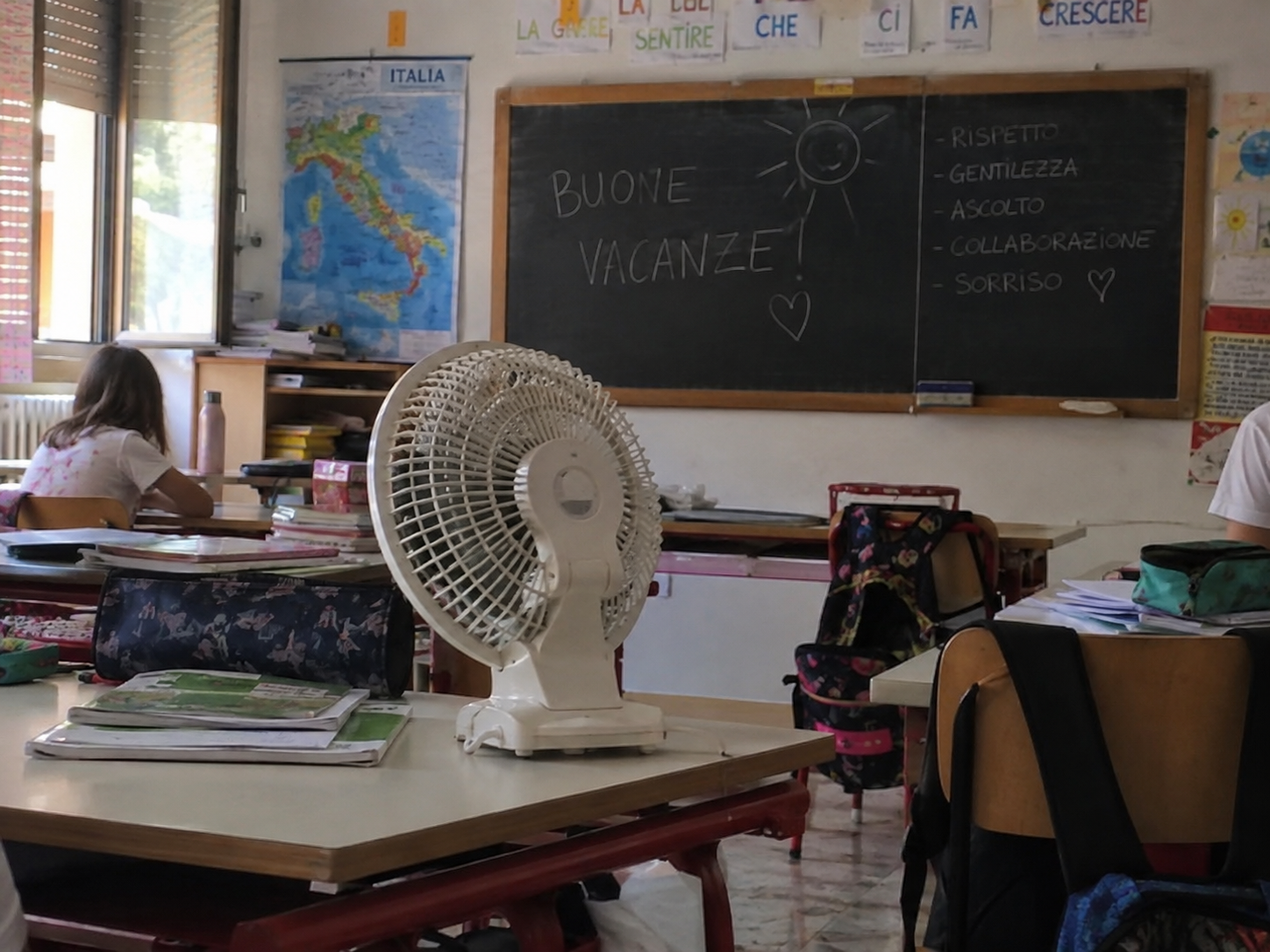
Fans in the classroom
On the day Amatrice returns to the center of national memory, ten years after the 2016 earthquake that devastated central Italy, the issue of school building safety once again raises questions for institutions and communities.
The national inauguration ceremony for the 2026-27 school year, attended by President Sergio Mattarella and Minister of Education and Merit Giuseppe Valditara, will take place in Amatrice. This choice carries strong symbolic significance in a community devastated by an earthquake that killed 299 people, injured 365, and left approximately 40 people homeless.
The ceremony is being held at the Sergio Marchionne comprehensive school, rebuilt in the San Cipriano district after the destruction of the historic Romolo Capranica complex. But the tenth anniversary of the earthquake also provides an opportunity to review the seismic safety of Italian schools.
The static certificate is present in only a little more than half of the buildings
According to an analysis conducted by Tuttoscuola based on the latest data available from the Ministry's single portal, referring to the 2023-24 school year, 53,3% of school buildings have a certificate of static suitability, the document certifying the safety conditions of the building's load-bearing structures based on the regulations in force at the time of its construction.
This data essentially means that almost half of school buildings do not have this certification.
A structural suitability certificate is not automatically required for buildings constructed before 1967, unless they have subsequently undergone structural interventions or modifications. Therefore, the framework should also be interpreted taking into account the age and characteristics of the school building stock.
Even more limited is the presence of specific anti-seismic design.
Seismic design stuck at 12,7% Only 12,7% of school buildings, approximately 5 out of a total of 40, have an earthquake-proof design.
This documentation represents, in practical terms, the "structural identity card" of a building constructed in an area classified as seismic risk and serves to demonstrate the structure's ability to withstand the stresses required by regulations.
Regional differences are marked. In Abruzzo, the percentage stands at 10,8%, while in Sardinia, only 11 out of 1.645 buildings have earthquake-resistant designs, equal to 0,7%.
Who is responsible for ensuring safety?
Responsibility for the safety of state school buildings falls to their respective owners. For primary schools, this is generally the municipality, while for secondary schools, this is the province or the competent local authorities.
It is therefore these entities that are responsible for ensuring the safety of the buildings and ensuring compliance with the regulations.
The analysis highlights that the Ministry of Education uses school buildings as a "host" entity and is not directly responsible for obtaining structural certifications.
The differences between the regions
The picture varies significantly from region to region. Regarding static testing, Aosta has the highest percentage, with 87,2% of school buildings certified. At the other end of the scale is Lazio, with 28%, or 896 out of 3.203 buildings.
According to Tuttoscuola, the northern regions, with the exception of Liguria, are overall above the national average. Conversely, the southern regions are mostly below average, with the exceptions of Molise and Abruzzo.
A picture that, according to the analysis, highlights a particularly delicate situation especially when considering the seismic risk of the area.
In zones 1 and 2 the issue becomes even more delicate
The Italian seismic classification divides municipalities into four zones, from zone 1, the one characterized by the greatest risk, to zone 4, with decreasing danger.
The school heritage present in the two areas considered most exposed is significant: 2.865 school buildings are located in seismic zone 1 and 15.014 in zone 2.
In these very areas, the data relating to static testing is particularly significant.
The overall percentage of certified buildings in the highest-risk areas is, in fact, lower than the general average of 49,4% reported in the analysis. This factor, Tuttoscuola defines as particularly significant given the seismic risk level of the affected areas.
Campobasso at 100% capacity, but other provinces remain critical.
Among the provinces with school buildings in seismic zone 1, Campobasso, according to data processing, has the highest rate: all the buildings considered have been static tested, while evacuation plans are also nearly complete.
This is followed by some provinces in the North-East and Isernia, another province in Molise.
The situation is different in Agrigento, where the percentages for both static testing and evacuation plan approval are significantly lower than the national average.
The analysis also highlights particularly significant cases in areas that have been affected by seismic events in recent decades, but in which the percentage of school buildings equipped with static testing remains far from high levels.
Naples, Rome, and Palermo: certification in just over 30% of schools
The picture remains problematic even when considering buildings located in seismic zone 2. The average percentage of static test certifications is substantially similar to that recorded for structures in zone 1.
Among the most significant data are those relating to the provinces of Palermo, Rome, and Naples, where the percentage of school buildings with static testing certification is just over 30%.
As a result, nearly seven out of ten school buildings lack static testing certification, according to data processed by Tuttoscuola.
Ten years after Amatrice, safety remains an open question.
The snapshot taken from ministerial data does not necessarily represent an immediate map of "unsafe" buildings: the presence or absence of a certification must be interpreted in light of the construction period, the interventions carried out, the applicable regulations, and the seismic classification of the area.
However, the scale of the problem remains clear: ten years after the Amatrice earthquake, 17 years after the L'Aquila earthquake, and 24 years after the San Giuliano di Puglia tragedy, the structural certification of Italy's school heritage continues to present strong territorial differences and coverage percentages that are still far from complete.
The school chosen to commemorate Amatrice thus also becomes a symbol of an issue that affects thousands of buildings: the safety of students and staff also depends on understanding the structural conditions of the buildings in which teaching activities take place every day.
Breaking News
Caserta, gun in waistband, drugs and counterfeit money: support base dismantled, three arrests
Caserta – The alarm was raised on the evening of September 21st with a call to 112:… Read more
"The port of Castellammare cannot be governed by tenders": appeal from the Democrats and Progressives
Castellammare – Piecemeal initiatives, a lack of comprehensive planning, and patchy interventions. The latest… Read more
Angelo Vassallo, sixteen years later that question remains: WHY?
Sixteen years after the assassination of Angelo Vassallo, the question remains unchanged. That simple word remains... Read more
Naples Central Funicular: The elevator has been out of service since July: "Accessibility isn't optional."
Naples - The elevator at the Corso Vittorio Emanuele station of the Central Funicular has been out of service since… Read more
Fires on the Amalfi Coast: Prosecutor's Office suspects shared responsibility
Salerno - A possible common direction behind the fires that, between the 13th and… Read more
Avellino: Tragedy at dawn, elderly man dies in his son's business
Avellino — A morning of work turned tragic at a company in the province… Read more

National Newspaper
Registration No. 1301 of 2016 – ROC 030531
Director: Giuseppe Del Gaudio
To contact the editorial staff click HERE |
Download our Official ANDROID APP