Antarctic sea ice is at its winter low: what's changing
In 2026, Antarctic sea ice reached its third-lowest winter maximum ever observed. Here's what that means and what the limitations of the data are.

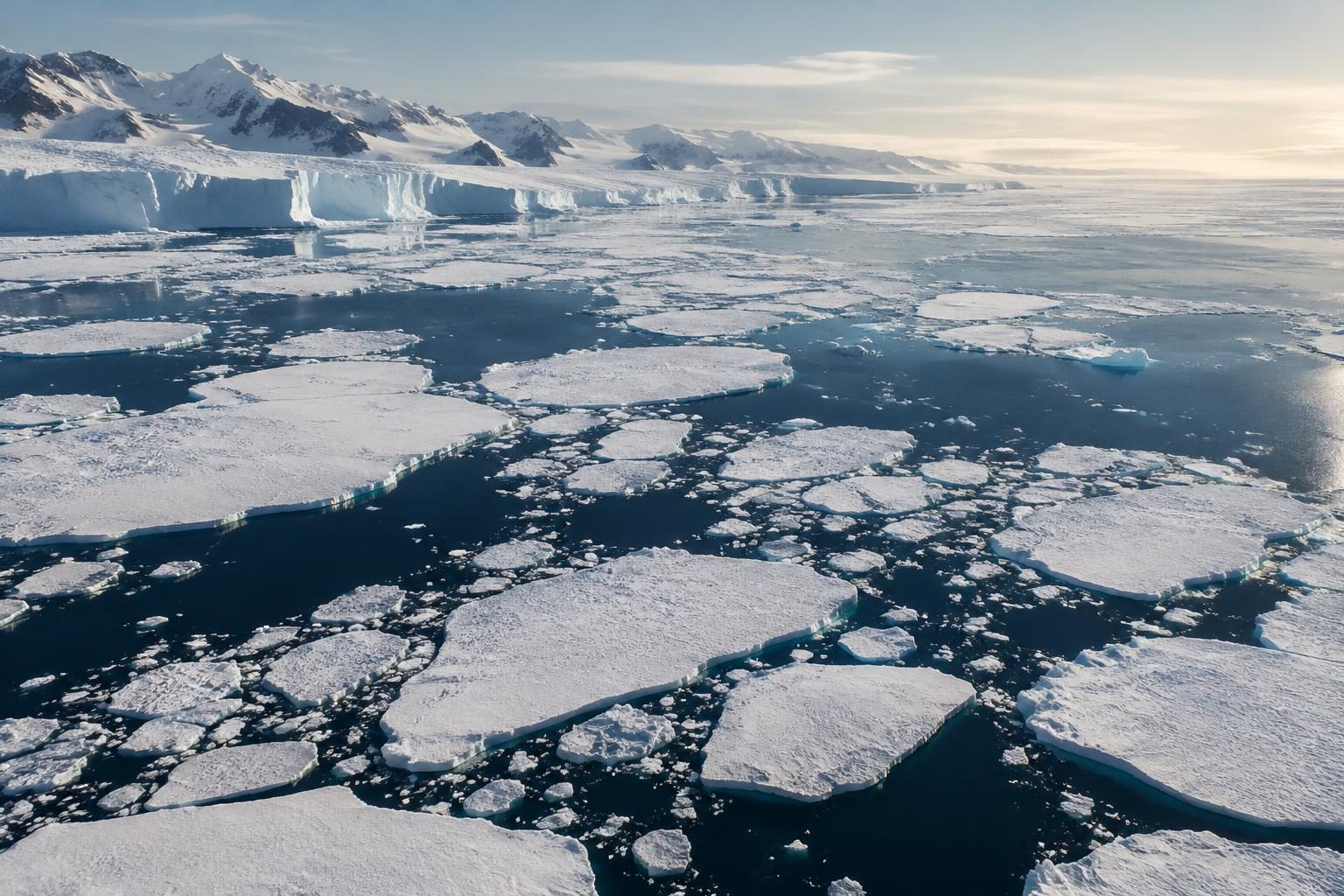
In 2026, Antarctic sea ice reached its third-lowest winter maximum ever observed: an important finding, but not yet definitive proof of a new trend.
A reversal after unusual years
During the southern winter, between June and September, the ocean surface around Antarctica is covered in ice. The seasonal maximum is generally reached between September and October, before increased solar radiation triggers the spring melt.
According to available information for 2026, the winter Antarctic sea ice maximum was the third lowest since satellite observations began. This result is part of a pattern of recent years characterized by lower extents than those observed early in the series.
This finding is striking because, until a few years ago, Antarctica had exhibited a different behavior than the Arctic. Between 2012 and 2014, Antarctic sea ice reached relatively large extents. That period fueled the idea that the two polar regions might respond in opposite ways to atmospheric and oceanic changes.
That reading, however, was too simple. Sea ice is not the same as continental ice sheets: it forms and melts on the ocean, responds rapidly to weather conditions, and can change dramatically from year to year.
Why Antarctic ice varies so much
The extent of ice depends on air and water temperatures, wind, ocean currents, salinity, and precipitation distribution. In Antarctica, these factors interact with a unique geographic configuration: unlike the Arctic, the continent is surrounded by an open ocean.
Winds can push ice away from the coast and create areas of open water, or push it outward and temporarily increase the area covered. Even changes in surface ocean temperatures can affect the autumnal formation and duration of ice.
One possible role is played by the relatively warm water circulating beneath the ocean's surface layer. If it reaches the continental shelf, it could promote melting from below. However, directly linking each annual minimum to a single mechanism is difficult: the Antarctic system is influenced by different regional processes.
Comparison with the Arctic
Comparison with Arctic ice helps avoid hasty interpretations. In the Arctic, the declining trend in extent is more pronounced and is accompanied by a reduction in the average thickness and age of the ice. In Antarctica, too, recent years have shown very low values, but the historical series is more variable.
To understand this difference, it's useful to distinguish between extent and volume . Extent measures the sea surface with an ice concentration above a threshold established by researchers. It doesn't directly indicate how thick the ice is or how much frozen water it contains.
An area may therefore appear similar to that of another year, despite having thinner ice. This is the same reason why a temporary slowdown in the decline of Arctic sea ice does not necessarily imply a recovery of the system: the overall mass may continue to decline. A more in-depth analysis of this aspect is available in the article dedicated to Arctic sea ice thickness.
What this means for the climate
Sea ice reflects some of the sunlight and contributes to heat exchange between the ocean and the atmosphere. When it disappears, the dark water absorbs more radiation than the ice surface. This effect, called albedo feedback, is particularly significant at high latitudes.
The loss of Antarctic sea ice may also alter the habitat of species such as krill, penguins, and seals. The ice provides breeding grounds and protected areas for certain stages of the food chain. The consequences, however, are not the same in all areas: some species may be affected by the reduction, while others can exploit new ice-free spaces.
Sea ice also influences the formation of dense water, a process linked to global ocean circulation. When seawater freezes, some of the salt remains in the liquid water, which becomes denser and can sink. If the extent, duration, and position of the ice change, these exchanges can also change, although the overall response is complex and still being studied.
A single year is not enough
The third winter minimum of 2026 is a signal to be followed, not a definitive conclusion. Establishing whether a persistent transformation is underway will require many years of consistent measurements, thickness analyses, oceanographic observations, and models capable of separating natural variability from the influence of human activities.
Satellite observations provide essential global coverage, but they have limitations: different sensors may produce data sets that aren't perfectly superimposable, and the threshold used to define ice can influence the results. For this reason, researchers compare satellite data with buoys, ships, aerial surveys, and oceanographic measurements.
The main scientific bases for polar monitoring and climate change are available from the US National Center for Snow and Ice Data and NASA . The most important point is to distinguish a seasonal record from a trend: in the Antarctic case, the pattern of recent years makes the issue urgent, but still requires in-depth verification.
Breaking News
Sant'Antonio Abate: A 20-year-old man under house arrest for dealing cocaine and crack cocaine.
A twenty-year-old native of Pompeii and resident of Sant'Antonio Abate has been placed under arrest… Read more
Fabrizio Corona, the mystery of the chase after Stefano De Martino and his escape from the Carabinieri
The story involving Fabrizio Corona and Stefano De Martino is enriched with a background story… Read more
Borgo Marinari, Luciana-style octopus between the tuff of Castel dell'Ovo and the Gulf
In the landscape of Borgo Marinari, octopus alla luciana retains its connection with Saint Lucia:… Read more
Why Arctic sea ice is getting thinner even as its extent slows
Arctic ice isn't just measured on its surface: its age, thickness, and volume explain why… Read more
Uranium cubes and the true limit of the Nazi nuclear program
Uranium cubes preserved after the war help explain why the German reactor… Read more
How big can a freshwater shrimp get? The limit is in the body.
The growth of freshwater shrimp is not infinite: muscles, exoskeleton, oxygen and molting fix… Read more

National Newspaper
Registration No. 1301 of 2016 – ROC 030531
Director: Giuseppe Del Gaudio
To contact the editorial staff click HERE |
Download our Official ANDROID APP
