Uranium cubes and the true limit of the Nazi nuclear program
Uranium cubes preserved after the war help explain why the German reactor never became operational.
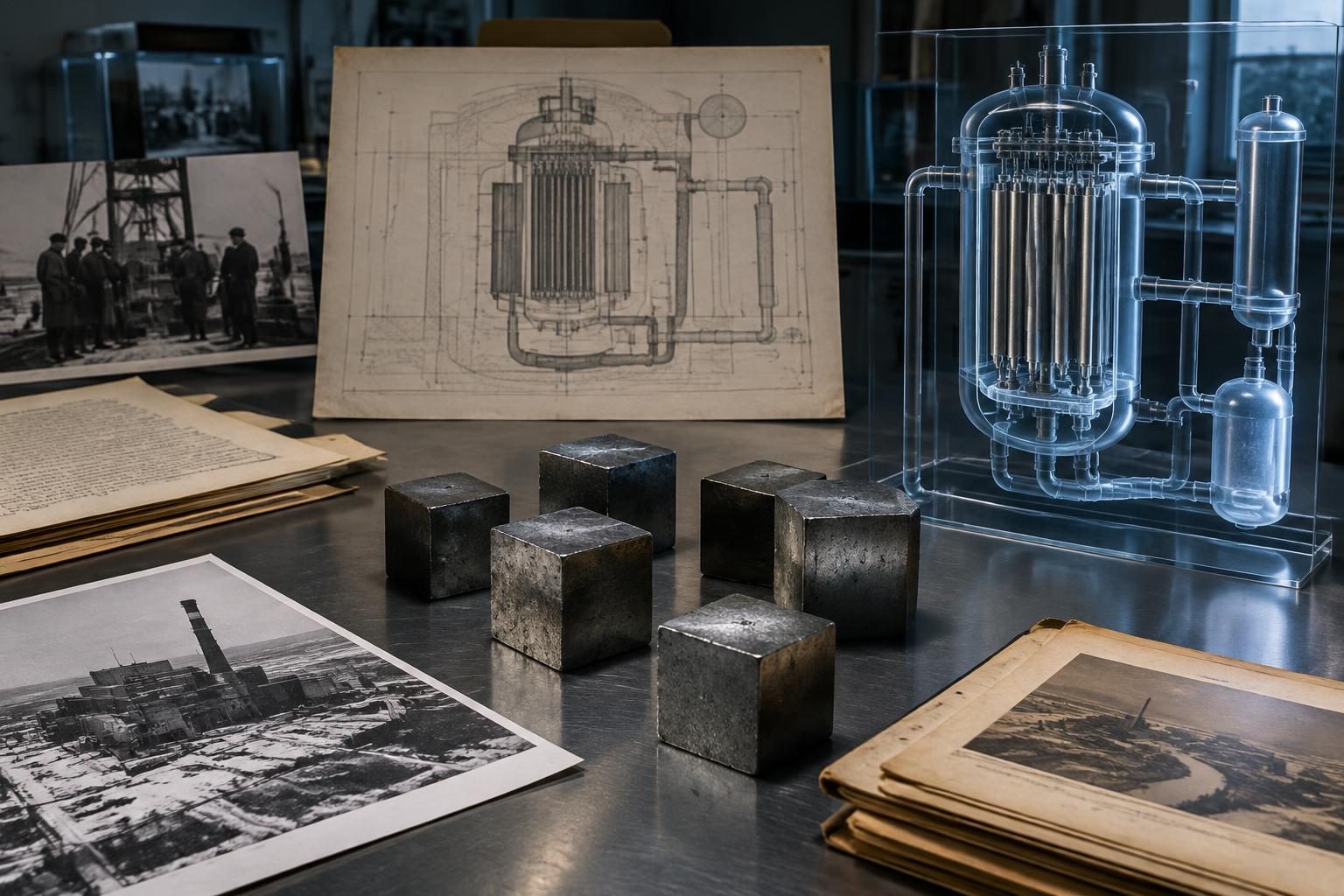
The uranium cubes recovered from the German nuclear program demonstrate one thing above all: in 1945, Nazi Germany had not yet built a self-sustaining reactor.
The project remained far from criticality
In the final months of World War II, a group of German physicists worked on a nuclear experiment in a cave beneath Haigerloch Castle in Baden-Württemberg. The device contained natural uranium arranged in blocks immersed in heavy water, a substance known as deuterium oxide, a substance capable of slowing neutrons without absorbing too many.
The principle was sound, but the scale of the facility was insufficient. To sustain a controlled chain reaction, a suitable geometry, a sufficient quantity of fissile or fertile material, and a very pure moderator were needed. If too many neutrons escape the system or are absorbed by impurities, the reaction will shut down.
Historical reconstructions indicate that the Haigerloch experiment fell short of the critical threshold: the system could produce neutron multiplication, but not enough to sustain the reaction on its own. It was therefore neither an unfinished bomb nor a miniature nuclear power plant, but rather an experimental attempt still far from its goal.
Why uranium cubes are important
The uranium blocks are not simply curious artifacts. Their shape, composition, and assembly methods help science historians reconstruct the German team's technical decisions. Some blocks were dispersed at the end of the war and later resurfaced in private collections, archives, or laboratories.
Their value lies in the connection between physical objects and contemporary documentation. An isolated block alone does not demonstrate how much uranium was available or how efficient the reactor was. However, it can be compared with photographs, military reports, testimonies, and neutron calculations to estimate the actual configuration built.
It's important to distinguish between the number of cubes produced and the actual amount usable in a reactor. Natural uranium contains only a small fraction of uranium-235 , the isotope most easily fissionable with slow neutrons. The remainder is mostly uranium-238. Without enrichment, the design therefore depended on an efficient moderator and a layout capable of limiting neutron losses.
The scarcity of heavy water
The other obstacle was heavy water. During the war, Germany also attempted to obtain it through the Vemork plant in Norway, controlled by interests linked to the chemical industry. Allied sabotage and bombing reduced the availability of the material and complicated its transportation.
Heavy water is not radioactive in the usual sense: it is water in which ordinary hydrogen is partially replaced by deuterium, a stable isotope. Its usefulness comes from its neutronic properties. In a heavy-water reactor, the moderator slows down the neutrons produced by fission, making them more likely to interact with other fissile nuclei.
Purity and quantity both matter. An insufficient or contaminated moderator increases neutron absorption and reduces the experiment's safety margin. The German logistical difficulties were therefore not an administrative detail, but a direct limitation on the project's physics.
Reactor, weapon and propaganda
In the postwar period, the German nuclear program was sometimes portrayed as a nearly successful project, halted only by the arrival of the Allies. This interpretation simplifies a more complex situation. German physicists knew about fission and understood its many applications, but the transition from a laboratory experiment to a functioning reactor required industrial resources, precise measurements, and a stable supply chain.
Furthermore, a reactor and a nuclear weapon are different problems. A reactor must maintain a controlled reaction to produce neutrons and heat. A device, on the other hand, requires highly concentrated fissile material, a very rapid configuration, and extremely complex detonation systems. The fact that the Haigerloch reactor was not critical doesn't automatically prove that Germany could never have developed a weapon, but it does show how far it was from an immediately usable technical basis.
What the new analyses really say
When new studies examine uranium cubes or wartime documents, the most robust result isn't necessarily the discovery of a single crucial object. It's often a more accurate estimate of the available quantities, the location of the materials, and the remaining margin to criticality.
However, conclusions must be treated with caution. Findings may have incomplete provenance, documents may be fragmentary, and testimonies collected after the war may be influenced by memory or personal interest. For this reason, historians compare independent sources and use physical simulations compatible with experimental data.
Finally, the case of the uranium cubes reminds us that science does not proceed solely through theoretical ideas. Transforming fission into a technology requires materials, energy, facilities, quality control, and time. In 1945, the German program possessed significant scientific expertise, but it had not combined these elements into a working nuclear machine.
For further information on the physics of fission and the history of nuclear technology, see resources from the International Atomic Energy Agency, the U.S. Department of Energy's nuclear information resources, and NASA 's historical materials on nuclear physics.
Breaking News
How big can a freshwater shrimp get? The limit is in the body.
The growth of freshwater shrimp is not infinite: muscles, exoskeleton, oxygen and molting fix… Read more
Naples: Carabinieri raid illegal taxis, fines, suspended licenses, and vehicle impounded.
During checks along the landing stages at the port of Naples, the Carabinieri identified illegal taxis… Read more
Naples, escape to Camaldoli: Carabinieri arrest 47-year-old after pursuit
A chase through the streets of Camaldoli ends with the arrest of Angelo Granatiglia, 47.… Read more
Busitalia is seeking permanent bus drivers: a national selection process in Campania (Salerno).
Busitalia is launching a national recruitment process for permanent bus drivers in Campania, with… Read more
The Raia clan of Scampia is seeking over 239 years in prison, with seven facing 20 years.
Fifteen defendants, a lengthy investigative effort, and an accusatory framework that spans some of the main… Read more
In Piazza del Plebiscito, youths cut down tents and stole drinks and supplies from Neapolis Marathon stands.
Naples - The Carabinieri of the Naples mobile radio unit intervened at 0:45 today,… Read more

National Newspaper
Registration No. 1301 of 2016 – ROC 030531
Director: Giuseppe Del Gaudio
To contact the editorial staff click HERE |
Download our Official ANDROID APP
