Naples' waterfront, fried fish between Castel dell'Ovo and the Gulf
On Naples's seafront, the skyline of Castel dell'Ovo offers the perfect Mediterranean backdrop for a crispy, flavorful, and seasonally-sourced fried fish dish.

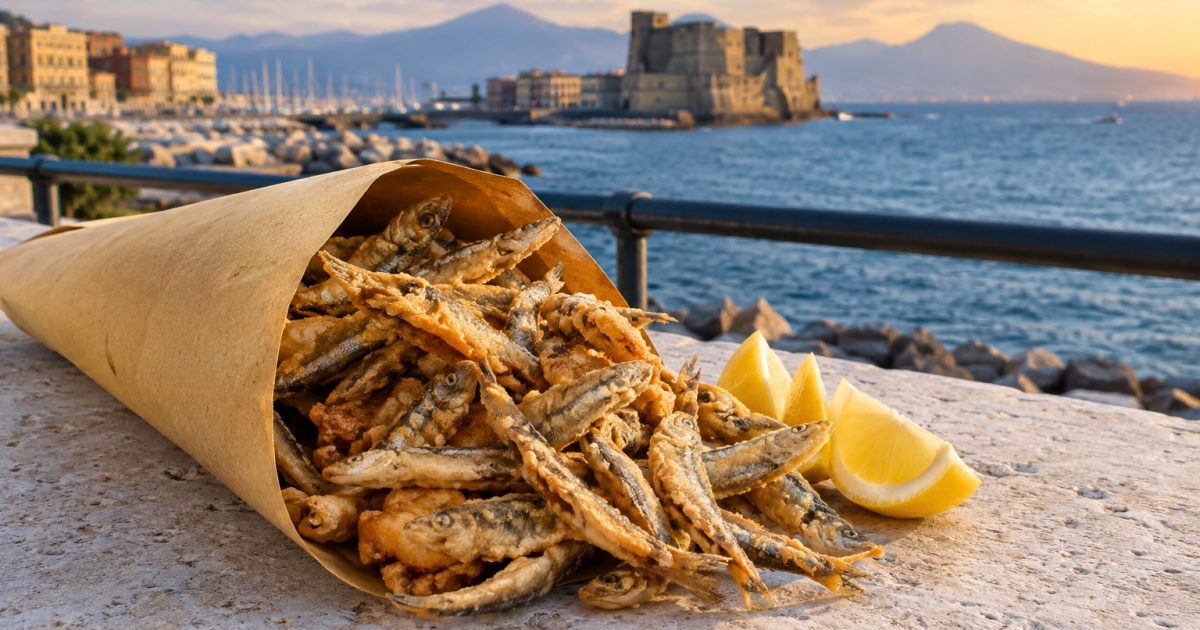
In the image, a context connected to the facts.
Between Naples's seafront and Castel dell'Ovo, fried fish finds a backdrop of open sea, salty breeze, and Mediterranean light.
The relationship between this dish and the landscape is evocative, not a declaration of origin: the paranza belongs to Campania's maritime culture in the broadest sense, while the Neapolitan waterfront perfectly captures its imagery. Here, the Gulf opens up before the city, the facades of Santa Lucia follow the coastline, and the castle, perched on the islet of Megaride, introduces a presence of stone and history to the landscape.
The walk offers different perspectives at every hour. In the morning, the water reflects a clear light, with boats barely breaking the surface; in the afternoon, the profile of Vesuvius can emerge from the gulf, while towards evening, the sky lowers over the rooftops and cliffs. It's a landscape that invites you to think of a simple cuisine, built on a few simple ingredients: fresh fish, flour, warm oil, lemon, and salt.
Fried paranza is not a rigid composition. The term refers to a variable mix of small fish, chosen based on the available catch and the regulations governing minimum sizes. In Campania, red mullet, cod, small hake, silversides, anchovies, or other blue fish compatible with the season and provenance may be included. The choice shouldn't be made based on a fixed list, but rather by always asking what the catch of the day is and favoring traceable products.
The salty landscape of the Lungomare
Walking between Santa Lucia, the Borgo Marinari, and the curve of the Lungomare, the sea is never just a backdrop. It's felt in the scent of the air, in the color of the boats, in the presence of the docks, and in the dark surfaces of the wet rocks. Castel dell'Ovo changes appearance with the weather: under the sun, it appears solid and golden, while on cloudy days, it takes on cooler hues, almost seamlessly blending with the water.
A fried fish served in this setting must maintain its simplicity. It doesn't need elaborate sauces or overbearing condiments. The decisive contrast is between the thin, dry crust and the moist flesh of the fish; lemon, used sparingly, adds acidity without overpowering the marine aromas. Even the paper cone or platter evokes casual eating, suitable for a stroll, but quality depends above all on the raw ingredients and careful temperature control.
Small fish, hot oil and light crust
For frying at home or in a well-equipped kitchen, you'll need about 800 grams of mixed small fish, gutted when necessary, 150-200 grams of soft wheat flour or re-milled semolina, peanut oil or an oil suitable for frying, salt, and lemon. Anchovies and silversides can be left whole after thorough cleaning; red mullet and cod should be inspected and dried thoroughly. The fish should not have an ammonia-like odor or a soft texture.
Preparation begins with cleaning. After removing any entrails and debris, rinse quickly only if necessary and dry with paper towels. This step is important: excess water lowers the temperature of the oil and makes the surface soft. The fish should then be floured shortly before cooking, gently shaking off the excess. The flour should coat the pieces, not form a thick layer.
In a large pot or deep fryer, heat the oil to around 175-180°C. It's best to fry in batches, without overcrowding the pan, to avoid a sudden drop in temperature. Smaller fish cook in a few minutes; slightly larger ones require longer. When the surface is golden brown and the flesh appears firm, remove them with a slotted spoon and transfer them to a wire rack or paper towels, without overlapping them.
Salt should be added immediately, but sparingly. A prolonged resting time, however, will cause the fish to lose its crispiness; fried fish should be eaten as soon as it's ready. Lemon can be served separately, cut into wedges, allowing everyone to choose how to use it. A variation using only re-milled semolina produces a more rustic crust; soft wheat flour, on the other hand, offers a thinner coating. In both cases, the goal is not to mask the fish.
The paranza also showcases the seasonality of the Campanian sea. The composition of the mixed fish is not always the same, and there's no need to follow a fixed recipe. Availability varies between the Gulf of Naples, the Vesuvian coast, the Sorrento Peninsula, the Domitian coast, and the Cilento areas; the size and fishing times also vary. Knowing the provenance and respecting the permitted sizes are part of the buyer's responsibility.
At the Lungomare, the dish can be imagined as the light reflects off the waves and the breeze barely stirs the coastal air. The fried food brings with it the warmth of the kitchen, while the view maintains its expansiveness: Castel dell'Ovo on one side, the city behind, the Gulf in front. It is in this balance between simple gesture and open landscape that the paranza finds its evocative meaning, without needing to transform a view into a false gastronomic origin.
When the walk resumes, the scent of lemon on your fingers and the salty sea air linger. Naples returns to being a city, a port, and a promontory; the fried food, however, remains a brief encounter between crispy fish, Mediterranean light, and the Campanian horizon.
Breaking News
Dracula buried in Naples: Mastìa presents 'The Curse of Dracula'
A new historical thriller set in the Spanish Quarter of Naples tells a legend linked… Read more
Naples, restoration of Santa Luciella: the beggars' souls resurface in the Booksellers' Cemetery.
With the support of the Banco Napoli Foundation, the restoration of a mural painting has been completed… Read more
Legal gaming in Campania: 2025 numbers and checks on irregular gaming halls
In 2025, gambling revenue in Campania reached 21 billion and 562 million… Read more
Balcony collapse at Santa Maria la Carità: three discharged, one injured still hospitalized.
Three of the four family members injured in the collapse of a small balcony in Santa Maria la… Read more
De Laurentiis shields Allegri and attacks the FIGC's politics: "We're moving forward with Malagò."
Rome - A comprehensive intervention that ranges from Napoli's tactical board to… Read more
Milan leads the crime rate, while Naples ranks twelfth in Il Sole 24 Ore's survey.
An in-depth analysis that examines the data for 2025: the collapse of car thefts and… Read more

National Newspaper
Registration No. 1301 of 2016 – ROC 030531
Director: Giuseppe Del Gaudio
To contact the editorial staff click HERE |
Download our Official ANDROID APP
