Paestum, paccheri with tomato and basil among the fields of the Sele Plain
Between the temples of Paestum and the countryside of the Sele Plain, paccheri with tomato and basil tell the story of a rural, bright, and down-to-earth Campania.

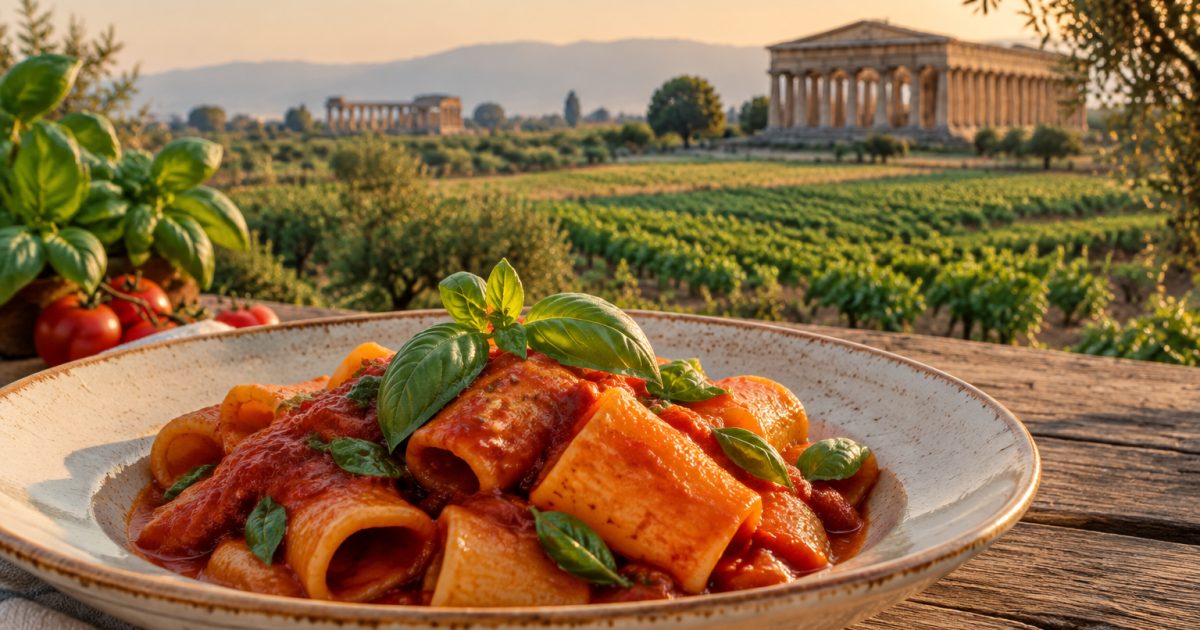
Between the temples of Paestum and the countryside of the Sele Plain, paccheri with tomato and basil tell the story of a rural, bright, and down-to-earth Campania.
The Sele Plain as an open table
Paestum presents a precise geometry: the great Doric temples, the roads of the archaeological area, the regular profile of the columns against the sky. All around, the Sele Plain expands the landscape into a succession of fields, canals, rows of vines, and secondary roads. It is a vast countryside, marked by agriculture and the presence of water, where the light changes rapidly between bright morning and late afternoon.
Here, the relationship between place and food requires no elaborate construction. The cultivated land suggests a cuisine made of discernible ingredients, short cooking times, and recognizable aromas. Tomatoes bring the color of Campania's summers to the plate; basil adds a green, fresh, almost balsamic note; pasta absorbs the sauce and delivers it in hearty bites.
The pairing with paccheri with tomato and basil is evocative, not a declaration of origin. The dish isn't presented as a specialty necessarily born in Paestum: rather, it's a composition consistent with the countryside surrounding the ancient city. Its homely character resonates with the region's vegetable gardens, farmers' markets, and the rhythm of days spent working in the fields and dining al fresco.
Visiting Paestum means alternating between contemplating the monuments and the more horizontal scale of the plain. After touring the archaeological area, the landscape invites you to slow down: the rows of trees, the cultivated fields, and the breeze coming from the coast create a setting capable of enhancing even a simple pasta dish. The cuisine, in this setting, doesn't seek theatrical effect. It seeks balance.
The sauce that follows the season
For four people, you'll need 360 grams of paccheri, 700 grams of ripe tomatoes or a good passata or peeled tomatoes, a clove of garlic, four tablespoons of extra virgin olive oil, a dozen or so basil leaves, salt, and, if necessary, a small amount of sugar to balance the acidity of the tomatoes. The basil should be added at the end to better preserve its aroma.
- Paccheri: 360 grams
- Ripe tomatoes, peeled or pureed: approximately 700 grams
- Extra virgin olive oil: four tablespoons
- Garlic: one clove
- Fresh basil: about ten leaves
- Salt and, only if necessary, a pinch of sugar
If using fresh tomatoes, it's best to blanch them for a few seconds, cool them, and peel them. Heat the oil and garlic in a saucepan, without letting it burn. Add the tomatoes and salt, and cook the sauce over medium heat for about twenty minutes, stirring occasionally. The sauce should be soft and fragrant, not overly thick: the paccheri need a sauce that's fluid enough to fill and envelop them.
Meanwhile, bring a large pot of salted water to a boil. Paccheri require care because they tend to break if cooked too long or stirred too vigorously. Drain them one or two minutes before the time indicated on the package, reserving a cup of the cooking water.
The pasta is transferred to the saucepan with the sauce and cooked over low heat. A few tablespoons of starchy water helps bind the sauce and prevent the paccheri from becoming dry. The basil is torn by hand and added at the last minute, or directly onto the plates. A drizzle of raw olive oil completes the dish.
The key to balance is simplicity: the tomato should remain recognizable, the garlic shouldn't dominate, and the basil should be a fresh note, not a slow-cooked aroma. Those who prefer a smoother consistency can pass the sauce through a sieve, but a slightly rustic sauce is ideal for the character of paccheri, which retain both the pulp and the seasoning.
Between columns, vegetable gardens and afternoon light
Served on a large plate, pacchero al pomodoro creates a natural contrast with the Paestum landscape. The red of the sauce evokes the earth and the fruits of the garden; the green of the basil dialogues with the vegetation of the plain; the large shape of the pasta conveys a sense of abundance without resorting to complex ingredients.
The best time to connect the dish to the place is late afternoon, when the light fades on the stones of the temples and the fields take on warmer hues. There's no need to bring the kitchen into the archaeological area or turn the monument into a mere backdrop: it's the transition between the historic site and the surrounding countryside that creates the evocation. On the one hand, the memory of the ancient city, on the other, the daily continuity of agricultural work.
For those planning a visit, the Paestum archaeological site deserves time and comfortable shoes, especially in the warmer months. The plain is exposed to the sun, and the distances between different points of the route can be challenging during the hottest hours of the day. A morning or evening stroll allows you to better observe the relationship between the temples and the surrounding landscape, while lunch can be an opportunity to rediscover the essential flavors of Campanian cuisine.
Paccheri with tomato and basil don't claim to summarize Paestum, nor replace the complexity of its history. Rather, they complement its luminous, agricultural dimension: an accessible recipe, built on a few ingredients and a precise technique. The flavor of the countryside lingers on the plate; the view extends to the expanse of the Sele Plain and the silent presence of the temples.
Breaking News
Holys Team, Renato Santi's challenge: motorsport as a bridge to internationalization
Using motorsport to accelerate the internationalization of companies: this is the path chosen by Renato Santi,… Read more
Brawl in Castellammare's municipal park: two adults beat a minor after a fight between teenagers.
Castellammare. - A fight between teenagers, then the intervention of two adults who apparently passed by… Read more
Neapolitan taxi drivers bring water supplies to striking truck drivers.
Naples - A shipment of bottles of mineral water delivered directly to checkpoints for… Read more
Public competition at the Municipality of Santa Maria Capua Vetere: 5 full-time, permanent positions for Administrative and/or Accounting Instructors.
Municipality of Santa Maria Capua Vetere: Public competition for 5 Administrative Instructor and/or… Read more
Venice, Nicola praises the team after their victory over Napoli: "Great response from the lads."
Venezia restarts from the success against Napoli and from Davide Nicola's confidence in… Read more
Shots fired at a daycare center in Acerra, the owner: "In 2025, I reported an extortion attempt."
Acerra - Seven gunshots fired at a private nursery school and a clear request to... Read more

National Newspaper
Registration No. 1301 of 2016 – ROC 030531
Director: Giuseppe Del Gaudio
To contact the editorial staff click HERE |
Download our Official ANDROID APP
