How a hurricane can generate invisible waves in the upper atmosphere
Tropical storms can also shake the upper atmosphere: this is how gravitational waves are created and what satellites can reveal.

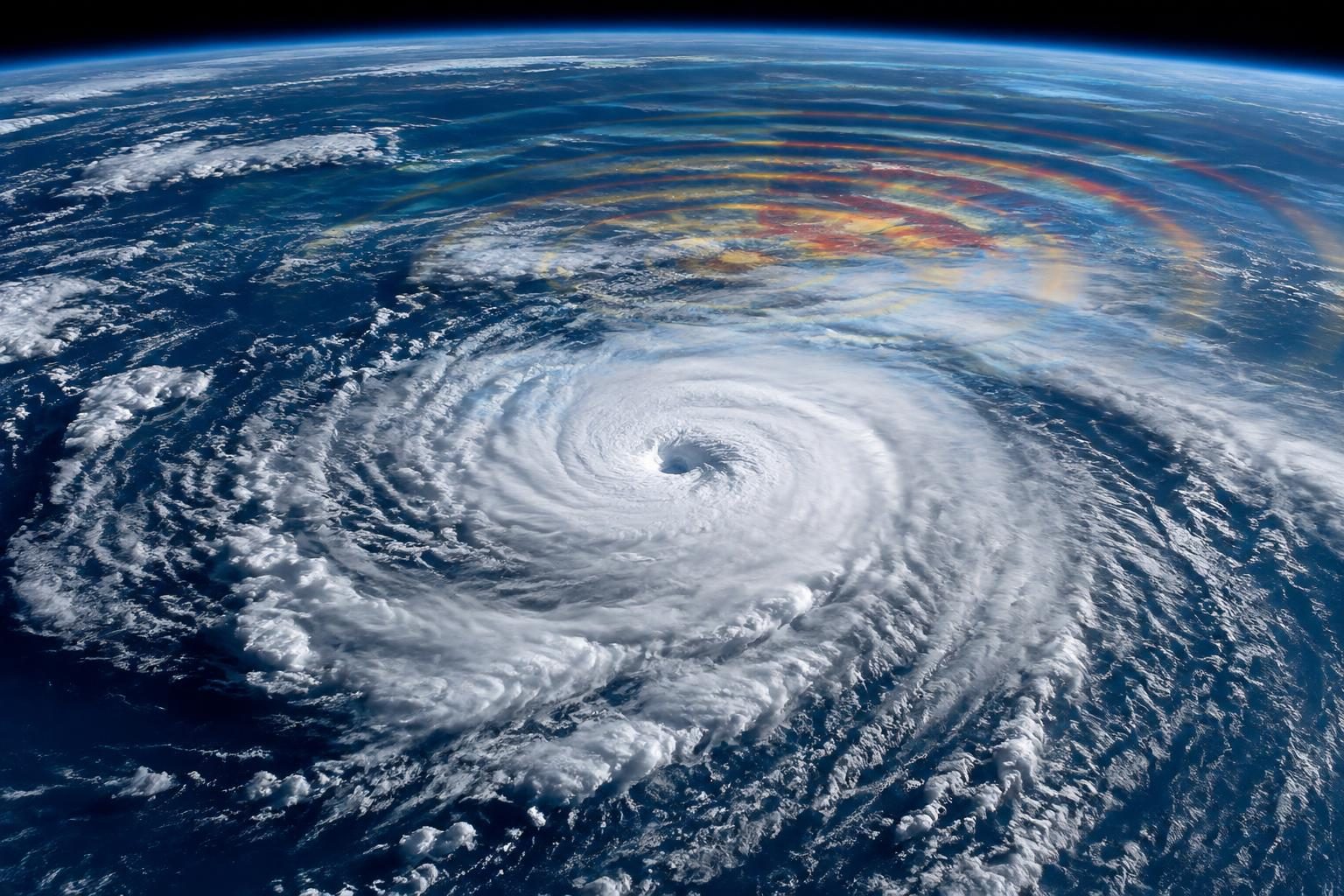
A hurricane doesn't just stir up the sea and air near the ground: its energy can propagate for tens of kilometers upward, generating atmospheric waves that can be observed by satellites.
The idea comes from images attributed to NASA observations during Hurricane Simon, but the available material doesn't allow for independent verification of every detail of the event. The physical phenomenon described, however, is well documented: large storms can alter the structure of the atmosphere all the way up to the stratosphere and, in some cases, even affect regions even higher.
What are atmospheric waves?
Structures that appear as ripples or concentric bands are not water waves. They are variations in air pressure, temperature, and density that propagate within the atmosphere. A significant portion of them belong to the family of atmospheric gravity waves : gravity tends to bring the air back to its equilibrium position after an ascending or descending current has displaced it.
The mechanism is similar, on a physical level, to that which produces the oscillations of a surface when it is disturbed. However, the analogy should not be taken literally: in the atmosphere, the wave travels in a stratified fluid and can change speed, direction, and amplitude as it passes through layers with different properties.
Why hurricanes are powerful generators
A tropical cyclone concentrates intense winds, deep convection, and large amounts of latent heat released by the condensation of water vapor in a relatively compact region. Thunderstorm towers rapidly transport warm, moist air upward, while downdrafts and pressure variations produce subsequent disturbances.
These pulses can generate waves that move away from the storm's center. Their shape depends on wind speed, the distribution of thunderstorms, the cyclone's rotation, and atmospheric stratification. Therefore, there is no single "signature" that applies to all hurricanes.
How satellites make the invisible visible
The human eye cannot directly distinguish these waves in the upper atmosphere. Satellites, however, measure the radiation emitted or reflected by molecules and particles in different layers. By processing the data, it is possible to reconstruct variations in temperature, water vapor concentration, or brightness of specific atmospheric components.
Satellite images can show waves as alternating bands, arcs, or ripples. The result isn't necessarily a conventional photograph: it's often a scientific visualization obtained by combining infrared measurements, data from different altitudes, and filtering techniques. Therefore, the image's colors and contrasts should not be interpreted as actual sky colors.
Satellite instruments such as those dedicated to studying atmospheric composition and temperature allow us to follow the propagation of disturbances even when clouds obscure the storm's center. These observations are useful because they offer a three-dimensional view that ground-based weather stations alone cannot provide.
What happens when the wave rises
During its ascent, a wave can undergo profound changes. Air becomes less dense with altitude, and under certain conditions, the amplitude of the disturbance increases. If the wave becomes unstable, it can break and transfer momentum to the surrounding environment, contributing to changes in the winds in the upper layers.
This transfer is one of the most interesting aspects of meteorology. The waves generated by thunderstorms can influence the circulation of the stratosphere and alter, at least locally and temporarily, the distribution of atmospheric energy. This effect does not mean that a single hurricane controls the global climate; rather, it indicates that meteorological phenomena are interconnected throughout the entire air column.
The possible link with the ionosphere
The most intense disturbances can propagate into the thermosphere and ionosphere, regions where solar radiation makes some of the gases electrically charged. In these areas, variations in density and winds can disrupt the propagation of radio waves and measurements taken by satellite navigation systems.
The connection is neither simple nor automatic. The ionosphere is influenced primarily by solar activity, electric and magnetic fields, and global circulation. A signal observed after the passage of a hurricane does not, by itself, prove that the storm was the sole cause. Comparisons with models, time series, and independent observations are needed.
Why these observations are useful
Studying the atmospheric waves generated by cyclones helps improve numerical models. Forecasts must describe not only the storm's trajectory and intensity, but also the energy exchanges between the troposphere, stratosphere, and upper regions.
A more accurate representation of these processes can help us better understand the evolution of cyclones and the reliability of forecasts in the upper atmosphere. It can also be useful for assessing potential disruptions to radio communications, satellite navigation, and space activities.
Spectacular images, however, do not necessarily indicate a new record or an unprecedented event. The apparent rarity also depends on the observation geometry, the resolution of the instruments, and the fact that many waves become visible only after specific processing.
What can we conclude?
The most robust conclusion is that a hurricane can act as a source of large-scale atmospheric waves. Satellite imagery reveals a normally hidden connection between tropical thunderstorms and the upper atmosphere.
To definitively attribute a given structure to a specific storm, however, public data, a description of the instrument, observation altitude, and comparison with simulations are required. General information on the functioning of the atmosphere and observation missions can be found on the NASA and NOAA websites. The phenomenon should therefore be viewed as an interesting manifestation of atmospheric physics, not as automatic evidence of exceptional consequences or climate change caused by a single storm.
Breaking News
Elderly nurse attacked in the emergency room: slap in the face and death threats
Naples - Another episode of violence against healthcare workers reignites safety concerns... Read more
Circumvesuviana, new timetable starting yesterday: 280 trips per day and trains every 30 minutes.
The new operating schedule for the Lines came into force on Saturday 17 October… Read more
Nightmare night for an 18-year-old in Naples: 'Drugged and abused in an apartment,' police are seeking evidence.
Naples - A time gap of several hours, waking up in an unfamiliar apartment and... Read more
Montella in Autumn: The Chestnut Soup That Tells the Story of Alta Irpinia
Among the woods of the Picentini Mountains and the chestnut groves of Alta Irpinia, the chestnuts of Montella… Read more
Campi Flegrei, a magnitude 2.5 earthquake struck at dawn.
A new tremor interrupted the relative calm in the Phlegraean Fields at first light… Read more
Public competition at the Luigi Vanvitelli University of Campania: 1 permanent administrative assistant position (Campania)
Public competition at the University of Campania – Luigi Vanvitelli for one permanent administrative assistant… Read more

National Newspaper
Registration No. 1301 of 2016 – ROC 030531
Director: Giuseppe Del Gaudio
To contact the editorial staff click HERE |
Download our Official ANDROID APP
