Why Arctic sea ice is getting thinner even as its extent slows
Arctic ice isn't just measured at the surface: its age, thickness, and volume explain why the system remains vulnerable to warming.

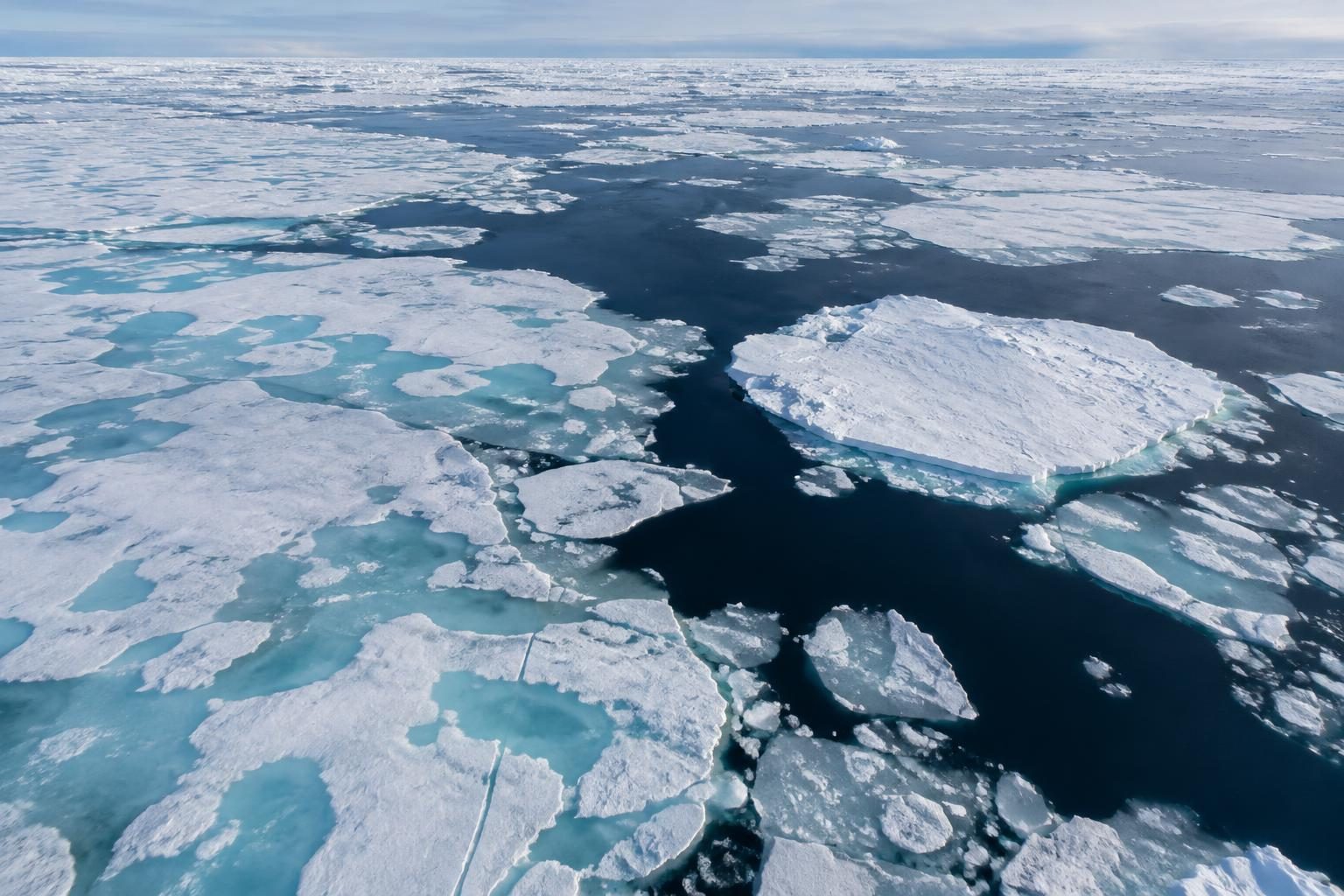
Arctic sea ice may slow its summer contraction and still remain more fragile: the key factor is not only the area covered, but also its thickness.
A little doesn't tell the whole story
Satellite observations have shown a decline in Arctic ice cover for decades, especially in late summer. However, comparing only the annual minimum extent can be misleading. Two years may have a similar surface area, but very different amounts of thick, durable ice.
To describe the state of the sea ice, at least three pieces of information are needed: its extent, the area covered by ice; its concentration, which indicates how much ice is present in a given area; and its thickness, which is essential for estimating the overall volume. The latter is more difficult to measure and requires a combination of satellites, oceanographic surveys, buoys, and physical models.
Why young ice melts more easily
Perennial ice survives multiple melting seasons and tends to be thicker. During the winter, it accumulates snow and grows downward, while in the summer, it loses mass from the surface and the submerged portion. If it survives the warm season, it enters the following year with a more robust structure.
Seasonal ice, on the other hand, forms during the winter and often disappears during the warmer months. Its presence can temporarily increase the extent measured by satellites, but it doesn't equal the same multi-year ice reserve. As the sea ice ages less, the likelihood increases that a warm season will cause a rapid loss of surface area and volume.
This shift doesn't mean that every summer must break the previous record. Meteorological variability remains significant: winds, clouds, ocean currents, and atmospheric conditions can alter the outcome of a single year. The long-term trend, however, emerges from the succession of many years, not from a single low.
The albedo effect amplifies the warming
Arctic sea ice plays a vital physical role because it reflects a significant portion of solar radiation. Light-colored snow and ice have a high albedo, while the open ocean absorbs much more energy.
When an ice sheet retreats, it leaves behind dark water. The ocean warms during the light season and can release heat back into the atmosphere and ice in the following months. This is a feedback mechanism: less ice means greater energy absorption, which makes it more difficult for the ice sheet to rebuild.
The process isn't uniform across the Arctic. Snow on top of the ice, melt pools, ocean circulation, and the arrival of warmer waters also influence the energy balance. This is why scientists analyze regional maps and time series, not just a basin-wide average.
What does “Nearly Ice-Free Arctic” mean?
The term does not necessarily mean a completely ice-free ocean. In research, a common definition identifies a nearly ice-free Arctic when the summer extent falls below a conventional threshold, often set at about one million square kilometers. This leaves frozen areas, especially along coasts and archipelagos.
The date of this potential milestone cannot be deduced from a single news item or model. Projections depend on future greenhouse gas emissions, ocean response, and natural variability. Climate studies can estimate timeframes and probabilities, but they cannot predict the exact year of a specific event with certainty.
Estimates published in recent years, however, agree on one point: with high emissions, a nearly ice-free Arctic summer could occur in the first half of the century. Rapid emissions reductions can delay this scenario, but they won't immediately erase the warming already accumulated in the climate system.
The consequences beyond the Arctic Circle
Reducing sea ice is altering ecosystems and human activities in the Arctic. Species such as polar bears, seals, and walruses depend on ice at different stages of their life cycles, while local communities are facing changes in navigation, hunting, and safe travel.
A warmer Arctic could also contribute to the loss of permafrost, potentially releasing carbon dioxide and methane. However, there is no simple, automatic relationship between a single year with little ice and the climate of a specific European city. The atmospheric effects at mid-latitudes are a matter of ongoing research and depend on many factors.
For southern Europe, the most concrete significance is systemic: the Arctic is a highly sensitive indicator of the planet's energy balance. Tracking its thickness, volume, and extent helps assess the rate of climate change, but it's no substitute for global monitoring of temperatures, oceans, and emissions.
How to read the data correctly
A record low doesn't necessarily mean that each subsequent year will be worse, just as a temporary recovery doesn't signal a reversal of the trend. The most robust interpretation combines homogeneous satellite series, independent depth measurements, and compared simulations.
Reference information is available from the scientific programme of the NASA e nella documentazione dell’IPCC, che riassume le evidenze sul sistema climatico. Per comprendere i termini e le grandezze usate nelle misure del ghiaccio marino è utile anche consultare le risorse dell’NOAA.
Breaking News
Fabrizio Corona, the mystery of the chase after Stefano De Martino and his escape from the Carabinieri
The story involving Fabrizio Corona and Stefano De Martino is enriched with a background story… Read more
Borgo Marinari, Luciana-style octopus between the tuff of Castel dell'Ovo and the Gulf
In the landscape of Borgo Marinari, octopus alla luciana retains its connection with Saint Lucia:… Read more
Uranium cubes and the true limit of the Nazi nuclear program
Uranium cubes preserved after the war help explain why the German reactor… Read more
How big can a freshwater shrimp get? The limit is in the body.
The growth of freshwater shrimp is not infinite: muscles, exoskeleton, oxygen and molting fix… Read more
Naples: Carabinieri raid illegal taxis, fines, suspended licenses, and vehicle impounded.
During checks along the landing stages at the port of Naples, the Carabinieri identified illegal taxis… Read more
Naples, escape to Camaldoli: Carabinieri arrest 47-year-old after pursuit
A chase through the streets of Camaldoli ends with the arrest of Angelo Granatiglia, 47.… Read more

National Newspaper
Registration No. 1301 of 2016 – ROC 030531
Director: Giuseppe Del Gaudio
To contact the editorial staff click HERE |
Download our Official ANDROID APP
