The Gulf of Naples in the simple gesture of pizza marinara
In Posillipo, the marinara pizza meets the Gulf skyline: tomato, garlic, oregano, and oil tell a simple Neapolitan story, born to showcase just a few ingredients.

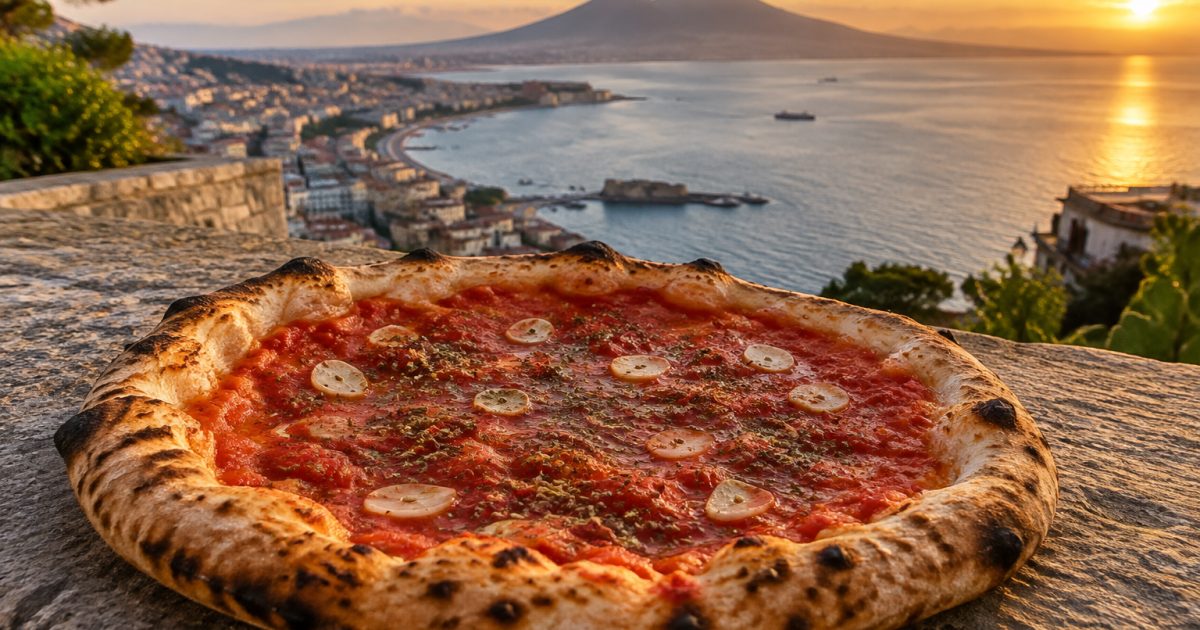
In the image, a context connected to the facts.
In Posillipo, the marinara pizza meets the Gulf skyline: tomato, garlic, oregano, and oil tell a simple Neapolitan story, born to showcase just a few ingredients.
Posillipo, between tuff, sea and light
The Posillipo neighborhood follows the western coast of Naples with a succession of slopes, viewpoints, and streets that open onto the Gulf. From here, the city appears to stretch out along the water: Vesuvius in the background, the silhouette of Capri on clear days, the islands and inlets changing color in the wind. The yellow tuff, historic villas, green slopes, and the sea create a layered landscape, where the urban dimension always remains close to the coastal one.
In this context, pizza marinara doesn't require sophisticated ingredients to find its connection with the region. It's one of the most recognizable expressions of the Neapolitan pizza tradition, linked to everyday cooking and the ability to transform a simple dough into a complete, fragrant, and accessible dish. The name can be misleading: the traditional recipe doesn't include fish or seafood. Its identity comes from the combination of tomato, garlic, oregano, and extra virgin olive oil.
The connection to Naples is direct: marinara is part of the Neapolitan pizza repertoire and brings Mediterranean flavors common to Campanian cuisine to the table. Tomatoes evoke vegetable gardens and preserves, garlic adds a bold note, and oregano dries out and prolongs the flavor of the sauce. In Posillipo, overlooking the Gulf, this simplicity finds a natural setting: the red of the sauce harmonizes with the warm light of the tuff, while the aroma of oregano and olive oil perfectly complements the sea breeze.
A pizza without mozzarella
Marinara is distinguished by what it doesn't contain. No mozzarella, provolone, or other dairy products: the toppings remain light, leaving room for the structure of the dough and the balance of acidity, saltiness, and aroma. For two round pizzas, you'll need approximately 500 grams of soft wheat flour, 325 grams of water, 12-15 grams of salt, and a small amount of fresh brewer's yeast—around 2 grams for slow rising. You'll also need peeled tomatoes or tomato passata, two cloves of garlic, dried oregano, and extra virgin olive oil.
- 500 grams of soft wheat flour;
- 325 grams of water;
- 12-15 grams of salt;
- about 2 grams of fresh brewer's yeast;
- 250-300 grams of crushed peeled tomatoes;
- 2 cloves of garlic, dried oregano and extra virgin olive oil.
Dissolve the yeast in the water and gradually incorporate the flour, adding salt once the dough has formed a firm consistency. Kneading should make the dough smooth and elastic, not necessarily perfect the first time you knead it. After a short rest, shape it into a loaf and let it rest, covered. To develop more complex flavors, the dough can be left to rise for several hours at room temperature, or you can begin the rising process in the refrigerator and finish it out before rolling it out.
Once the dough has risen in volume, divide it into two parts and shape into loaves. Spread the dough with your fingertips, working from the center outward, without flattening the crust. This way, the disk stays thin in the center and retains a puffier edge around the perimeter. Spread the tomato sauce sparingly: too much sauce would leave the bottom moist and overwhelm the flavor of the wheat.
The seasoning follows tradition
Add thinly sliced or roughly chopped garlic, a sprinkling of oregano, and a drizzle of olive oil to the sauce. The garlic should be present but not overpowering; the oregano, on the other hand, should leave a dry, herbaceous note, not a bitter taste. The salt content of the tomatoes can be adjusted, especially if the peeled tomatoes are already salty.
Ideally, pizza is cooked in a very hot oven, on a refractory surface or on a preheated baking sheet. In home ovens, it's best to reach the highest temperature available, generally between 250 and 300 degrees Celsius, and cook the pizza in the hottest part for a few minutes, until the edge browns and the tomato sauce has evaporated. In a professional wood-fired or electric oven at a high temperature, cooking is much quicker. The result should be a soft but not wet center, a light crust, and uneven browning.
As it comes out of the oven, you can add a final drop of oil. Nothing else is needed. The marinara is best eaten hot, when the garlicky aroma rises from the surface and the oregano blends with the tomato. The bite alternates the delicate, elastic texture of the dough with the lively sauce, with an aromatic finish that remains clean and not heavy.
The essential taste in front of the Gulf
Seen from Posillipo, pizza marinara seems to encompass some of Campania's key characteristics in just a few elements: the culture of baking, tomatoes, oil, Mediterranean herbs, and the practice of cooking with moderation. It's not a dish to be transformed into an excuse to add ingredients; its strength lies in the precision of the ingredients and the quality of the ingredients.
The landscape completes the experience without becoming decoration. After the pizza, the Gulf returns with its open horizon, the reflections on the boats, the shadows of Vesuvius, and the rugged profile of the coast. Posillipo thus remains the meeting point between the city and the sea, while the marinara preserves, in its thin dough and the scent of oregano, the concrete measure of Neapolitan tradition.
Breaking News
Naples also occupied the Alberti High School. Students say, "Destroy the CPRs, not our schools."
Another school occupied in Naples. This time the protest started at the Leon Battista High School... Read more
Naples, raid at Case Nuove: drug dealer arrested
Naples - A 28-year-old man was arrested by the State Police on charges of possession… Read more
Herculaneum: Winter opening hours at the Archaeological Park begin October 15th; two domus reopen on October 21st.
From October 15, 2026, the Herculaneum Archaeological Park will observe winter hours with gates open… Read more
Naples hosts the second edition of the Campania Jazz Med Festival from October 23rd to 25th.
From October 23 to 25, 2026, the Monumental Complex of Santa Maria la Nova will host… Read more
Caivano, a whole new music continues with Peppe Barra and Maurizio De Giovanni
The exhibition, promoted by the Il Canto di Virgilio Foundation and funded by the Ministry of Culture, goes… Read more
Public transport in Campania, Simeone calls for an immediate review of the distribution criteria.
Regional Councilor Nino Simeone warns of a possible reduction of over €210 million… Read more

National Newspaper
Registration No. 1301 of 2016 – ROC 030531
Director: Giuseppe Del Gaudio
To contact the editorial staff click HERE |
Download our Official ANDROID APP
