Naples, superhashish alert: white and frozen, psychosis, and heart attacks. Experts: "No one knows if he's predisposed."
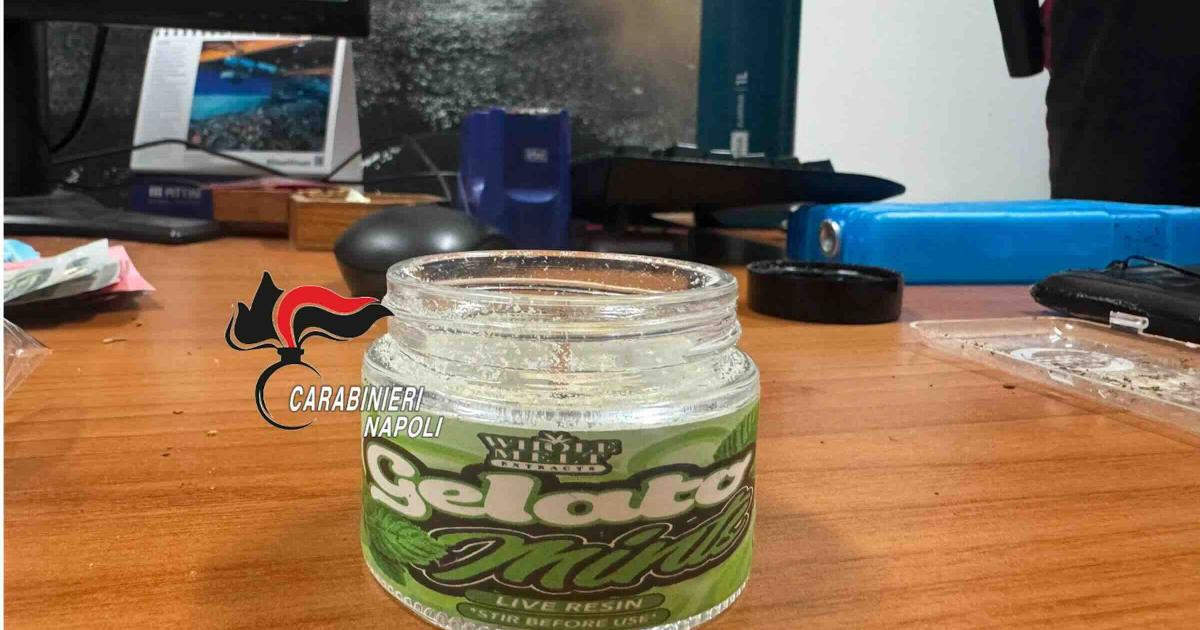
The package of White hash seized
Naples – It's the new frontier of drug trafficking in the Naples area: after white hash, here comes frozen hashish. Concentrated cannabis resin with extremely high THC content, sold as "premium," with luxury prices (up to €80 per gram) and a tempting promise for consumers: a faster, more intense, and longer-lasting effect.
But behind that glittering window display lurks explosive health risks: panic attacks, paranoia, the onset of psychosis, and, according to recent studies, a tripled risk of death from cardiovascular causes even in apparently healthy people under 50.
The seizures that raised the alarm
Pozzuoli, August 26: Carabinieri officers from the local unit arrested four young men with no criminal record (aged 20–26) for possession with intent to sell. In the box, along with hashish, marijuana, €1.500, and scales, they found a jar containing 7 grams of white hash: labeled "Live Resin," with a THC content of 78,6%. This is the first seizure of white hash in the Naples area.
Melito, August 27: Just 24 hours later, Carabinieri officers from the Giugliano operations unit intercepted a 25-year-old man already known to the police and a 24-year-old man with no criminal record. In a false bottom of the Smart, and then at the former's home, they found 45 grams of frozen hashish in seven small bags, along with other quantities of marijuana and "traditional" hashish. Frozen hashish, obtained by cold processing to concentrate the resin glands, can fetch up to €80 per gram.
Two raids, two different products, same logic: push “high-end” substances onto the market, with catchy names and record concentrations.
What are White and Frozen: An Expert's Explanation
"White hashish and frozen hashish aren't exactly the same thing," Riccardo Gatti, a psychiatrist and coordinator of the Lombardy Region's Addiction Technical Committee, explained yesterday to Adnkronos Salute. "Both are part of modern extractions, designed to obtain a high content of the active ingredient from cannabis."
White: the name recalls the light colour, linked to a slightly early harvest of the trichomes and/or to a purification of the resin.
Frozen: the name comes from the cold production and preservation process, which aims to preserve and concentrate the active ingredients.
But be careful: "We're in a black market: there's no guarantee that what's sold as white or frozen is actually purer or more potent. In some cases, it could be a legal and controlled product in countries with different legislation, where it represents a 'premium' range, which justifies higher prices and revenues."
The logic of the mass drug market, profits and the premium segment
According to Gatti, illicit drug markets "move like legal markets." "Premium" products not only guarantee higher profits, but also broaden the customer base and act as a driver for the lower end of the spectrum.
"New products must be the most powerful and 'better' ever. Constant growth is essential to sustain distribution and profits."
In the case of cannabis, the market "seems to be stabilizing in growth and, therefore, it is not surprising that, even here, even though they are illegal, more and more new products are being found."
Health risks: "It's not cannabis light. It's a ticking time bomb."
"A product's high potency doesn't make it better: it often makes it more difficult to manage," warns Gatti. Compared to products from the last century, today's active ingredients are significantly superior.
Those looking for white or frozen hashish are looking for "faster action and a longer-lasting effect," but "the unwanted consequences can also be stronger."
Among the most feared effects:
- Acute anxiety, panic, paranoia more frequent with high-potency products.
Worsening of existing psychiatric disorders, even if latent.
Higher risk of triggering a psychotic state in predisposed individuals. "It's a shame that no one knows whether or not someone is predisposed to psychosis," the expert emphasizes.
Memory and learning difficulties, with a constellation of disorders that compromise daily performance.
For young people, Gatti warns, "it can be a disaster." And not just psychologically: "Recent, very large studies are showing that cannabis users have a significantly increased risk of heart attack, ischemic stroke, heart failure, and a tripled risk of death from cardiovascular problems. And this is true in people under 50, without significant cardiovascular problems and with normal blood pressure and tests."
The paradox of "conscious consumption": paying to harm yourself
"Markets seem very keen to create ever new opportunities for self-harm, for a fee, for people seeking 'well-being' and perhaps even conscious consumption, but who tend not to consider the real consequences," concludes Gatti. "Somewhere, they always find someone or something to encourage their choices."
Breaking News
Benevento: Thefts at self-service checkouts and vending machines: 39-year-old arrested
A series of thefts and attempted break-ins, carried out mostly at night, between… Read more
Avellino, a 60-year-old man walks again after three years: innovative surgery at Moscati Hospital
He lived in a wheelchair for three years after a hip infection compromised… Read more
Sant'Arpino: 77-year-old man reported for threatening son with rifle during argument
A 77-year-old man was reported by the Carabinieri of Caserta for serious threats… Read more
Pozzuoli: Two brothers were stalked by their ex's new partner.
The grip of justice has tightened around two brothers, respectively 33 and… Read more
Castel Volturno: Carabinieri night patrols seized 7,34 grams of cocaine and reported a 34-year-old man.
A night of checks in Castel Volturno: Carabinieri seized 7,34 grams of cocaine and reported… Read more
Pozzuoli: Attempted robbery: Carabiniere shoots at fleeing van, one arrested and three charged
A night of chases in Pozzuoli: a van flees after an attempted robbery, a robbery... Read more

National Newspaper
Registration No. 1301 of 2016 – ROC 030531
Director: Giuseppe Del Gaudio
To contact the editorial staff click HERE |
Download our Official ANDROID APP
