Tonino 'O Scienziato, that unconventional voice who spoke about the Phlegraean Fields forty years ago
In the image, a detail related to the story.
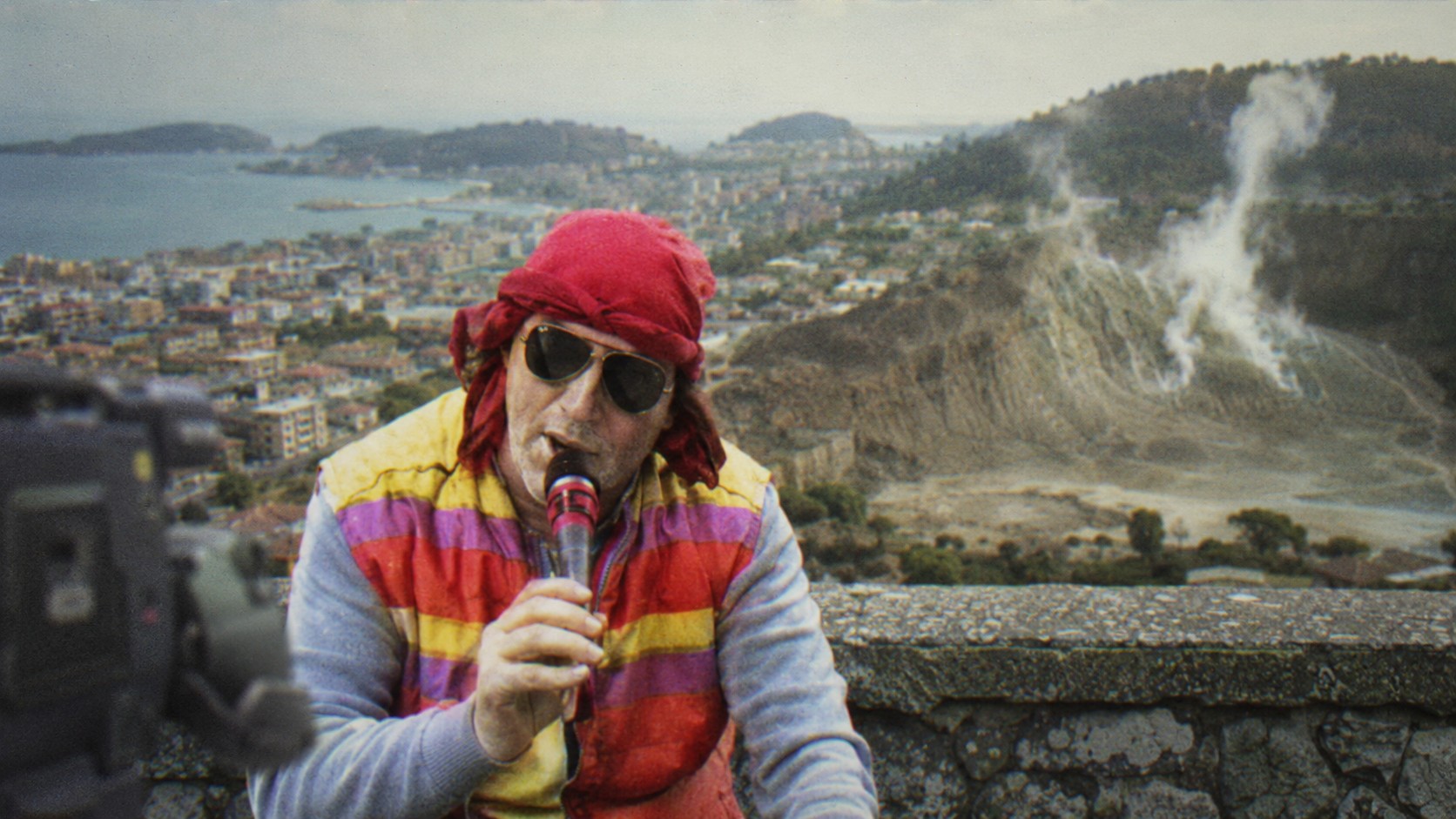
He's not a volcanologist, and many of his theories lack any recognized scientific basis. Yet Tonino 'O Scienziato , born Antonio Andreone, is a unique figure on Neapolitan local television: a popular voice who, as early as the 1980s, sought to report on the region's problems and draw attention to the dangers associated with the Phlegraean Fields.
We shouldn't turn him into a prophet, nor attribute to him knowledge he didn't possess. Tonino was and is above all a neighborhood man, tied to the Rione Traiano, capable of using the small television stations of the time to bring to the cameras issues often ignored by the mainstream media.
With his colorful, direct, and sometimes confusing language, he covered urban decay, property speculation, abandoned public spaces, and the plight of the suburbs. He would turn on his camera and go talk to people. He didn't follow the patterns of traditional journalism and lacked the training of a researcher, but he possessed the conviction that certain problems needed to be exposed before it was too late.
Report on the bradyseism of Pozzuoli
One of the best-known documents linked to Tonino 'O Scienziato is “Earthquake: panic and fear” , made in Pozzuoli in 1984 during the great bradyseismic crisis that caused evacuations, damage to buildings and thousands of displaced people.
In the report, Tonino reaches the port of Pozzuoli in the early hours of the morning, meets with fishermen, speaks with residents, and listens to families affected by the emergency. He also visits the Schiana area, gathering testimonies from people who felt abandoned and unsure what would happen to their homes.
Part of the full version is still available in the film "Tonino 'O Scienziato and the Pozzuoli Earthquake ." Other images show him going directly to the Solfatara area , trying to explain, in his own language and through his own beliefs, what was happening underground.
Those films can't be considered scientific documentaries. However, they are important social testimonies because they show how a portion of the population experienced that crisis. Tonino wasn't reporting on bradyseism from a laboratory: he was reporting it from the streets, among the frightened, the displaced, and those fearing to lose everything.
His theory on sulphurous waters
Tonino's most famous theory linked bradyseism to the closure of the sulphurous water fountains of the Chiatamone, known to the Neapolitans as “acqua 'e mummera”.
According to his interpretation, the closure of the springs would have prevented the water and gases present underground from finding a natural outlet. The pressure, no longer able to be released through those fountains, would have therefore shifted towards the Pozzuoli area, contributing to the tremors and the uplift of the ground.
To explain this idea, Tonino compared the subsoil to a car engine: when a valve is closed, he argued, the pressure inevitably seeks another outlet. He therefore called for the springs to be reopened and the underground gases to find an outlet.
This was a suggestive and easily understandable explanation, but it was not supported by scientific knowledge of the phenomenon . The bradyseism of the Phlegraean Fields is linked to the complex dynamics of the volcanic and hydrothermal system, to soil deformation, fluid circulation, and seismicity. Its evolution can only be assessed through the joint analysis of data collected by monitoring networks.
Telling the story of Tonino 'O Scienziato therefore means keeping two aspects clearly distinct: on the one hand, his personal theories, which cannot be presented as scientific truths ; on the other, his attempt to draw attention to a fragile territory and the difficult relationship between the population, the institutions and nature.
What Tonino was trying to tell
Beyond the flawed or superficial explanations, Tonino had grasped a fundamental fact: the Phlegraean Fields are not just a topic for scholars, conferences, and bulletins. They are a densely populated area, built on an active caldera, where every movement of the ground directly impacts homes, schools, businesses, and the daily lives of hundreds of thousands of people.
Already forty years ago, he was trying to say that it was impossible to look the other way. He did it in his own way, through a television that was limited in resources, with often jumbled words and scientifically questionable conclusions. But he still tried to highlight the problem and bring a camera where the earth was shaking and people were afraid.
This is where the value of his testimony lies. Not in having scientifically predicted what would happen, but in having recounted a risk that existed then and continues to exist today.
A land that continues to remind us of its nature
Today, scientific knowledge and monitoring tools are vastly more advanced than in the 1980s. The Vesuvius Observatory continuously monitors seismicity, ground deformation, gas emissions, and geochemical parameters. Any serious assessment must start from this data, not from personal hypotheses or theories spread on social media.
The magnitude 4.7 earthquake of July 31, 2026, was identified by the INGV as the most energetic recorded at Campi Flegrei since instrumental data became available. The institute also clarified that a single tremor, however significant, does not in itself demonstrate a change in the state of the volcanic system. Updates can be found on the Vesuvius Observatory's official website.
The point, however, isn't to fuel alarmism. The point is to ask whether, after so many years, the region is truly ready to face a more serious crisis. Scientific monitoring is essential, but alone isn't enough. We need safe buildings, truly practicable escape routes, plans known to the population, credible exercises, and communication capable of building trust.
Every time the earth trembles, the discussion returns to prevention, evacuations, and safety. When the tremors subside, there's a risk that attention will also wane. It's precisely this discontinuity that makes some of Tonino's old films still relevant, despite all their limitations.
Not a prophet, but a voice that tried to warn
Tonino 'O Scienziato shouldn't be turned into a hero or an unjustly overlooked scholar. His theories are based on a personal interpretation of phenomena and shouldn't be confused with scientific research.
It must be acknowledged, however, that many years ago, in his own small way, he tried to warn the population and to communicate about a land exposed to enormous risk. While many preferred to dismiss bradyseism as a temporary problem, Tonino entered the neighborhoods, spoke with the displaced, and reminded them that beneath Pozzuoli and a large part of the Naples area, there existed a natural force with which they would have to continue to coexist.
Sometimes it's precisely the most unusual and least orderly voices that intercept a concern that others prefer to push aside. Like Cassandra, condemned to be ignored, even those who warn of danger can easily be mocked or reduced to folkloristic characters. This doesn't mean their explanations were correct, but it does mean that the question posed then remains valid today: are we truly prepared?
Tonino, with his own way of doing things, had understood at least one thing that today many people are finally understanding:
Nature is not to be trifled with. We can study it, monitor it, and learn to coexist with it, but we cannot attempt to dominate it with concrete, improvisation, or fleeting reassurances. Sooner or later, nature will present its bill. And if we continue to prepare only after each new shock, we may find ourselves unable to pay it.
Breaking News
Theft at the Regional Museum of Messina: Archeoclub d'Italia calls for the return of Antonello's works and a strengthened protection network.
The theft of precious paintings by Antonello da Messina has shaken Sicily and rekindled the urgency… Read more
LIVE TRANSFER MARKET – NAPLES, excluded from the Community Shield: Nwaneri and Gabriel Jesus on the doorstep of Arsenal
Arsenal: Ethan Nwaneri and Gabriel Jesus excluded from the Community Shield. Nwaneri could return… Read more
LIVE TRANSFER MARKET - NAPLES, Spain is making an attempt to sign free agent Ceballos: he prefers Real Betis.
Ceballos is free after leaving Real Madrid (26/06/2026) and, according to the Spanish press, he would prefer… Read more
LIVE TRANSFER MARKET - NAPLES, Galatasaray reconsiders Noa Lang: negotiations reopened
According to Turkish sources, Galatasaray has submitted an offer for Noa Lang to the club that owns… Read more
Castellammare, they book a holiday from Mantua but arrive and discover that the house is inhabited
A family from Mantua discovers too late that the house they booked for Ferragosto in Castellammare… Read more
Femicide in Sant'Angelo a Cupolo: The murderous husband has been transferred to prison.
A 75-year-old pensioner is accused of stabbing his wife to death in… Read more

National Newspaper
Registration No. 1301 of 2016 – ROC 030531
Director: Giuseppe Del Gaudio
To contact the editorial staff click HERE |
Download our Official ANDROID APP