A year at the State, a lifetime of memories: Paolo, the Navy, and that night at the port of Genoa
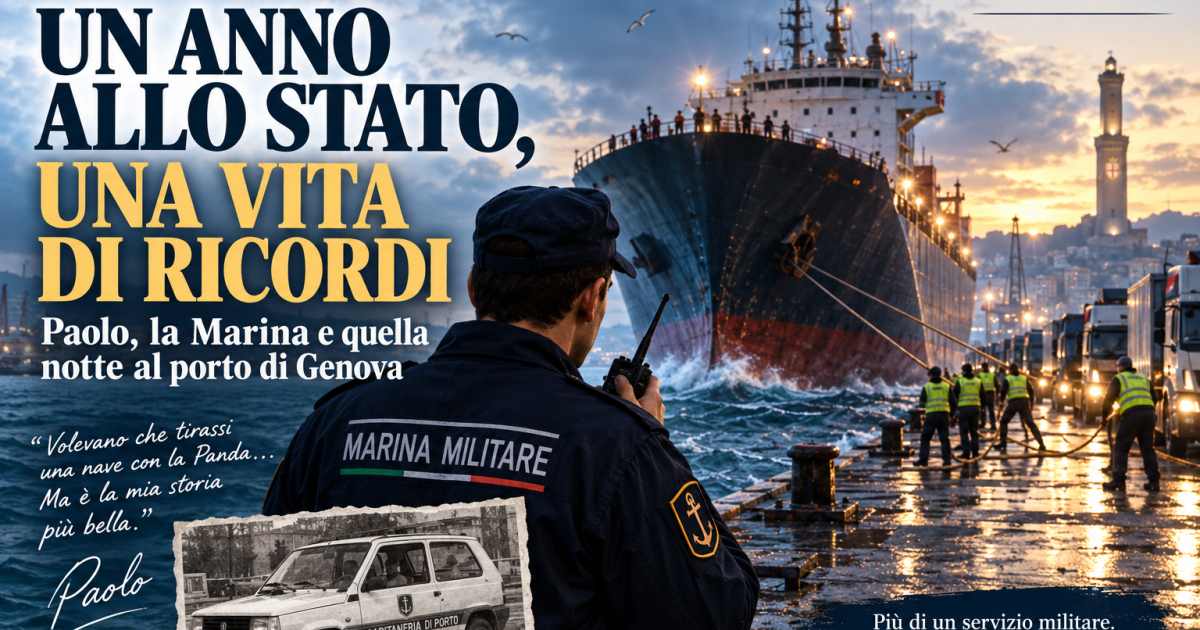
In the photo, a detail of the story.
For many young Italians, compulsory military service was, at least initially, almost a sentence: a year away from home, family, friends, work, or studies.
Twelve months of one's life to be given to the State.
For many it simply seemed like a waste of time.
Yet, years later, many of those who lived through that experience say something very different.
They tell of nostalgia.
Not so much about the early morning alarm clocks, the night guards, or discipline, but rather about that period of life in which, perhaps for the first time, one found oneself truly alone facing the world.
Military service forced boys from completely different cities, families, cultures and social backgrounds to live together.
We slept in the same dormitory.
We ate together.
We worked together.
We had to learn to adapt.
There was no mom and dad there to solve every problem, there was no room to retreat to, and often not even the usual friends.
There were strangers.
And those strangers, after a few months, could become companions.
When a year seemed lost
For many Italians, leaving for military service was a difficult experience.
It meant quitting a job, postponing a project, leaving a girlfriend, friends, or family.
But perhaps this was precisely one of the most important aspects of that experience.
For once we were forced to leave our personal dimension and enter something bigger.
The State was no longer just a word heard on the news or studied in books.
The State was becoming something concrete.
It was the uniform you wore.
The service you were supposed to perform.
The companion who needed you.
The responsibility that someone entrusted to you.
For many young people it was also the first opportunity to truly leave their own country or city.
Some people moved from the South to the North, some from the provinces to the big city, some saw the sea for the first time, and some discovered an Italy completely different from the one they grew up in.
When that year ended, almost everyone was happy to go home.
But then something curious happened.
As the years passed, those days that seemed endless became stories worth telling.
Would conscription still make sense today?
The return to a form of compulsory service is periodically discussed in our country too.
Probably, if one ever decided to rethink it, it would make no sense to simply imagine the old military conscription being reintroduced exactly as it once was.
Society has changed.
But the idea that boys and girls can dedicate a period of their lives to the community still holds important significance.
Serving one's country, in fact, does not necessarily mean taking up arms.
Within the Armed Forces there are administrative, logistical, healthcare, technical, operational, culinary, maintenance and rescue activities.
And a possible modern national service could also include Civil Protection, emergencies, assistance, environmental protection and other public utility activities.
The principle would be simple: for a few months of your life, stop asking yourself only what the State can do for you and also ask yourself what you can do for the community.
Because this is also what growing up means.
Paul and the Navy
Among the many stories we have been told is that of Paolo.
His military service dates back to the period between 1999 and 2000.
He had been assigned to the Navy and served in Genoa, at the Port Authority.
One of his duties was to keep watch.
The shift could start in the evening and end at seven the next morning.
A whole night.
Generally nothing special happened.
During the first hours Paolo could be employed in patrolling some port areas using a company car.
Once the checks were completed, he returned to the Harbour Office.
When the situation was calm it was possible to rest for a few hours.
But first you had to tell the guard exactly where you were.
Room.
Branda.
Precise place.
Because if an alarm had come during the night, someone would have had to know immediately where to go to wake him.
Sleeping with clothes on
Paolo had learned early on one of the unwritten rules of the night guards: it's better to sleep with your clothes on.
It could happen that you fell asleep and, a few minutes later, you were called back for an alarm.
Maybe it was a false alarm.
Maybe not.
We had to be ready.
Some nights Paolo even preferred not to sleep and stayed in the control room to talk to whoever was on duty.
Other times we joked with the guard.
They were boys.
And, fortunately, the truly dangerous moments were infrequent.
Until that night.
"Paolo, wake up. There's a problem."
It was just after five in the morning.
There were about two hours left until the end of the watch.
That night Paolo had finally managed to fall asleep deeply when someone shook him.
It was the orderly.
"Paolo, wake up. There's a problem. They called you, hurry."
Still half asleep, he got up from his cot and quickly reached the control room.
The lieutenant on duty explained the situation to him.
There was a large merchant ship in distress.
The sea was rough.
Someone was needed on site who could see firsthand what was happening, contact the crew, and report back to the Coast Guard.
Paolo took the radio.
He got into the company car.
And he left.
A giant ship in front of the pier
The indicated point was only a few minutes away.
When Paolo arrived at the platform he found himself faced with an impressive scene.
A short distance from the pier was a gigantic merchant ship.
The sea kept moving it.
On the deck, numerous sailors were shouting and gesticulating.
Many of the crew members were Filipino or Asian, and at first Paolo couldn't even understand what they were trying to tell him.
After several attempts he managed to identify the radio frequency used by the ship.
They began to communicate.
A little in English.
A little in Italian.
A lot of gestures.
Eventually the problem became clear.
The ship could not get close enough to the dock.
The crew wanted help from the ground.
Then, suddenly, a rope shot out from the ship.
The captain tried to make Paolo understand that he would have to connect it to the service car to pull the ship towards the dock.
Paul looked at the rope.
Then he looked at the car.
It was a Panda.
His reaction, even today, is one of the memories he recounts with a smile.
"Are you stupid? I have a Panda! If I tie this ship to my car, we'll end up in the sea, me, the Panda, and everything else!"
Today it may seem like a comical scene.
At that moment, however, no one really felt like laughing.
A sailor throws himself into the sea
Tensions on board were rising rapidly.
The men on the ship were exhausted.
Then something happened that made Paul realize that the situation could get much more serious.
One of the sailors threw himself into the water.
He didn't even have a life jacket.
Paul immediately reported what was happening and was told to begin providing first aid while more men arrived.
The bulk of the personnel were located about two kilometers away and, with those sea conditions, it would have been necessary to intervene mainly from land.
It took a few minutes.
But in a situation like this, even ten minutes can seem like a very long time.
Paul took a lifebelt and threw it at the sailor.
Some people who had stopped on the platform in the meantime helped with the operations.
Together they managed to recover it.
But one problem remained.
It was necessary to prevent other men, seized by panic, from deciding to throw themselves from the ship.
The real problem: the ship was at the wrong dock
Only later was it better understood what had happened.
The merchant ship was not simply having difficulty docking.
She had approached the wrong pier.
For reasons that were never fully clarified, the captain had brought that large vessel to a dock that was not equipped to accommodate vessels of that size.
Perhaps the rough sea had affected it.
Perhaps the crew, already tired from a difficult voyage, simply wanted to reach land as quickly as possible.
Perhaps it was simply a maneuvering or communication error.
Paul never knew for sure why this had happened.
The concrete fact, however, was only one: that ship was in front of the wrong pier.
And that pier did not have the means, winches and equipment normally used to safely dock a merchant ship of that size.
At that point the problem became even more complicated.
With the sea conditions like that, the ship couldn't simply turn away, turn back, and calmly reach the correct pier.
She had already arrived there.
A solution had to be found.
And it had to be found quickly.
That's why everything was improvised.
First the almost surreal request to use the service Panda to pull a rope.
Then the sailor who threw himself into the water.
Finally, the idea was to stop the trucks entering the port and use their force to help the ship approach the dock.
This was not the expected procedure.
That was not the dock where the ship should have been.
But at that moment it no longer mattered who had made the mistake.
The important thing was to prevent the crew's fear from turning a docking error into a tragedy.
The idea of trucks
Paul tried to reassure the commander.
He explained to him that they would intervene.
But something was needed that could exert a force much greater than that of a small car.
And here's the intuition.
Paul ran towards the port entrance.
He started stopping some trucks that were coming in.
He quickly explained to the drivers what was happening.
There wasn't much discussion.
The truck drivers decided to lend a hand.
One by one they reached the pier.
Within minutes, several heavy vehicles had arrived.
More ropes were thrown from the ship.
A.
Two.
Three.
Finally there were several ropes stretched between the ship and the land.
They were connected to the trucks.
Then came the time to try.
All together
The trucks started pulling.
For a few moments the force of the ship and that of the sea almost seemed to prevail.
The vehicles were pushed towards the edge of the platform.
Then the engines revved up.
The tops remained taut.
The waves probably also helped the maneuver for a few seconds.
Meter by meter the great ship began to approach.
Just a few more moments.
Then finally she was close enough to be secured to the dock.
The worst moment was over.
The ship was safe.
The hard work was done.
«I hadn't done anything special»
Paul received thanks from practically the entire crew.
Men.
Women.
Sailors.
Commanders.
He still continues to downplay that episode today.
He says he didn't do anything extraordinary.
He had simply tried to understand what was happening and find a solution while waiting for further help to arrive.
But maybe that's the point of the story.
Being helpful doesn't always mean performing a heroic act.
Sometimes it just means being there when someone needs a hand.
A crew at the end of its tether
The behavior of the men and women on board also became more understandable when it became known that the crew had already faced a particularly difficult voyage.
They were tired.
Try them.
Scared.
Probably seeing the land finally a few meters away had made even the last resistance collapse.
That was precisely the paradox.
They were practically there.
They saw the port.
They saw the dock.
But they couldn't get off.
And, most importantly, they found themselves at the wrong dock, without the necessary equipment to complete the docking process properly.
The ship itself did not appear to be about to sink.
The most immediate danger was the panic of the people on board.
Someone had already decided to throw themselves into the sea.
Others could have imitated him.
This is why we had to intervene immediately.
And so, in a Genoa port at first light, a situation that had probably arisen from an error, rough seas, or crew fatigue was resolved with what was available.
A radio.
A life preserver.
Some men on the platform.
And a line of trucks called to do the work that, under normal conditions, would have been done by the equipment of a pier prepared for a ship of that size.
The Panda that was supposed to pull a ship
Of all the details of that night, Paolo remembers one in particular.
That rope thrown towards his Panda.
After more than twenty-five years it has become a funny anecdote.
One of those stories you tell over dinner.
«They wanted me to pull a merchant ship with a Panda».
And everyone laughs.
But behind that seemingly absurd request there was something very different.
There was fear.
There was a crew that had reached the limit.
There was someone who, just to set foot on dry land, was willing to try anything.
Even entrusting a ship to a Panda.
The meaning of a uniform
Maybe military service was also this.
Being a twenty-year-old kid and suddenly finding out that someone expected something from you.
Not because I was special.
But why were you there at that moment.
You were wearing a uniform.
You had a radio in your hand.
And you represented someone.
The Harbour Office.
The marine.
The State.
These are experiences that are difficult to reproduce in everyday life.
Experiences in which you learn that being part of a community also involves responsibilities.
And perhaps this is precisely one of the reflections that deserves to be recovered today.
Doing something for others
One can argue endlessly about whether or not to reinstate compulsory military service.
One can argue about its duration, its organization and even the necessity for it to be necessarily military.
But perhaps it is worth recovering at least the principle behind that experience.
Ask every young man or woman to dedicate a small part of their life to the community.
Not necessarily with a rifle.
Maybe in a hospital.
In a military kitchen.
In an operations center.
In Civil Protection.
On an emergency vehicle.
In an office.
During an environmental emergency.
Wherever there is something that can be done for others.
Because becoming a citizen also means understanding that a society only works when someone decides to do their part.
Paul did not save the world that night.
He didn't fight a war.
He didn't do a movie-like action.
He saw people in trouble, took a radio, recovered a man who had fallen into the sea, stopped some truck drivers and looked for a solution.
Then, once the emergency was over, he returned to his life as a conscript.
This probably also means serving one's country.
Be present.
Taking responsibility.
Learning to live with people different from us.
Doing your part when needed.
And discover, perhaps only many years later, that that year that seemed to have been taken away from your life had, in fact, left something behind.
A story.
An experience.
Some friends.
Memories.
And above all, the awareness of having been, at least for a moment, part of something bigger than ourselves.
Breaking News
He shoots and kills one of the burglars who entered his home: he is under investigation for murder.
A man died after being shot in the courtyard… Read more
Naples cracks down on nightlife on Via Petrarca: security summit scheduled for Tuesday
Prefect Michele Di Bari convenes the Provincial Committee following residents' reports of… Read more
- Caserta and Province
- Naples News
- Chain drive
- Flash NEWS
- live,
- Live
- Socials
- Stories
- Breaking News
- zoom meeting
State Road 7 Quater: 22-year-old Roberto Ancona was hit and killed in front of the cameras.
It was around 6:30 in the morning when the Volkswagen Golf, in which they were travelling… Read more
Naples: A 58-year-old drug dealer was arrested in Piazza Garibaldi.
A 58-year-old man was arrested by the State Police in Piazza Garibaldi… Read more
Marcianise: Two Neapolitans reported for theft and fraudulent use of a debit card at the Campania Shopping Center.
After the theft of a wallet, two people were reported by the Carabinieri for having… Read more
Carinaro, found on the street with a stolen bag shortly before: reported
A 44-year-old man was charged with receiving stolen goods after the discovery of a… Read more

National Newspaper
Registration No. 1301 of 2016 – ROC 030531
Director: Giuseppe Del Gaudio
To contact the editorial staff click HERE |
Download our Official ANDROID APP