Sant'Agata de' Goti, the Sannio landscape in a plate of pan-fried broccoli rabe
In Sant'Agata de' Goti, the green valleys and the stone of the village accompany a simple Campanian recipe: broccoli rabe, oil, garlic, and chili pepper.

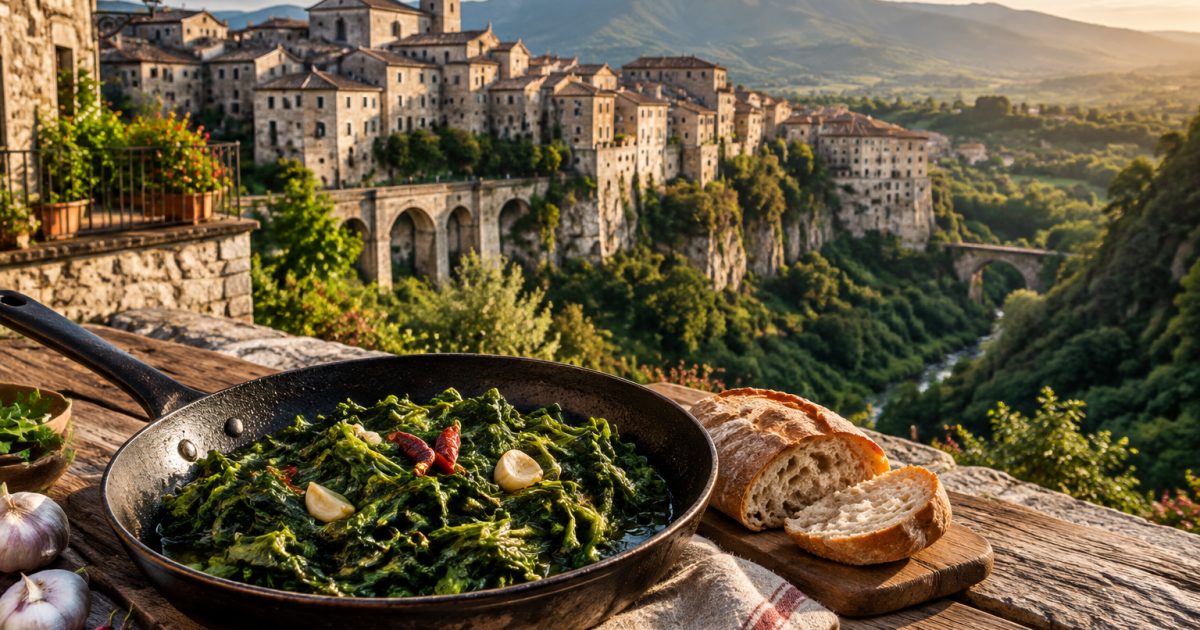
In Sant'Agata de' Goti, the green valleys and the stone of the village accompany a simple Campanian recipe: broccoli rabe, oil, garlic, and chili pepper.
Arriving in the Benevento town, the landscape unfolds before you even see its streets. Sant'Agata de' Goti sits on a tuff hill carved by valleys and waterways, with its historic center nestled in a position that offers open views of the Sannio countryside. The houses, arches, and palaces follow the contours of the land; below, the greenery rises from the valley floors toward the hills, while further away, the presence of Mount Taburno can be seen.
It's an environment where the cuisine doesn't need elaborate effects to express the region. The cuisine of the Campanian hinterland often begins with vegetables, bread, legumes, preserves, and uncomplicated meats. Friariello belongs to this geography of flavor: a vegetable with a bold character, especially tied to the Neapolitan area but present in regional cuisine, where it is enhanced by quick cooking and a very simple aromatic base.
The village between stone, valleys and countryside
The historic center of Sant'Agata de' Goti invites a leisurely stroll. The steep streets and passages between buildings lead to scenic spots where the urban landscape gives way to the countryside. In the colder months, the grazing light highlights the stone tones and the bare outlines of the trees; in spring, however, the valleys fill with shades of green and the landscape appears softer.
The relationship with food is understood by observing this continuity between the village and the surrounding agricultural areas. Friariello is not a neutral ingredient: it has tender leaves, inflorescences, and stems that require careful selection, and a bitter taste that lingers even after cooking. In the pan, however, that bitterness is rounded out. Extra virgin olive oil brings a fruity note, garlic adds depth, and chili pepper introduces a brief spiciness that sustains without overpowering.
For this preparation, it's best to choose fresh bunches, with intact leaves and unwilted tops. The larger stems can be kept if tender; the fibrous ones should be discarded. Cleaning takes a few more minutes, but it determines the final consistency: a well-selected vegetable stays tender without falling apart and retains a distinct vegetal aroma.
Frying pan-fried broccoli rabe with just a few ingredients and the right amount of heat.
For four people, you'll need about a kilo of broccoli rabe (unpeeled), four tablespoons of extra virgin olive oil, two cloves of garlic, a fresh or dried chili pepper, and salt. It's also helpful to have a little water, adding only if necessary. This recipe can be served with homemade bread, eggs, or meat, but it also works as a standalone side dish, especially when you want to bring a bold, vegetable flavor to the table.
- Remove the tough stems and damaged leaves, then rinse the broccoli rabe thoroughly in cold water. Drain without drying them completely.
- Heat the oil in a large skillet, add the crushed garlic cloves and chili pepper. The heat should be medium: the garlic should be fragrant and lightly browned, but not burnt.
- Add the still-moist broccoli rabe, stir, and cover for a few minutes. The water remaining on the leaves will create the steam needed to start cooking.
- Remove the lid, season with salt sparingly, and continue cooking over medium heat, stirring frequently. If the pan dries out too quickly, you can add water a tablespoon at a time.
- Cook for about fifteen minutes, or until the stems and leaves are tender but not mushy. In the final minutes, let the moisture evaporate, allowing the oil to coat the vegetables again.
The best result isn't a uniform mass, but a blend of textures: softer leaves, still recognizable buds, and a few stems that offer a subtle bite. Salt should be added at the end, when the volume has reduced and the flavor has concentrated. Even the chili pepper can be adjusted according to the variety used: the goal is to complement the bitterness, not turn the dish into a test of endurance.
In some Campanian cuisines, friarielli are paired with sausage, but the simple version allows for a better understanding of the ingredient. Served warm with slices of bread, they collect the aromatic oil on the bottom of the dish and become a complete dish in its simplicity. A brief rest of a few minutes, off the heat, also helps balance the garlic's aroma.
The value of this dish also lies in its rhythm: it's prepared as the light changes over the hills, without requiring complex techniques or lengthy cooking. It's a homely, down-to-earth cuisine, capable of connecting flavor to the season and the availability of the garden. In Sant'Agata de' Goti, where the village maintains a strong visual connection with the countryside, pan-fried friarielli thus find a natural setting, balancing the character of the hinterland with the broader identity of Campanian cuisine.
Before or after the meal, it's worth returning to the vantage points overlooking the valleys and observing the town from the outside. The stone of the historic center, the green of the slopes, and the bitter aroma lingering on the plate all combine to create the same image: that of a region that expresses itself through simple forms, recognizable ingredients, and a cuisine that leaves room for the landscape.
Breaking News
Naples: The City Council allocates €50 million for renovations at the Maradona Stadium: A European dream.
Naples – The City Council of Naples, at the request of Mayor Gaetano Manfredi, has authorized… Read more
Pepe in Grani Pizzeria in Caiazzo is still the best in Italy and Campania in 2026.
Caiazzo - Franco Pepe's pizzeria has been confirmed again this year, too. Read more
Garlasco's Reasonable Doubt: Meeting with the Magistrate Who Absolved Stasi in Padula
Padula - The Garlasco case, one of the longest-running legal proceedings… Read more
Naples-Bari high-speed rail contract and gangmastering: links to the Belforte clan under scrutiny
There are 49 suspects in the investigation coordinated by the Naples DDA and conducted by the Guardia di Finanza… Read more
Naples, Geolier's Ballon d'Or is born, inspired by Secondigliano
Naples - A golden ball that's not just for playing, but for telling stories. This is how it was born... Read more
Naples: Five establishments inspected on Via Petrarca: fines imposed, and outdoor area suspended.
Naples - Checks continue on Posillipo Hill. During the night, Carabinieri from the Company… Read more

National Newspaper
Registration No. 1301 of 2016 – ROC 030531
Director: Giuseppe Del Gaudio
To contact the editorial staff click HERE |
Download our Official ANDROID APP
