Sorrento, a lemon delight among terraced citrus groves and a view of the Gulf
In Sorrento, the lemon delight translates the character of the citrus fruits grown on the terraces of the Sorrento Peninsula into a soft and fragrant dessert.

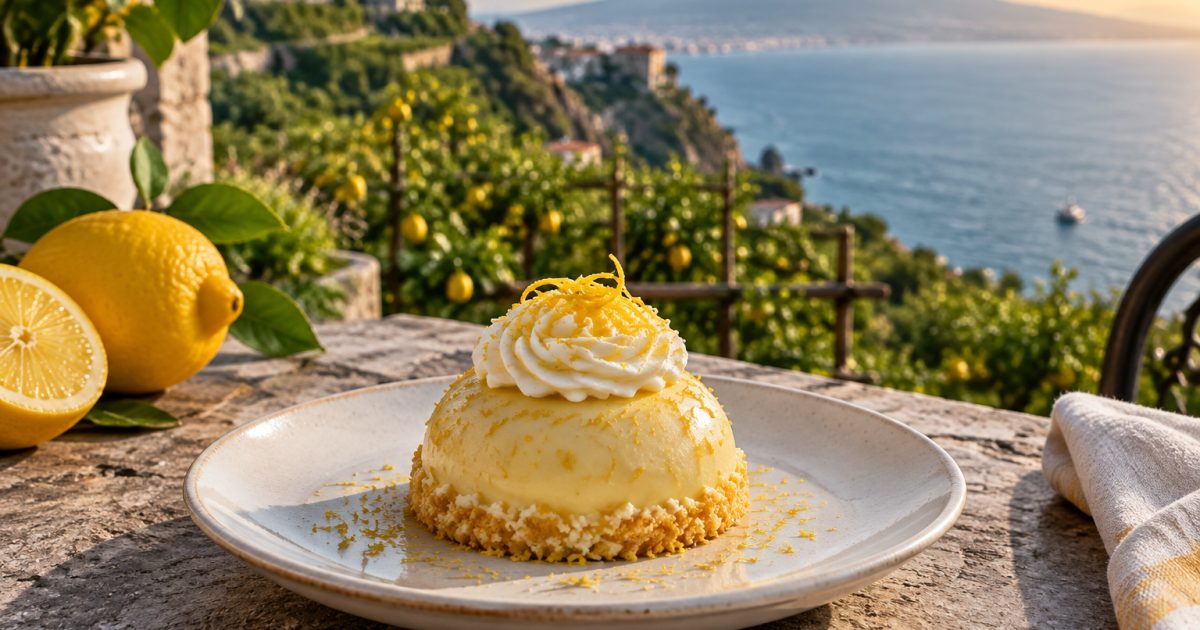
In the photo, a representative element of the story.
Among the terraces of the Sorrento Peninsula, the lemon delight brings the scent of local citrus fruits and the light of the Gulf of Naples to this dessert.
The landscape that gives shape to the dessert
Sorrento often appears as a city suspended between tuff rock and the sea, overlooking a stretch of coast where gardens, vegetable gardens, and citrus groves occupy the spaces protected by high rock faces. Lemon orchards are a recognizable part of the peninsula's landscape: they grow on terraced plots, supported by dry stone walls and often sheltered by characteristic roofs used to protect the plants.
Here, lemon is more than just an ingredient. Its zest is part of household customs, homemade liqueurs, creams, and traditional desserts from Campania. The fruit grown in the Sorrento area, also known as Limone di Sorrento PGI (Sorrento IGP), is distinguished by its juicy pulp, fragrant zest, and a balance of acidity and aromatic notes. These qualities find a precise expression in the lemon delight: a soft casing, a creamy filling, and a clear topping, where the citrus fruit remains recognizable without becoming overpowering.
Lemon delight is directly linked to the pastry culture of the Sorrento Peninsula and, more generally, to the cuisine of coastal Campania. Its presence in pastry shops and on festive tables has consolidated the association between this dessert and the region. It's not a rustic dessert, nor is it quick to make: it requires multiple steps, cooling times, and a careful balance between the sweetness of the sponge cake and the freshness of the cream.
Served after a seafood lunch, at the end of a summer dinner, or during a family celebration, this delicacy evokes the landscape without the need for elaborate decorations. The scent of freshly grated lemon zest, released when the knife cuts into the surface of the dessert, is enough to evoke the lemon groves overlooking Sorrento, Sant'Agnello, Massa Lubrense, and other towns on the peninsula.
A soft dome, between cream and zest
The traditional preparation begins with small sponge cakes baked in hemispherical molds. The batter requires eggs, sugar, flour, and a little starch, creating a light structure yet sturdy enough to be hollowed out and filled. Grated lemon zest can add flavor to the batter, as long as you use only the yellow part of the peel, avoiding the more bitter white pith.
- For the shells: eggs, sugar, flour, starch or potato starch and untreated lemon zest.
- For the cream: milk, egg yolks, sugar, starch and lemon zest or juice, with whipped cream incorporated when the cream is cold.
- For the syrup: water, sugar, and lemon zest; according to family tradition, you can add a small amount of lemon liqueur.
- For the topping: lemon cream lightened with cream, adjusted with a little milk or liquid cream until it reaches a fluid consistency.
Beat the eggs and sugar until light and fluffy. Sift the flour and starch and fold in gently, without deflating the mixture. Divide the batter into greased and floured molds, filling them only partially because it will expand during baking. The oven must be preheated; baking is complete when the domes are golden brown and dry in the center.
While the sponge cake cools, prepare the cream. The milk is heated with the lemon zest, then strained and combined with the egg yolks, previously mixed with sugar and starch. The cream should be heated to a temperature sufficient to thicken, stirring constantly. The lemon juice is added carefully, preferably when the base is cool, to preserve its aroma and control the acidity. After cooling, part of the cream can be softened with whipped cream.
The domes are removed from a small portion at the base and carefully hollowed out. The removed crumbs shouldn't be wasted: they can be crumbled and mixed with the cream to create a more consistent filling. The shell is moistened with a light syrup, then filled and closed. A second lemon cream, made smoother with a little cream, completely covers the cakes. The surface should remain smooth but not heavy, because the treat must retain its lightness.
Refrigeration is part of the recipe: a few hours allow the syrup to spread and the aromas to meld. Before serving, the dessert can be garnished with fine zest, small curls of cream, or a lemon leaf. Too low a temperature, however, mutes the aromas; it's best to let it rest for a few minutes before serving.
The taste of the Sorrento Peninsula
When cut, the lemon delight reveals simple yet distinct layers: moist sponge cake, pale cream, and silky topping. The initial impact is sweet, followed by the tart note of the juice, and finally the lingering aroma of the zest. There's no need to overwhelm it with decorations or accompaniments: its character depends on the quality of the lemon and the proportions of sugar, cream, and syrup.
This dessert finds a natural place in the Sorrento landscape. Its compact shape recalls the citrus fruits of the groves, while the cream conveys the brightness of a coastline where the green of the gardens meets the blue of the gulf. After the last bite, a distinct aroma lingers, connecting the table to the terraces, the scenic roads, and the constant presence of lemons in the life of the Sorrento Peninsula.
Breaking News
The Court orders the ASL Napoli 3 Sud to equip itself with an eye-controlled self-administration system for Irene
The Court of Torre Annunziata orders the ASL Napoli 3 Sud to duplicate a piece of equipment… Read more
It is one of the most beautiful places in Naples, but you will not find it in the classic tourist guides
There is a Naples that can be discovered away from the crowded streets, from the symbolic monuments… Read more
Naples: Man hides over €21 in counterfeit banknotes behind a magnetic mezzanine floor; 51-year-old arrested
High-impact police checks in central Naples continue unabated.… Read more
Payroll and Contributions Clerk in Naples: Gi Group is seeking a temporary position.
Gi Group is seeking a full-time, temporary payroll and benefits clerk in Naples for a… Read more
City weather stays put with an AI API
Napoli publishes the evening weather forecast before the match even ends, and the scoresheet… Read more
Pozzuoli: 49-year-old man arrested for stealing €400 worth of coffee pods
Pozzuoli – Various packs of coffee pods, for a total value of approximately €400… Read more

National Newspaper
Registration No. 1301 of 2016 – ROC 030531
Director: Giuseppe Del Gaudio
To contact the editorial staff click HERE |
Download our Official ANDROID APP
