Superconductors, an atomic scale can drive quantum vortices
A step one atom high could direct the motion of vortices in superconductors. Here's the principle, possible applications, and limitations.

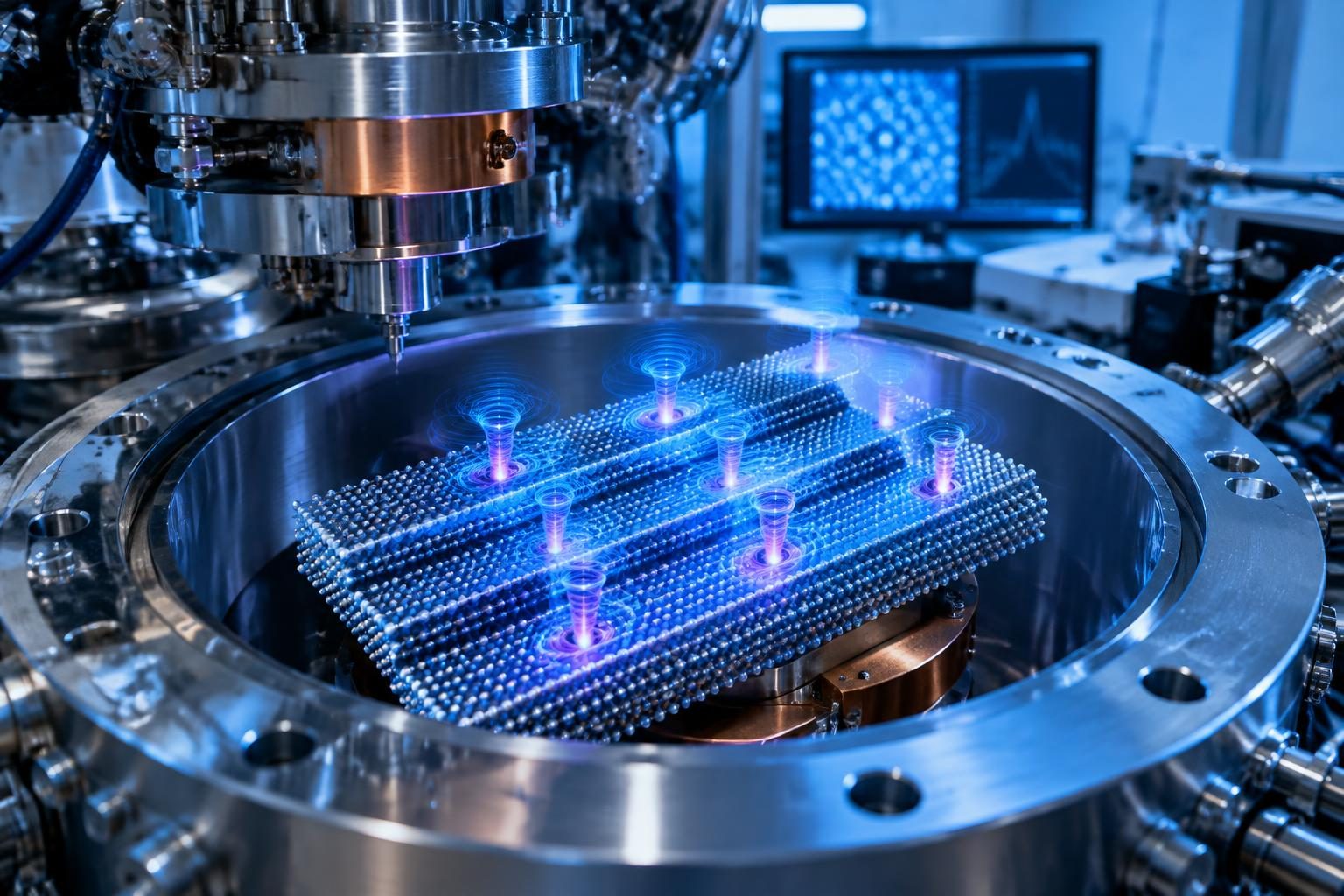
A step just an atom high can alter the path of quantum vortices inside a superconductor. The result, reported as a research point for October 2026, involves nanoscale control that could make current management more efficient.
What are quantum vortices?
In a superconductor, electric current can flow without resistance only when the material is below a certain critical temperature and in conditions compatible with its quantum state. However, an external magnetic field can penetrate the material in the form of small filaments of magnetic flux.
These filaments are called Abrikosov vortices. Charge carrier currents flow around each of them according to the rules of quantum mechanics. In a real material, vortices don't necessarily remain stationary: if they move under the influence of a current, they generate dissipation and can reduce the device's performance.
This is why the physics of superconductors isn't just about reaching low temperatures. It's equally important to control the movement of vortices, anchoring them when needed or directing them along predictable trajectories.
The role of an atomic step
The novelty suggested by the idea concerns a surface with an extremely precise discontinuity: an edge approximately as high as a single atom. Such a structure can act as a guide for vortices, locally modifying the energy required to make them pass through or deflect.
The most interesting aspect is the possible rectifying behavior. The vortex could move more easily in one direction than the opposite, similar to an element that favors a transition in one direction. However, this is not a visible path in the usual sense: it is a variation in the energetic landscape that governs the collective motion of the superconducting state.
According to the description given for the result, the difference in mobility between the two directions could exceed a factor of a thousand. Such a large value would be remarkable, but it must be interpreted carefully: it depends on the material, temperature, magnetic field strength, applied current, and the experimental definition of "ease of movement."
Why the effect is important
When vortices move haphazardly, some of the electrical energy can be converted into heat. An atomic guide capable of directing their motion could mitigate this problem under specific operating conditions. It could also help design devices in which the magnetic flux is transported, blocked, or switched with greater precision.
Potential applications include superconducting circuits, magnetic sensors, components for quantum computing systems, and electronic devices operating at low temperatures. Directional vortex control could also be useful in research on materials with higher critical temperatures, where the movement of magnetic flux often represents a practical obstacle.
It's important, however, to distinguish between an effect observed in a well-controlled sample and a market-ready technology. Superconducting applications often require cryogenic systems, uniform materials, reliable contacts, and very tight manufacturing tolerances.
How to build such a precise surface
Creating an atomic edge isn't simply a matter of carving a small groove. The surface must be prepared using growth or deposition techniques capable of controlling the crystalline structure, then analyzed with instruments that distinguish defects, impurities, and height variations.
One possible strategy is to create a matrix of parallel steps. This way, the vortices encounter an ordered series of potential barriers and can be studied as they flow through the material. Measurements must then separate the effect of geometry from that due to disorder, roughness, heating, or changes in the flow.
Comparing motions in opposite directions is particularly useful. If the difference persists even after changing the temperature and magnetic field, the hypothesis of a mechanism linked to the atomic structure becomes more robust. However, reproducible results in independent samples and a complete characterization of the material are required.
The limit: it's not a superhighway for electrons
The image of a quantum "highway" may be intuitive, but it risks creating confusion. The step doesn't allow electrons to travel freely like a frictionless track. It primarily affects the behavior of vortices, which are collective configurations of the magnetic field and superconducting current.
Furthermore, high motion anisotropy does not automatically imply a general reduction in losses. The benefit can only be seen within a specific range of temperature, current, and magnetic field. If the current exceeds a threshold, if the material develops defects, or if the temperature increases, the behavior may change.
From research to device
The most realistic prospect is a platform for controlling magnetic flux in specialized components, not an immediate replacement for ordinary electronics. Before discussing products, it would be necessary to demonstrate long-term stability, production on larger surfaces, compatibility with electrical connections, and operation in non-ideal conditions.
The scientific value of the result therefore lies in the fine-grained control of a collective phenomenon. A structural modification the size of an atom can dramatically alter the way a vortex flows through a superconductor, offering researchers a new tool for studying and designing quantum materials.
To learn more about the general principles of superconductivity, you can consult NASA resources and scientific information published by CERN . Confirmation of the specific result requires access to the original publication, experimental data, and independent verification by the scientific community.
Breaking News
Alzheimer's disease: P3 peptide reopens debate on proteins involved
The P3 peptide, long considered harmless, can form aggregates in the laboratory: here's what it means… Read more
A forgotten fossil reveals a clawed predator.
A fossil preserved for nearly a century could document a 120-year-old megaraptoran in Europe… Read more
Rice, wheat, and barley: a new strategy against fungi that threaten crops
Lab-engineered plant immune receptors could recognize more pathogenic fungi, but the technology is… Read more
Black holes, a possible common pattern for jets after eruptions
Observations of black holes of different masses suggest a link between accretion and jets, but… Read more
The enzyme that degrades some bioplastics: why it doesn't solve pollution on its own
Some bacterial enzymes degrade bioplastics under controlled conditions, but the result does not apply to… Read more
Avellino mourns the death of police officer Antonio Villani.
Antonio Villani was 50 years old and was carrying out his service, engaged in one of the… Read more

National Newspaper
Registration No. 1301 of 2016 – ROC 030531
Director: Giuseppe Del Gaudio
To contact the editorial staff click HERE |
Download our Official ANDROID APP
