Campi Flegrei: The 'driving force' of the crisis has been revealed: magmatic fluids rising to a depth of 3-4 kilometers.

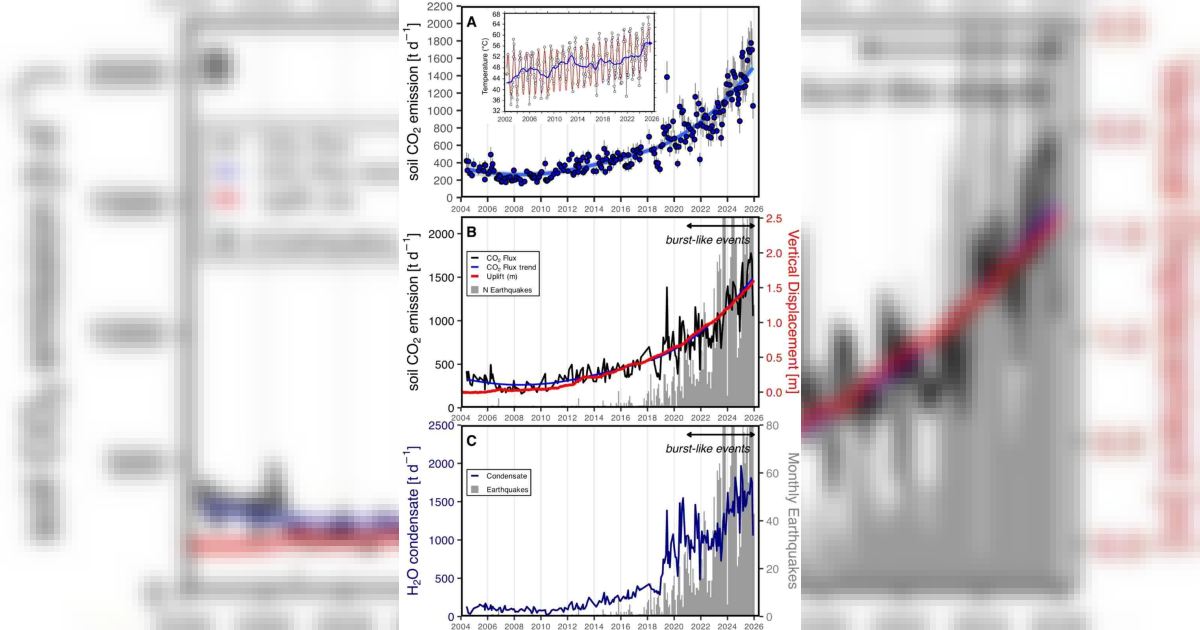
In the image, a reference to the narrated facts.
The Campi Flegrei crisis appears to be driven by a deep-seated "engine," invisible on the surface but capable of progressively altering the entire volcanic system. It's the continuous rising of magmatic fluids, which, according to a new multidisciplinary study, accumulate at a depth of approximately 3-4 kilometers and then rise upward, pressurizing and heating the overlying hydrothermal system.
This is the picture that emerges from research conducted by a group of scholars from the National Institute of Geophysics and Volcanology (INGV), the University of Perugia, and the Luigi Vanvitelli University of Campania, published in the scientific journal Science Advances.
Twenty-seven years of data to understand the volcano's evolution
The study is based on a particularly large body of data: more than 30 measurements of carbon dioxide (CO2) fluxes taken in the Solfatara-Pisciarelli area over a 27-year period, from 1998 to 2025.
The monitoring campaigns, conducted on a monthly basis, allowed researchers to follow the evolution of emissions over time and compare it with other main parameters of volcanic activity.
The most significant data concerns CO2. Since 2005, the year identified as the beginning of the ongoing crisis, emissions from the Solfatara have grown almost exponentially.
A trend that, according to the researchers, is closely correlated with the progressive uplift of the ground in the Phlegraean Fields area.
The ground rises, seismicity increases
The bradyseism phenomenon thus finds further insight into geochemical data. The ground uplift in Pozzuoli reached approximately 1,6 meters in December 2025, accompanied by an intensification of seismicity.
For the authors of the research, the correlation between CO2 emissions, ground deformation and earthquakes helps to outline the mechanism underlying the current phase of unrest.
The process, according to scientific reconstruction, begins deep underground: fluids of magmatic origin continue to rise, initially accumulating a few kilometers below the surface. Their progressive pressure then modifies the hydrothermal system, causing ground deformations and contributing to seismic activity.
The heat hidden beneath the Solfatara
But it's above all the energy balance that provides one of the most significant insights from the research. "While CO2 is emitted to the surface, significant amounts of water vapor condense underground," explains Giulio Bini, a researcher at the INGV and lead author of the study.
The researchers' thermodynamic calculations, correlating CO2 fluxes with the chemical composition of fumaroles, indicate that steam condensation transfers a considerable amount of latent heat to the rocks. This phenomenon could explain a significant portion of the transformations observed over the last twenty years.
Thermal energy exceeds that of earthquakes
The energy balance drawn up by the researchers provides another particularly relevant piece of data.
According to Giovanni Chiodini, associate research director at the INGV and co-author of the article, the thermal energy released by the fluids would be an order of magnitude greater than the elastic energy associated with the deformation and uplift of the Earth's crust.
But that's not all. The thermal energy itself would be five orders of magnitude greater than the total energy released by earthquakes recorded between 2005 and 2025.
A comparison that, according to the authors, helps to understand the dominant energetic component in the process affecting the caldera.
The thermometer of the crisis at Solfatara
There's another indicator that shows the system's progressive warming. At Solfatara, over the course of about two decades, the average soil temperature has increased by more than 10 degrees Celsius.
For Stefano Caliro, senior technologist at the INGV and responsible for geochemical monitoring of Campania's volcanoes, this is the most direct evidence of heating produced by the pressurization and condensation of fluids.
CO2, temperature, fumarole composition, ground deformations, and earthquakes thus become pieces of a single sequence to be constantly observed.
A system to be monitored in a densely populated area
The study therefore underscores the strategic value of integrated monitoring. No single parameter, taken in isolation, can convey the complexity of a volcanic system like that of the Phlegraean Fields.
For this reason, CO2 fluxes and the chemical composition of fumaroles are analyzed together with geodetic and seismological data.
The goal is to follow the evolution of the caldera as precisely as possible and identify any changes in the system's behavior.
In a densely populated area like the Phlegraean Fields, knowledge of the processes occurring beneath the surface becomes a fundamental tool for assessing and mitigating volcanic risk.
Breaking News
Severe weather: Orange alert in effect from 15 p.m. in Naples, the islands, and the Vesuvian area.
From 15pm today, Thursday, October 8th, until 15pm tomorrow, Friday, October 9th… Read more
A torrential rainstorm hits Naples, causing flooding and disruption: mud on Mount Epomeo. The church of San Gaetano in Forio is closed.
The severe weather is part of the ongoing disturbance currently affecting the Tyrrhenian regions. A… Read more
Naples, the story of Gabriella Poppiti, 'outlaw mother' and symbol of the rights denied to women in Italy.
The story of Gabriella Poppiti, a forty-two-year-old Neapolitan and single mother of little Matteo, is very… Read more
A worker dies after a skylight collapses from a roof: a workplace tragedy in the Avellino area.
A 55-year-old worker lost his life while he was working on a… Read more
Pozzuoli, 'My home is safe, but I can't go back': The bureaucratic odyssey of an eighty-three-year-old evacuee
In the documents filed at the offices of the Municipality of Pozzuoli there is an accounting paradox and… Read more
Naples: Third day of awareness raising against cigarette butts with Erion Care and Plastic Free in Piazza Sanità.
In Naples, Erion Care and Plastic Free Onlus are organizing an awareness and cleanup day… Read more

National Newspaper
Registration No. 1301 of 2016 – ROC 030531
Director: Giuseppe Del Gaudio
To contact the editorial staff click HERE |
Download our Official ANDROID APP
