
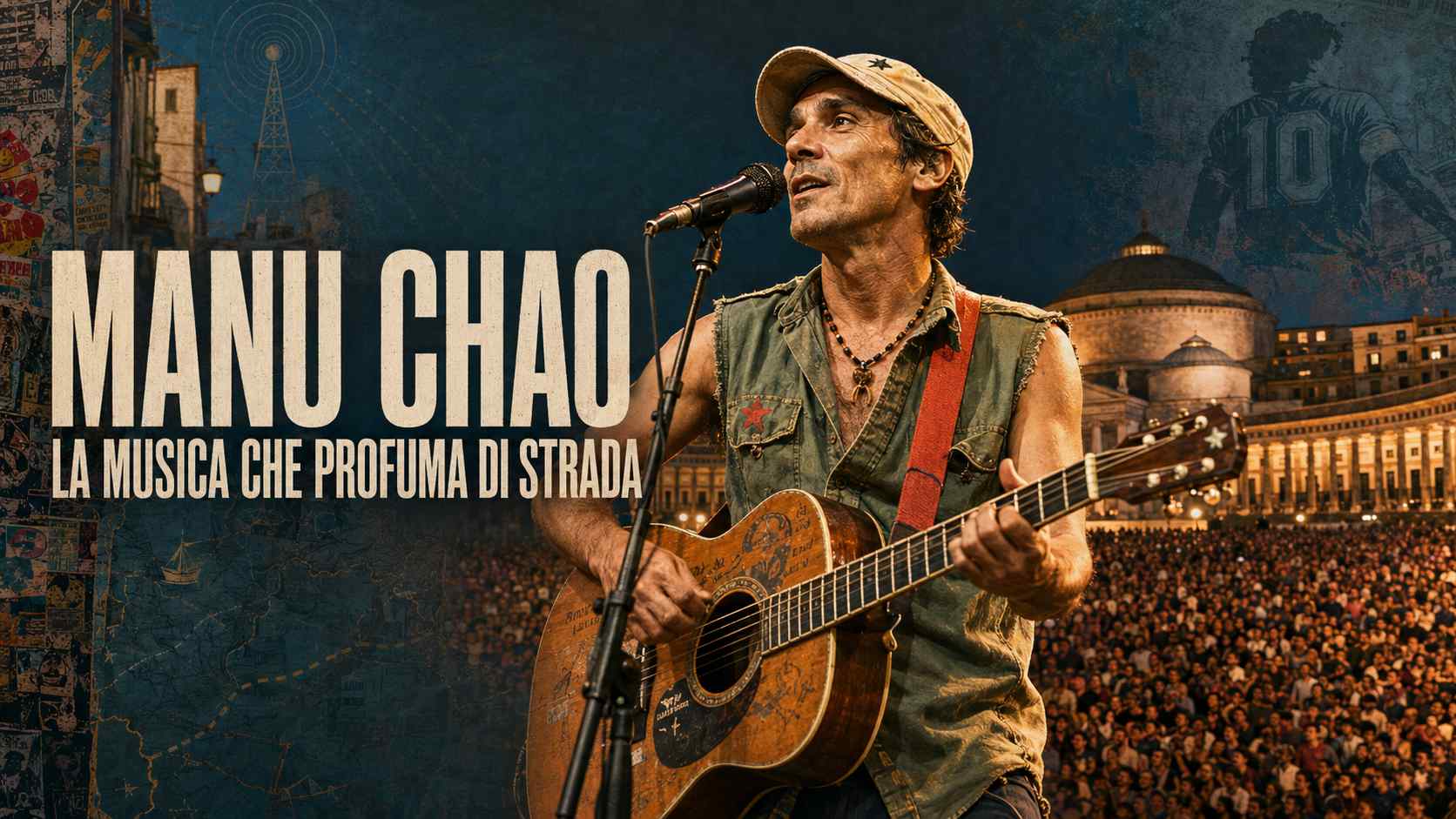
In the photo, a detail of the story.
Today, when we talk about Music with a capital "M," it's difficult to identify artists capable of transcending their time and becoming eternal. There are countless talented musicians, but those destined to become history are truly few.
If we add to music civic engagement, consistency, and the ability to stand with the least fortunate without turning every gesture into publicity, one name immediately comes to mind: Manu Chao.
For anyone who's been on the moon for the past thirty years, Manu Chao probably represents the very essence of independent music. Not simply "indie" as a genre or a commercial label, but independent in the truest sense of the word: free from trends, promotional mechanisms, and the rules imposed by the great circus of music with a lowercase "m."
An artist capable of filling stadiums, arenas, and squares, especially in Latin America and Europe, without ever acting like a star. In Western countries more closely tied to commercial circuits, he's sometimes considered almost a cult artist. Elsewhere, however, he's a popular, cross-genre figure, beloved by generations.
His songs touch the heart because they tell of a world he's truly traveled through and experienced. Not observed from a hotel room window, but experienced on the streets, in neighborhoods, on trains, in bars, in occupied spaces, and in places forgotten by great narratives.
The first bands and the birth of Mano Negra
Manu Chao, born in Paris in 1961 to a family of Spanish origin, grew up in an environment permeated by art, politics, and the narrative of exile. His first musical experiences came in the Parisian alternative scene of the 1980s, through groups like Hot Pants and Los Carayos.
It was a period of experimentation, cross-pollination, and concerts lived without too much frills. Punk, rockabilly, reggae, ska, and sounds from different cultures began to blend into a music that was difficult to classify.
In 1987, together with his brother Antoine Chao, his cousin Santiago Casariego, and other musicians, he founded Mano Negra. The name quickly became synonymous with energy, creative chaos, and cultural fusion.
The band defines their style as “patchanka”: a musical celebration in which punk, rock, flamenco, Latin rhythms, reggae, and street music coexist without asking anyone’s permission.
The first big signal comes with Bad life, a song that was already created during the Hot Pants experience and later taken up by Mano Negra. It is the beginning of that first, overwhelming wave of success that will lead the group to release albums such as Patchanka, Puta's Fever, King of Bongo e Casa Babylon.
But the history of Mano Negra is not just made up of records.
The band chooses to travel and perform in ways that would seem almost impossible today. In 1992, they embarked on the Cargo Tour, traveling by ship to various port cities. The following year, they crossed Colombia on the famous "fire and ice train," performing in locations far from the traditional concert circuit.
They weren't just tours: they were collective adventures, human and musical experiments in which the journey became as important as the stage.
The end of Mano Negra and the birth of Clandestine
The intensity of those experiences inevitably created tension. Some members left the group, and in 1995, Mano Negra's adventure ended.
For many artists, it would have been time to capitalize on their newly acquired fame and build a traditional solo career. Manu Chao chooses the opposite direction.
He continues to travel, especially in Latin America. He records sounds, voices, radio snippets, and conversations. He observes cities and listens to people. From this long wandering, he was born in 1998. Clandestine.
It's a seemingly simple album, and for that very reason, revolutionary. Stripped-back guitars, circular rhythms, radio interference, and immediate melodies accompany stories of migrants, borders, loneliness, injustice, love, and hope.
Inside there are songs that have become universal, like Clandestine, Bongo Bong, Missing, Mentira e Golden tears.
Success doesn't explode immediately. It grows slowly, almost by word of mouth. Clandestine It passes from one person to another, from one journey to another, until it sells millions of copies. It's proof that a song doesn't need to scream to reach far.
Radio Bemba and music without borders
In 2001 it arrives Next station: Esperanza, an album that further expands that sonic universe. The title is taken from a Madrid subway stop, but it also seems to capture the essence of Manu Chao's entire journey: hope as the next station, always to be reached.
During those same years, the extraordinary live experience with Radio Bemba Sound System took shape. To call them simply a backing band would be an understatement.
On stage, the songs take on a new dimension. They become faster, more powerful, and more physical. Reggae, punk, ska, and Latin rhythms intersect without pause, creating concerts that resemble folk festivals and, at the same time, moments of collective sharing.
Alongside Manu Chao, exceptional musicians perform. Among them, the Franco-Algerian guitarist stands out. Madjid Fahem, considered by many—including this writer—to be one of the world's finest and most personal guitarists. His playing isn't about displaying virtuosity: it supports, ignites, and complements the songs.
The live album Radio Bemba Sound System, published in 2002, only partially conveys the power of those performances. To truly understand them, one had to be among the audience, when an entire square seemed to transform into a single body.
Songs as a necessity
Manu Chao's songs seem to be born first and foremost from necessity. Not from the obligation to release a single or stick to a recording strategy, but from the need to share what he encounters along the way.
Immigration, inequality, marginalization, exploitation, and people's rights permeate his entire output. However, his music almost never takes on the heavy tone of a political lecture.
Even when he speaks about the world's wounds, Manu Chao maintains his rhythm, his irony, and his desire to be together. His civic commitment isn't a pose constructed for photographers: it's part of his life and his way of looking at reality.
Over the years, she has supported social movements and causes related to migrants, the excluded, and forgotten communities. She has collaborated with organizations such as La Colifata, the radio station founded within the José Tiburcio Borda Psychiatric Hospital in Buenos Aires, helping to combat the stigma surrounding people with mental health issues.
He never tried to present himself as a savior or a leader. He remained a man among men, with a guitar in his hand and a willingness to listen.
Manu Chao, Naples, and Maradona's embrace
Manu Chao has always had a special relationship with Naples. The city welcomed and loved him because it recognized something profoundly familiar in his music: the streets, the creative chaos, the melting pot of cultures, the melancholy that suddenly turns into celebration.
In 2001 he filled Piazza del Plebiscito with a great free concert: the night of the concert remains unforgettable. August 31, 2001, when Manu Chao returned Piazza del Plebiscito to a huge crowd, filling a space that hadn't hosted a musical event of that magnitude in years. It was a historic concert, one of those evenings where an entire city seems to breathe and sing with one voice.
I was there, and after all these years, my only regret is not having pictures that can capture those moments. Kids today are lucky: they always carry a phone with them to capture what they're experiencing. We have only a few photographs left, but memories so profound they're still alive.
In 2013 he returned to perform at the Mostra d'Oltremare, finding an audience that had never forgotten him.
Naturally, this bond is made even stronger by Diego Armando Maradona. During his musical wanderings, Manu Chao dedicated to him La vida tombola (video here) , a song that later appeared in the documentary Maradona by Emir Kusturica. The video of the meeting between the two is wonderful: Manu arrives with his ever-present guitar and sings the song in front of Diego, almost by surprise. Maradona initially listens from afar, smiles, is moved, and finally reaches out to the musician for a hug. In that moment, there is no longer a rock star and the greatest footballer in history, but two men who recognize each other: two irregular symbols, beloved by the people and incapable of being pigeonholed into a definition.
The song also seems to speak to Naples, the city that transformed Maradona into something much greater than a champion. It's not hard to understand why Manu Chao is so beloved by Neapolitans: his music possesses the same ability as Naples to encompass joy and pain, anger and hope, the sacred and the profane.
Barcelona, the city where Manu Chao chose to live, still allows him to maintain this everyday dimension. In the Gothic Quarter, you can often find him wandering the streets and bars, guitar in hand, far from the rituals of celebrity. Barcelona and Naples, after all, seem to belong to the same geography of the soul: seaside cities, popular and contradictory, where languages, smells, and histories continually intermingle.
You can almost smell Manu Chao's songs. Inside, you can smell the alleys after the rain, crowded bars, train stations, the sea, smoke, and nights spent playing music. Just close your eyes and, for a moment, you find yourself projected into his musical universe: a fantastical yet incredibly real world, inhabited by illegal immigrants, dreamers, lovers, rebels, and ordinary people.
This is Manu Chao: an artist capable of transforming every street into a stage and every encounter into a song.
Collaborations, meetings and new music
His path is dotted with meetings and collaborations: from Amadou & Mariam, for whom he produced the acclaimed From Bamako, up to Tonino Carotone, Toots and the Maytals, Calypso Rose, Bomba Estéreo and numerous musicians he met during his travels.
In the public 2007 Radiolin, which contains songs like Call me Calle, Rainin in Paradise e La vida tómbola, dedicated to Diego Armando Maradona.
Then the record releases slowed down, but Manu Chao didn't disappear. He continued to play, often choosing smaller concerts and acoustic bands. He released songs without chasing industry deadlines and pursued his own path with the calm of someone who had nothing to prove.
In 2024, seventeen years after Radiolin, returns with Long Live YouIt's not an attempt to reclaim a scene that has since changed. It's simply another chapter in his journey: thirteen songs dedicated to the people he meets in everyday life and to the dignity of seemingly ordinary existences.
This time too, Manu Chao remains faithful to his artisanal idea of music: few instruments, immediate melodies, human stories and no need to construct something needlessly monumental.
Being an artist without feeling like a star
A complete review of Manu Chao's career would require much more than one article. But this isn't meant to be just a eulogy or a traditional biography.
It's the story of a different way of making music.
A way of being an artist without feeling superior to others. Achieving success without becoming a prisoner of success. Defending your ideas without turning them into an advertising slogan. Traveling not to collect photographs, but to meet people and let them change you.
Manu Chao slowly, unhurriedly, brought street music around the world. Music that may not always top the charts, but remains in the hearts and souls of those who encounter it.
He sang in Spanish, French, English, Italian, Portuguese, Galician, Arabic, and many other languages. Yet, beyond the words, his true language was always one: that of humanity.
In an era where many artists seem obsessed with their image, Manu Chao continues to remind us that music can still be about sharing, about the road, about joy, about denunciation, and about hope.
Perhaps this is the secret of his greatness: having become a legend without ever trying to behave like one.
To have remained Manu, simply Manu. Always ready to bring a guitar, a song, and a little cheer wherever it's needed.
Note: The main biographical references have been verified through the official biography released for Long Live You, Manu Chao's official website and the reconstruction of the discographic return published by Le Monde.
Breaking News
A 40-year-old man from Naples dies after crashing his hang-glider in the Frosinone area, hitting high-tension power lines.
Naples - A flight that was meant to be an afternoon dedicated to a passion for hang gliding... Read more
Earthquake in Naples, Cumana and Circumflegrea trains suspended: rail network checks, blackouts in several neighborhoods.
A strong earthquake struck the Campi Flegrei area this evening... Read more
Fake Carabinieri Scam an 88-Year-Old Man; His Nephew Photographs the Car and Arrests Them
AREZZO – They had presented themselves as plainclothes Carabinieri and staged a… Read more
A magnitude 4.2 earthquake shakes Naples.
Naples - A strong earthquake shook the Campania capital and the… Read more
Don Antonio Mazzi dies at 96: farewell to the founder of the Exodus Community.
Don Antonio Mazzi, founder of the Exodus Community and one of the… Read more
Napoli celebrates 100 years of history: thousands of fans march amidst memories and passion.
NAPLES – Scarves fluttering, flags waving, and torches lit in the night: Naples has begun… Read more

National Newspaper
Registration No. 1301 of 2016 – ROC 030531
Director: Giuseppe Del Gaudio
To contact the editorial staff click HERE |
Download our Official ANDROID APP