Lega, Salvini's crossroads: return to the North or truly complete the national project?

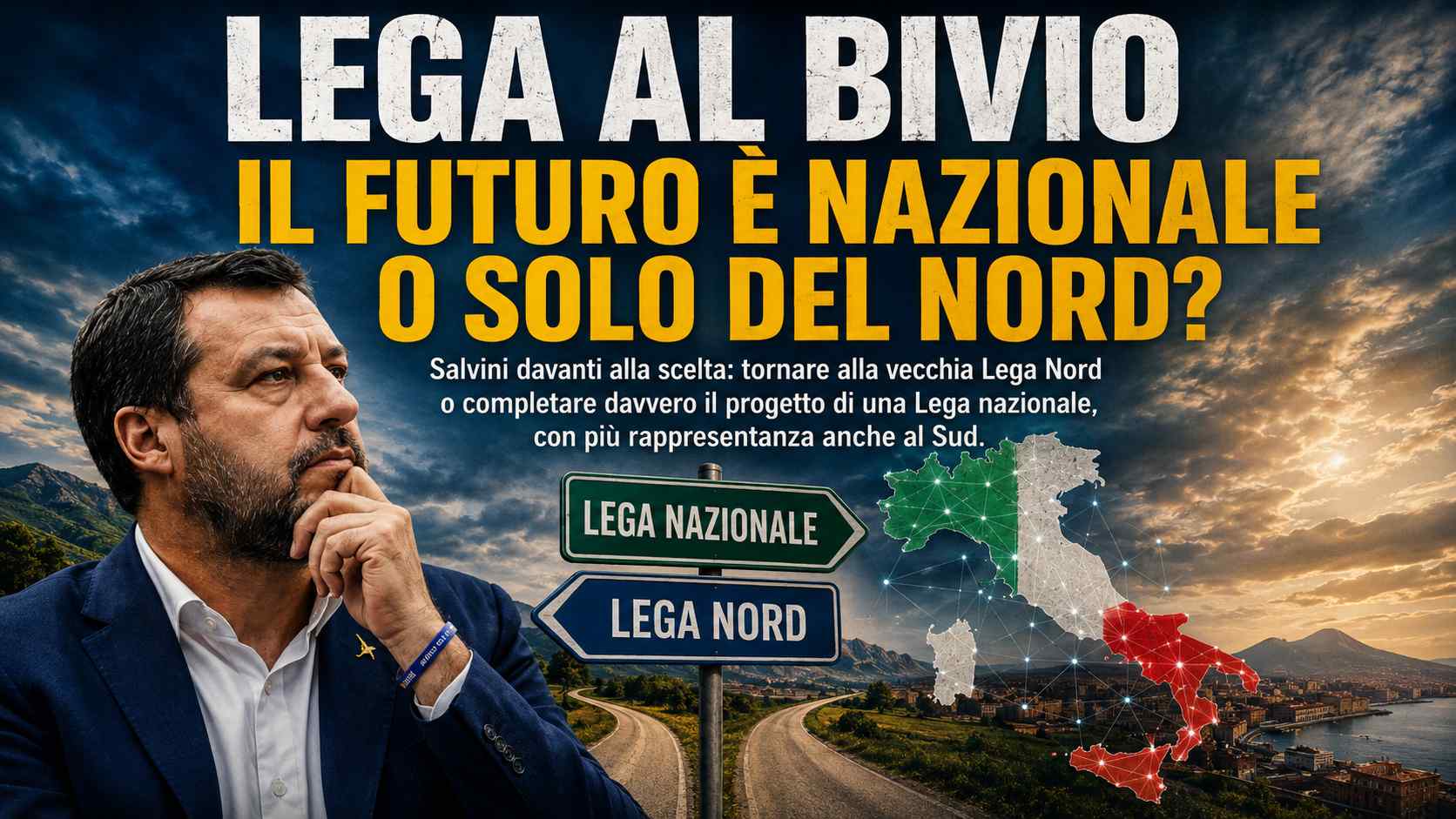
In the photo, a detail of the story.
The writer is not a member of the Northern League, nor is he a supporter of Matteo Salvini. He's simply a political observer who, looking at the conflict that's unfolding within the League, sees a much more interesting question emerging than the simple question: should Salvini stay or leave?
The real question is another: should the League return to being primarily the party of the North, or should it fully complete its transformation into a national force?
Because, if you look closely, Salvini's idea wasn't necessarily wrong.
The old Northern League had a clear limitation: it could have become very strong in Lombardy, Veneto, and the other northern regions, but it could hardly have aspired to be a major national force and, above all, to permanently lead the country.
Salvini tried to break that barrier.
He gradually erased the "North" from the national message, brought the party to Campania, Sicily, Calabria and Puglia and sought votes even in areas where, until a few years earlier, it would have seemed almost paradoxical to see the League competitive.
And it is precisely here that, perhaps, there was an interesting intuition.
A National League could have made sense
If the goal was to build a truly national party, then the project might have made sense.
A political force rooted in the North but capable of creating autonomous pockets of political power in the South as well , strong administrators, credible managers and territorial leaders capable of truly counting within the party.
At least one hopes that was the idea.
Because this is precisely the crucial step: being national doesn't simply mean getting votes from all over Italy.
It means distributing power throughout Italy.
This means that a leader from Campania, Puglia, Sicily, or Calabria can have the same political weight within the party as a leader from Lombardy or Veneto.
This means that the South is not just an electoral basin but also a place in which to build leadership.
If Salvini had imagined a League made up of several territorial centers of power—a very strong one in the North, others capable of emerging in the Center and South—then the idea was politically interesting.
The problem is that that transformation seems to have stopped halfway.
The South voted for the League, but how much did it count?
During its peak expansion, the League also gained support in Southern Italy.
But how many Southern leaders have truly become indispensable to the party?
Not how many were nominated.
Not how many got a seat.
Not as many as attended the rallies.
How many have become strong enough to influence a national decision?
How many can say to the secretary: "We don't agree with this choice"?
How many can impose a priority regarding the South?
Here the answer becomes much more difficult.
And this is probably the greatest limitation of Salvini's national project.
The League has expanded its electoral market, but has not built a truly national system of power at the same speed.
Would returning to the Northern League be the solution?
Today, a significant segment of the party is calling for greater attention to the North, greater emphasis on historic territories, and a return to the themes that shaped the Northern League's original identity.
It's an understandable request.
If a party loses part of its traditional electorate without consolidating a new one, sooner or later it must question its own identity.
But simply returning to the old Northern League would be a defeat.
It would mean admitting that the attempt to build a national strength has failed.
And perhaps it would even be a strategic mistake.
Because the problem wasn't necessarily trying to go national.
The problem may be that we haven't become enough.
The project had to be completed, not abandoned.
If you want to be a national party, you must create a strong leader in Campania.
You have to build one in Sicily.
You need to develop administrators in Puglia and Calabria.
You have to allow those managers to gain autonomy.
You even have to accept the risk that one day one of them might challenge the secretary.
Otherwise you are not building a national party.
You are simply exporting a Northern party to other territories.
And that's a huge difference.
A truly national League should be able to imagine, in the future, even a secretary from the South.
If this hypothesis seems absurd, then it means that the transformation has not been completed.
Salvini has two options today
The first is to go back.
Refocus on the North, recover territorial identity, autonomy, administrators, and traditional electoral base.
The second is much more difficult.
Continue on the national road, but really do it.
Not just by asking for votes in the South, but by distributing power.
Not just by nominating Southerners, but by building leaders capable of counting.
Not just by opening offices, but by creating leadership.
Because the true test of a national League is not how many votes it manages to get in Naples or Palermo.
It's whether one day a leader from Naples or Palermo will be able to sit at the same table as a governor from Lombardy or Veneto and have the same weight.
The real mistake might have been stopping halfway
Salvini could therefore find himself facing a paradox.
His mistake would not necessarily have been to transform the League.
It might have been that he only half- transformed her.
It expanded the party's electoral territory, but without managing to create an equally strong ruling class in all areas of the country.
And this is precisely what makes the project fragile today.
Because a League that returns exclusively to the North risks definitively scaling back its national ambitions.
But a League that continues to define itself as national without actually distributing power risks being perceived as a northern party simply seeking votes elsewhere.
The question, therefore, is not simply whether Salvini should continue to be the “Captain.”
The real question is another:
Does the League want to go back to being the party of the North or does it finally want to become the national party it promised to be?
Breaking News
When TikTok Becomes Reality: The Risk of a Society That Believes Everything That Appears on the Screen
More and more people are turning unverified videos, comments, and stories on social media into absolute truths.… Read more
Lotto draws for Saturday, August 22, 2026
Today's lottery draws, August 22, 2026, BARI 61 – 62 – 19… Read more
Extraordinary checks in the Spanish Quarters: 133 people identified
A joint operation by the Police, the Guardia di Finanza, and the Local Police has led to 7… Read more
Cardiac arrest: the challenge for first responders: the South must build a lifesaving network.
Southern Italy. A phone ringing. A notification on your smartphone. A few hundred meters away... Read more
Private healthcare in Campania: unions declare a state of unrest against the ban on hospital admissions.
Uil Fp and Fp Cgil react to the announcement of the suspension of scheduled hospitalizations in… Read more
Pozzuoli: Caritas opens housing assistance center following the tremors in Campi Flegrei.
After the tremors of July 31st, Caritas Pozzuoli opens a new center… Read more

National Newspaper
Registration No. 1301 of 2016 – ROC 030531
Director: Giuseppe Del Gaudio
To contact the editorial staff click HERE |
Download our Official ANDROID APP