Annarita Borelli, cinema beyond the set: from Pompeii to Vanzina, a story of memory and future
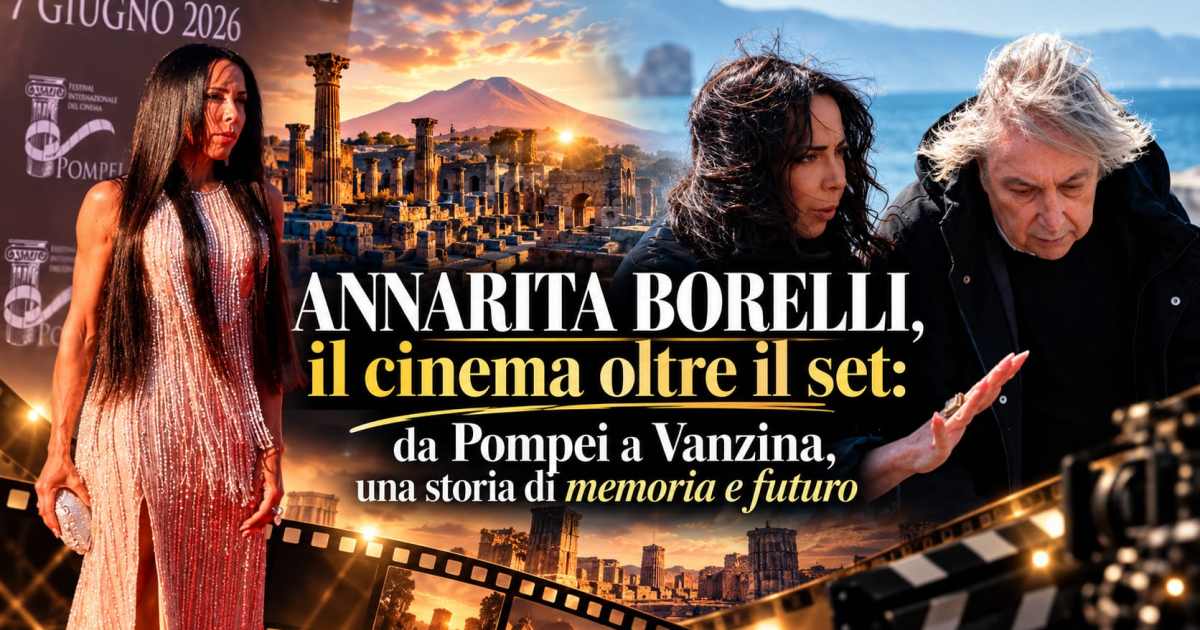
In the image, a reference to the narrated facts.
From chairing the Pompeii International Film Festival to Enrico Vanzina's set: for Annarita Borelli, her participation in La sera a Roma isn't just a brief acting stint, but a new chapter in a journey that intertwines production, direction, culture, and memory. At the center remains Pompeii, the symbolic site of a cinematic project destined to grow.
There's a thread that connects a film set, a camera, and Pompeii. It's the thread of memory.
And it is precisely around this concept that the path of Annarita Borelli, president of the Pompeii International Film Festival , creator of the event and protagonist of an experience on the set of La sera a Roma , the new film written and directed by Enrico Vanzina , expected at the Rome Film Festival on October 23, develops.
Annarita Borelli plays a Neapolitan noblewoman in the film. But it would be reductive to interpret this experience solely through the word "actress." For her, the set represents, above all, another opportunity to closely observe the complex mechanisms through which a film takes shape: from direction to photography, from framing to directing the actors, and even the relationship between artistic and technical expertise.
An experience that is part of a broader journey, in which cinema is not just acting, but also production, planning, direction, and cultural construction.
Her relationship with cinema finds one of its most significant expressions in the Pompeii International Film Festival, an event she conceived and presided over, under the artistic direction of Enrico Vanzina. The second edition took place from June 1 to 7, 2026, and featured a program of screenings, meetings, panels, international cinema, and a focus on younger generations.
"Being on set means experiencing cinema in its entirety."
In Vanzina's film, Annarita Borelli plays a character, but her attention inevitably remains that of someone watching the cinema even from behind the scenes.
"I believe that every talent, even when it belongs to the most intimate dimension of the person, needs to be cultivated and, above all, translated into experience.", he says.
And evenings in Rome become just that: an experience.
"Being in front of the camera is only part of what happens on set. I was also deeply interested in what was happening around me: the relationship between direction and photography, the construction of the shot, the organization of the shots, the direction of the actors, the coordination between the cast and crew."
A perspective that well describes the way Borelli looks at cinema: not as a sum of separate roles, but as an organism in which every professional contributes to the creation of the work.
«A film is born from the meeting of many skills, but it becomes a work of art only when those skills are brought together to form a vision».
From the set to the direction: Time Regained
That same vision was also put to the test in the making of Il tempo ritrovato, written and directed by Borelli and chosen as the visual manifesto for the second edition of the Festival. The work, presented at the opening of the 2026 Festival, addresses one of the themes that seems to run through the president's entire career: the relationship between cinema , memory , and time.
"Directing means having an internal image of the work and being able to harness different professionalism, sensibilities, and languages toward that image ," explains Borelli. From the choice of actors to the photography, from the technical cast to the pace of filming, every element must therefore respond to the same idea. It's a concept that finds a natural continuation in the Pompeii Festival.
The Pompeii Festival: Cinema as Memory
The Pompeii International Film Festival was born with a specific cultural mission: to use cinematic language to narrate and bring different identities into dialogue. The project was conceived by Annarita Borelli and artistically entrusted to Enrico Vanzina . The event was conceived as a bridge between past and present, with Pompeii as a symbolic place where cinema, culture, and identity meet.
"I don't consider cinema merely a form of entertainment. For me, it's first and foremost a powerful tool for memory: it possesses the extraordinary ability to free images, places, people, and stories from the dispersal of time."
And it is perhaps precisely here that Il tempo ritrovato , the Festival, and Vanzina's experience on set end up meeting. Cinema, in Borelli's vision, does not only serve to narrate the present. It can preserve what is at risk of disappearing and return it to future generations.
Pompeii is not a backdrop: it is part of the story
And in this vision, the territory plays a central role. " The territory is never just a backdrop. Places preserve identities, stratifications, and memories." Pompeii thus becomes much more than a location. It is the place where the relationship between time and eternity is already written into the city's very history. A dimension that the Festival seeks to transform into a contemporary language, bringing works, authors, professionals, and the public to the territory.
The second edition confirmed this approach through a program that combined the competing films with meetings dedicated to writing, journalism, language, culture, and the relationship between cinema and the territory.
For Annarita Borelli, therefore, the Festival's growth also depends on its ability to build a true cultural experience around cinema. "I want to build a recognizable filmography." This is the direction that seems to be emerging for her professional future as well.
"I want to build a recognizable filmography. Not through repetition, but through consistency." Identity, memory, the relationship between man and time, places capable of preserving stories: these are the themes that Borelli identifies as potential coordinates for his cinematic journey.
A filmography, therefore, born not from the need to occupy a space, but from the desire to develop a precise idea of cinema over time. And in this journey, the relationship with Enrico Vanzina also takes on a special significance.
"Enrico is the artistic director of the Pompeii International Film Festival, and our professional collaboration has spanned a variety of experiences over the years." From the Festival's cultural project to the set of La sera a Roma, our professional relationship has thus transformed into a journey of diverse experiences, while maintaining a common thread: the exchange of ideas about cinema.
From the Festival to the set, and from the set to the Festival
Her participation in La sera a Roma thus comes at a crucial moment in Borelli's career. She will be present as a performer on October 23rd, when the film premieres at the Rome Film Fest. But that evening, in her words, will only be a stage.
«I will be present at the preview as an actor in the film and will experience that evening with the feeling of someone observing a point on a journey, not a point of arrival».
Perhaps this is the key to understanding his presence in Vanzina's film. Not a change of direction, but a different perspective on the same world.
From the Festival to the set. From production to direction. From the organizational machine to the camera.
With Pompeii always in the background and, above all, at the centre of a cinematic idea that Borelli summarises in one sentence: «Cinema takes from time what deserves to remain».
Breaking News
Endoscopic ear surgery at San Paolo: a live international workshop strengthens training and innovation.
The 8th and 18th International Workshop on Endoscopic Ear Surgery concluded at San Paolo Hospital in Naples… Read more
Giulio Regeni, half-justice: three Egyptian 007s sentenced to 10 years in prison, one acquitted
The trial held before the Court of Cassation ended with a historic, albeit partial, ruling… Read more
Morandi in Naples to celebrate the 60th anniversary of 'There Was a Boy'
Gianni Morandi arrives in Naples for the penultimate leg of the summer leg C'ERA UN RAGAZZO… Read more
Garlasco murder: Parma RIS investigators knew Stasi was innocent; evidence was not included in the trial.
Pavia - Alberto Stasi could have been exonerated 19 years ago: the Parma RIS... Read more
Catapano leads SINch: innovation, training, and patient care at the heart of Italian neurosurgery
Naples celebrates the appointment of Giuseppe Catapano as president of SINch during the 75th Congress… Read more
Garlasco Murder: Investigations into Andrea Sempio concluded, new trial 19 years after the crime
Garlasco - Murder of Chiara Poggi: the Pavia Public Prosecutor's Office notified today... Read more

National Newspaper
Registration No. 1301 of 2016 – ROC 030531
Director: Giuseppe Del Gaudio
To contact the editorial staff click HERE |
Download our Official ANDROID APP
