Dog and cat meat in Italy: what the law really says and what precedents exist.
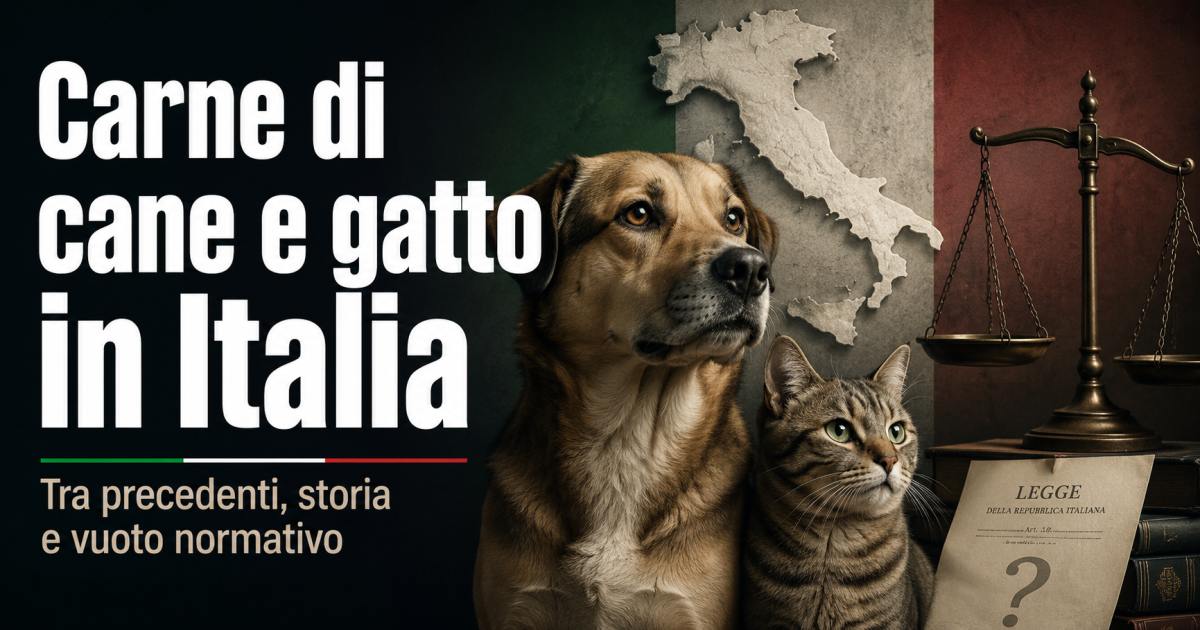
In the image, a reference to the narrated facts.
Eating dog or cat meat in Italy is a virtually nonexistent practice, alien to our contemporary food culture. Yet, delving into current events, history, and especially regulations, a less simple picture emerges than one might imagine.
There are, in fact, some documented precedents regarding the consumption of dog meat, while for cat meat we have to go back in time, through wars, famine, and popular traditions. And above all, there is an open question: in our legal system, there is currently no specific, autonomous crime that simply punishes the consumption of dog or cat meat.
The case of the cooked dog in Calabria
One of the best-known Italian episodes dates back to February 2018 and occurred in Briatico, in the province of Vibo Valentia.
According to contemporary reports, a 29-year-old Nigerian man was caught barbecuing a dog at a shelter. He reportedly found the animal dead on the roadside and then decided to cook it.
Some newspaper reports also claimed that the meat was consumed along with other residents of the center. However, it was not confirmed that the man actually killed the animal.
This is an important distinction, because talking about a real event is one thing; turning it into evidence of a widespread practice among African immigrants in Italy would be quite another.
In fact, there is no data demonstrating the existence in our country of festivals, rituals or organized customs in which African communities habitually consume dog meat.
In Nigeria consumption really exists
This does not mean, however, that the consumption of dog meat in Africa is a legend.
In some areas of Nigeria , for example, the phenomenon is scientifically documented.
A study published in 2023 in the journal Animals , conducted with the participation of the Department of Veterinary Medicine at the University of Bari, analyzed Nigerian dogs specifically intended for human consumption. The researchers themselves explain that dog meat is considered a specialty in some areas of the country.
A previous study conducted in the Calabar area of southern Nigeria also analyzed the relationship between the trade in dogs for human consumption and the risk of rabies. The researchers described the trade in stray dogs for human consumption as a widespread practice in that area.
The introductory report to a bill presented to the Italian Senate in 2018 specifically cited Nigeria, China, Vietnam, and Laos among the countries with traditions of dog meat consumption.
But we must avoid a simplification.
Saying that dog meat is eaten in some parts of Nigeria does not mean that all Nigerians do so , just as a regional tradition in Italy does not automatically represent the entire country.
Africa is a vast continent, made up of profoundly different societies, religions, and cultures.
And what about cats? In Italy, the story is different.
While dogs are not part of our gastronomic tradition, the historical context for cats is decidedly more complex.
In the collective imagination, the most famous area is that of Vicenza.
Even today the people of Vicenza are jokingly called “magnagati” , meaning cat eaters.
But even this tradition needs to be scaled down.
The Vicenza tourist consortium recalls that there are several popular explanations for the origin of the nickname and that there is no convincing historical evidence that it derives directly from the habit of the people of Vicenza of eating cats.
This does not mean that cats have never been eaten.
During periods of extreme poverty, and especially during World War II, the phenomenon was reported in various parts of Italy. There are reports that, when animals normally used for food became unavailable, even dogs and especially cats could become an emergency food source.
A historical reconstruction even recalls a 1943 circular from the Ministry of the Interior that prohibited the killing of cats for food, also to prevent the decline in the feline population from causing a proliferation of rats.
Piedmont, Langhe and countryside
Piedmont also preserves stories and testimonies related to the consumption of cats, especially in the countryside and during periods of great poverty.
In the Langhe, Monferrato and Asti areas, oral tales have survived according to which cat could be cooked and, in some cases, passed off as rabbit.
However, it is important to correctly define its nature.
This is neither an official specialty of Piedmontese cuisine nor a recognized dish from the Langhe tradition.
Rather, we are talking about a diet of necessity , belonging to a rural society very different from the contemporary one, in which during wars and famines people simply ate what was available.
The myth of the "Corbara rabbit" in Campania
An urban legend surrounding cat meat has been circulating in Campania for decades. In the Corbara and Valico di Chiunzi areas , it was said that some establishments, especially in the 1980s and 1990s, served cat meat, passing it off as rabbit.
The story was often enriched by the detail of a customer who discovered the deception by finding a paw with claws on his plate, prompting the intervention of the authorities.
However, there is no reliable judicial or medical evidence for this story . It should therefore be considered a typical urban legend, especially useful for understanding how deeply rooted the theme of the cat passing itself off as a rabbit has become in the Italian popular imagination.
Today there is no legal supply chain
In contemporary Italy, there is no authorized food supply chain for dog and cat meat.
There are no farms designated for this purpose, no authorized slaughterhouses, no veterinary procedures to place the meat on the market, or any normal possibility of selling it to the consumer.
A parliamentary report also recalled the ban on the import of dog and cat meat provided for by veterinary legislation and the impossibility of marketing them normally as food.
Deliberately slaughtering a dog or cat can also trigger criminal penalties for killing animals.
And this is where a legal paradox arises.
Eating dog meat is not a separate crime
The central question is this.
In Italy there are already numerous regulations that can affect killing, mistreatment, irregular slaughter, importation or marketing.
But there is not yet an autonomous criminal provision that simply states:
“It is forbidden to eat dog or cat meat.”
The Italian Parliament has raised this issue several times.
In 2018, bill no. 845 was introduced in the Senate, which would have introduced a specific ban on the consumption of dog and cat meat into the penal code, carrying a penalty of four months to one year and a fine of €1.000 to €5.000. The measure did not become law.
Another proposal from the 18th legislature even envisaged a ban on slaughter, trade, supply and consumption , with penalties of up to one year in prison and fines of up to 50.000 euros.
The issue has also come up again in the current 19th legislature.
Bill C.32 , presented in October 2022, proposes the introduction of Article 544-bis.1 of the Criminal Code to prohibit the slaughter, trade, administration and consumption of dog and cat meat.
As of the date currently available on the Parliament's website, however, it appears to have been assigned to the Justice Committee and its examination has not yet begun.
A void that deserves to be filled
And perhaps this is the point worth reflecting on.
Laws do not only serve to repress widespread phenomena.
They also serve to establish which values a society considers worthy of particular protection.
In Italy in 2026, dogs and cats are no longer perceived socially as animals intended for food.
They live in our homes, accompany children and the elderly, and are part of our families. Dogs also work alongside humans in rescue operations, law enforcement, assisting people with disabilities, and dozens of other roles.
This particular relationship does not make other animals morally “inferior” nor does it eliminate the complex debate on human nutrition.
But it means recognizing an evident social fact: our community attributes to dogs and cats the status of pets par excellence.
Precisely for this reason, it seems reasonable to ask why Italian law must continue to rely on a combination of health, veterinary, and animal welfare regulations without explicitly stating a very simple principle:
Dogs and cats are not slaughtered or eaten.
Not because there is an emergency in Italy today related to the consumption of their meat.
The known cases are very few and sporadic.
But because a rule can also have a cultural value.
Not a battle against other cultures
A clarification is essential.
The issue should not turn into a conflict between Italians and immigrants, nor become a pretext for attributing a certain behavior to an entire nationality.
Societies are constantly changing, and Italy, too, has a history of animal consumption that we would consider unthinkable today.
The cat itself reminds us of this.
The principle should be much simpler: anyone living in Italy respects the rules and fundamental values established by the community in which they live , regardless of their origin.
If our legal system considers dogs and cats to be pets, then it would be consistent to translate this consideration into an unequivocal rule.
No gray areas, no interpretations.
An explicit ban on slaughter and consumption, accompanied by the necessary sanctions.
Not to criminalize anyone, nor to rewrite history.
But to acknowledge what dogs and cats represent in Italian society today and transform this collective awareness into equally clear legal protection.
Breaking News
Naples: An illegal parking attendant was arrested for attempted extortion and found in possession of scissors.
A 27-year-old man, already known to law enforcement, was arrested by the State Police in… Read more
Villa Literno: 22-year-old Tunisian man arrested after argument
Carabinieri intervened in Villa Literno following a street fight: a Tunisian man… Read more
Abandoned waste: A van with Romanian license plates seized: the first raid since the Terzigno-Poggiomarino agreement.
The first operational result of the memorandum of understanding signed in recent days between the Municipalities of Terzigno... Read more
Porta Capuana, new security crackdown: increased controls and evening patrols.
New security crackdowns at Porta Capuana, one of the most important historic areas of the city center… Read more
Juve Stabia, Guerri's defense: "Just a technical misinterpretation."
Faced with the media coverage and the severity of the real and personal precautionary measures, Alfredo… Read more
Piazza Garibaldi: Four expulsions carried out by the Naples Police Headquarters
Naples – Yesterday, the State Police carried out an extraordinary service… Read more

National Newspaper
Registration No. 1301 of 2016 – ROC 030531
Director: Giuseppe Del Gaudio
To contact the editorial staff click HERE |
Download our Official ANDROID APP