Farage and the paradox of sovereignty: he wanted to liberate the United Kingdom, now he risks seeing it divided.
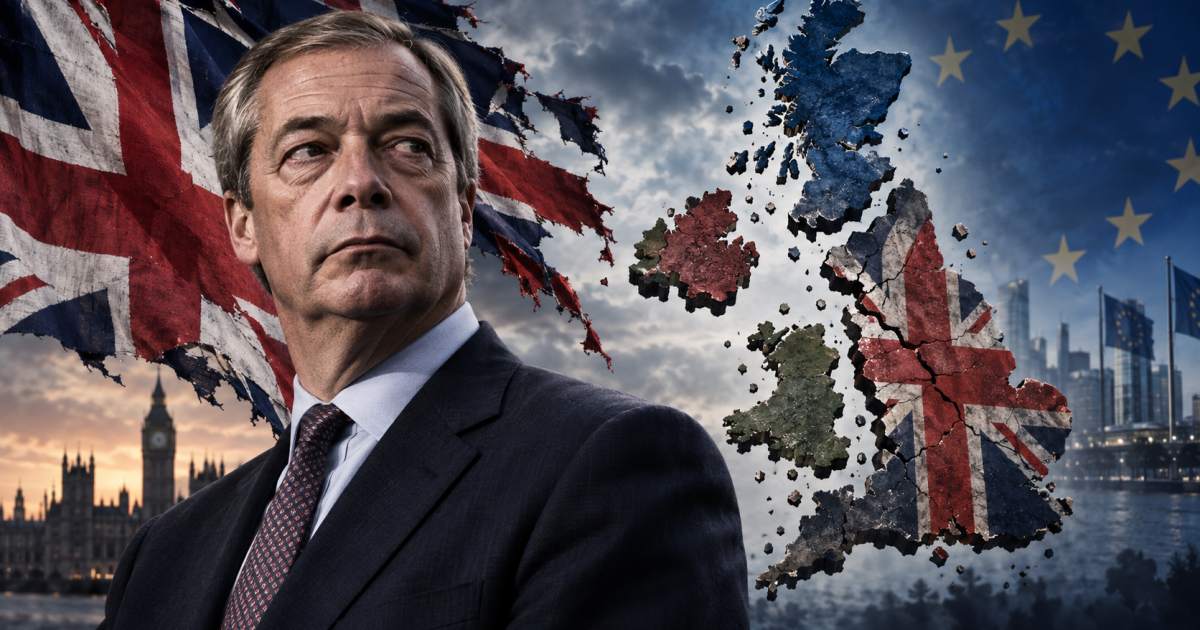
In the image, a context connected to the facts.
There's a huge paradox in Nigel Farage's political career. For years, he's built a crucial part of his political battle around one word: sovereignty . Taking back control, freeing himself from Brussels, giving the United Kingdom back the power to decide its own future.
Ten years after the Brexit referendum, however, the question becomes inevitable: sovereignty of what, if in the meantime the very unity of the United Kingdom is being called into question?
Farage was certainly not solely responsible for Brexit, nor can the 2016 referendum simply be called "his referendum." But it would be equally difficult to deny the central role the then UKIP leader played in the long campaign that led to the UK's vote on June 23, 2016.
Leave won by 51,9% to 48,1% and Farage became one of the political symbols of that victory.
Ten years on, however, British public opinion appears profoundly different.
An Ipsos poll from April 2026 found that 54% of Britons now consider the decision to leave the European Union to be wrong , compared to 31% who still consider it the right one. 52% also describe Brexit as more of a failure than a success.
This doesn't mean that all those who voted Leave regretted it: among the 2016 Leave voters themselves, a clear consensus remains that their choice is positive. But it does mean that, looking at the British population as a whole, the prevailing view today is that leaving the Union was a mistake.
Sovereignty conquered and the Union creaking
On September 14, 2026, something politically significant happened.
In Cardiff, the leaders of the SNP, Plaid Cymru and Sinn Féin signed an agreement in which they assert the principle of self-determination for Scotland, Wales and Ireland.
It is important to be precise: this does not mean that three governments have already decided to call as many referendums and the signatories participated in the initiative in their capacity as party leaders, not as institutional representatives of their respective governments.
The constitutional situations of Scotland, Wales and Northern Ireland are also profoundly different.
But one politically significant fact remains: three important nationalist forces have decided to jointly raise the issue of the constitutional future of their respective nations.
And this is where the great paradox returns.
For years we were told that the problem was Brussels.
That we needed to “take back control”.
That a nation was truly free only when no one else could interfere in its decisions.
But what happens when, once that sovereignty has been recovered, parts of the nation itself ask to leave?
But does absolute sovereignty really exist?
Perhaps we should start from this very question.
No one in the contemporary world is truly sovereign in the absolute meaning that certain propaganda attributes to this word.
The UK is not.
Italy is not.
Not France, Germany or any other European country.
And, to a varying extent, even the great powers cannot simply ignore everything that happens around them.
Every state lives within a network of economic, commercial, financial, energy, military and diplomatic relations.
We need to sell products to others.
We need to buy raw materials from others.
We need agreements on security, on energy, on communications, on investment, on research, on trade.
A country can choose to be more or less integrated with others. It can decide which skills to share and which to retain.
But to think that simply raising a wall is enough to suddenly become the absolute masters of one's own destiny is confusing a slogan with reality.
Absolute sovereignty is a much easier concept to pronounce at a rally than to practice when the time comes to govern.
A wall doesn't necessarily make you stronger
This is one of the most dangerous misunderstandings in contemporary politics.
The idea that being smaller automatically means being freer.
That having fewer interlocutors means having more power.
That closing oneself off means being safer.
It doesn't necessarily work that way.
Because while you build a wall on one side, on the other you continue to need someone.
You can leave the European Union, but you will still need the European market.
You can claim full trade autonomy, but you will still have to negotiate trade agreements.
You can proclaim complete political independence, but you will remain dependent on international financial markets, energy supplies, military alliances, technologies, and production chains.
Politics is precisely about managing these interdependencies.
The serious question is therefore not simply:
“Are we sovereign?”
The question should be:
“How much real power do we have, and how can we best exercise it together with others?”
They are two profoundly different things.
Governing means above all holding together
There is another issue that is often forgotten.
Governing a complex reality is difficult.
Governing a neighborhood is generally easier than governing a city.
Governing a city is easier than administering a nation of tens of millions of people, with different territories, cultures, economies, and interests.
And it is precisely this difficulty that distinguishes politics from propaganda.
Dividing is relatively simple.
Saying “us against them” is simple.
Spotting an enemy is simple.
Promising that by eliminating that enemy everything will work better is even easier.
To govern instead means to mediate.
It means accepting compromises.
It means bringing people with different interests together at the same table.
Sometimes it means giving up something to prevent the whole system from breaking down.
Governing by force, imposing everything with weapons and repression, belongs to the logic of dictatorships.
Democratically governing a large community means being able to convince different people that, despite their differences, staying together produces more benefits than separating.
And it's much more difficult.
The strength of a great nation
Maybe we should revisit this very concept.
A great nation is not great simply because it has a powerful army, because it controls borders, or because it can proclaim that it takes orders from no one.
A great nation is such also when it manages to hold together different realities.
When he builds compromises.
When it prevents every difference from automatically turning into a separation.
When it manages to simultaneously represent rich and poor territories, cities and countryside, young and old, majorities and minorities.
This is immensely more difficult than creating a community made up only of like-minded people.
It is easy to govern a fence built around one's identity.
It is much more difficult to govern a country.
And it is precisely this ability that has distinguished many of the great powers for centuries: being at the center of complex international relations, creating alliances, mediating interests, and exercising influence precisely because they represented something bigger than their own small backyard.
The dream of small potentates
The feeling, observing some of the new European sovereignist and identitarian movements, is almost the opposite.
There seems to be a desire emerging to carve out an ever smaller space in which everyone shares the same idea of the world.
Before, Europe would be too big.
So let's go back to the nation.
But then a part of the nation thinks differently.
Then that region claims its sovereignty.
Then, even within the region, there will be cities, territories, and communities with different interests.
Where does this process end?
This is the great contradiction of fragmentation.
Taken to its extreme, the principle that each community must be completely sovereign because it does not want to be conditioned by the larger one potentially leads to continued division.
From Europe to the nations.
From nations to regions.
From regions to local communities.
To the point of transforming the modern idea of the State into a collection of small potentates.
Almost a return, naturally in completely different forms, to a political logic reminiscent of that of medieval Europe: small kingdoms, small territories, small centers of power, each convinced that it was finally sovereign because its own border had become closer.
But being smaller doesn't necessarily mean being more powerful.
Very often it means exactly the opposite.
The great paradox of Brexit
And this is where the British case becomes emblematic.
Brexit was also portrayed as the return of British sovereignty.
“Take back control”.
Taking back control.
But sovereignty is not a magic formula.
It only makes sense if there is a political community upon which to exercise it.
If London reclaims powers from Brussels but at the same time Edinburgh wants to reclaim them from London, Cardiff asserts its right to self-determination, and in Northern Ireland the debate over the reunification of the island continues, the result is a clear political short circuit.
What is the value of gaining sovereignty externally if at the same time the challenge to the sovereignty of the center internally increases?
It is a question that directly affects the political project represented by Farage.
Because the leader of Reform UK continues to use sovereignty, control and national independence as key elements of his political proposition.
But today the issue is no longer just how much sovereignty the United Kingdom possesses in relation to Europe.
The question becomes:
which United Kingdom?
A more independent country or simply a smaller one?
Here emerges probably the most politically interesting contradiction of the entire season that began with Brexit.
A project designed to make the United Kingdom more autonomous from Europe now coexists with political movements calling for greater autonomy from the United Kingdom itself.
Of course, it would be incorrect to argue that Brexit created Scottish, Welsh or Irish independence out of thin air.
The referendum on Scottish independence was held in 2014.
The Irish constitutional question has much older roots.
Welsh nationalism also long predates Brexit.
But Brexit has changed the context in which these demands are discussed.
And above all it shows a conceptual contradiction.
If the principle is:
“a community must be able to decide for itself because no one from outside should impose choices on it” ,
it becomes inevitable that someone else might use the same principle against you.
If Westminster could tell Brussels:
“we want to decide for ourselves” ,
Edinburgh can answer:
“we also want to decide for ourselves.”
And at that point sovereignty ceases to be the solution and becomes the problem itself.
When the slogan meets the consequences
This is probably one of the limits of politics built on absolute words.
Sovereignty.
Independence.
Borders.
Check.
These are powerful concepts because they transform extremely complex problems into understandable messages in seconds.
But governing means having to deal with the consequences.
It means understanding that every decision produces a reaction.
That every closed border creates a new relationship to be negotiated.
That every regained power carries with it a responsibility.
That every separation solves some problems and inevitably creates others.
And above all, it means understanding that politics shouldn't aim to create an ever-shrinking territory in which those in power find no one willing to contradict them.
It should do exactly the opposite.
It should be able to create a space large enough for different people to continue to live together.
This is the hard part.
Britain facing its own history
Of course, no one can say today that the United Kingdom is necessarily destined to dissolve.
There is no certainty that Scotland will become independent.
It is not certain that Wales will leave the Union.
It is not automatic that Northern Ireland will join the Republic of Ireland.
Presenting these scenarios as inevitable would be wrong.
But the fact that the constitutional issues of the three nations are simultaneously part of the political debate makes it much more interesting to ask what happened after Brexit.
The United Kingdom, which in 2016 decided to leave the European Union to "take back control," must now also confront those within its borders who claim exactly the same principle.
And perhaps here the most important lesson emerges.
Destroying a balance is much easier than building a new one.
Creating a border is relatively simple.
Building a community that can overcome it is difficult.
Separation may require a referendum.
Staying together, however, requires politics every day.
It requires compromise.
It requires skill.
It even requires a willingness, at times, to accept a decision we don't like because the price of unity is precisely the recognition that we can't always get everything we want.
Nigel Farage has built a fundamental part of his political career around the idea that the United Kingdom must reclaim its destiny.
Today other political leaders are using virtually the same principle to argue that Scotland, Wales and Northern Ireland should be able to choose their own.
This is the great paradox.
Perhaps the true strength of a nation does not consist in being small enough to no longer have to compromise with anyone.
It consists exactly in the opposite:
be big enough, authoritative enough, and politically mature enough to be able to bring together people who don't think alike.
Because if every time we disagree with someone the solution becomes building a new border, in the end we will not have gained greater sovereignty.
We will only have built ever smaller kingdoms, ever more numerous walls, and ever less relevant countries in a world that, like it or not, continues to be profoundly interdependent.
Breaking News
Naples, attempted murder in Molosiglio: 19-year-old with no criminal record arrested
Naples – One word too many, an argument between youngsters that risks escalating, and the… Read more
Today's horoscope for September 20, 2026, by Paolo Tedesco
Dear astrology enthusiasts, welcome to today's forecast. Sunday... Read more
Naples, another robbery at the 'La Birreria' shopping center: the Piazza Italia store was burgled.
Naples - There's no peace for the "La Birreria" shopping center in Miano. Just… Read more
SuperEnalotto: No 6s in the September 19st draw, jackpot at €30,4 million
Superenalotto, here's the winning combination: 20 - 42 - 45 - 48 - 68 - 85 Number… Read more
10eLotto Winning Numbers for Today, September 19, 2026
In this evening's 10elotto draw, the following numbers were drawn: 03 – 06 –… Read more
Campi Flegrei: Doctors request a state of emergency to ensure local healthcare.
Solidarity with the citizens of Campi Flegrei and a call to action by the institutions: the OMCeO Napoli initiative arrives in… Read more

National Newspaper
Registration No. 1301 of 2016 – ROC 030531
Director: Giuseppe Del Gaudio
To contact the editorial staff click HERE |
Download our Official ANDROID APP