United Kingdom? No, Kingdom Divided!
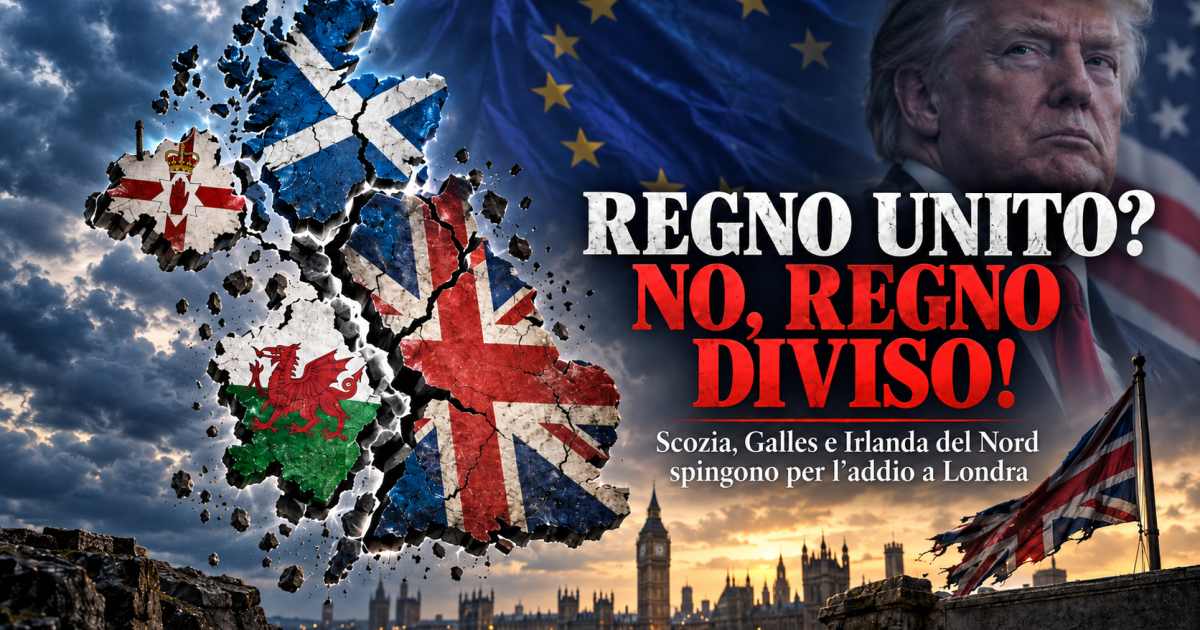
In the image, a detail related to the story.
For centuries we called it the United Kingdom. Today, perhaps it would be more correct to begin asking how much "united" it really is.
Because what's happening in the British Isles no longer resembles merely the cyclical debate over Scottish independence or the historic Northern Ireland question. This time, Scotland, Wales, and Northern Ireland simultaneously find themselves with political leaders openly in favor of a future outside the current United Kingdom.
And it's an unprecedented situation.
On September 14, in Cardiff, the leaders of the Scottish National Party, Plaid Cymru, and Sinn Féin signed a joint memorandum. John Swinney for Scotland, Rhun ap Iorwerth for Wales, and Mary Lou McDonald and Michelle O'Neill for Sinn Féin committed to a very simple principle: each of their nations must be able to democratically decide its own future.
In the document, they argue that no Westminster government should be able to prevent this choice and call on the British government to prepare, plan, and facilitate any constitutional changes. Even more significant is the section dedicated to Europe: according to the signatories, Brexit would have damaged economies and opportunities, and the future of their nations should lie within the European Union.
It doesn't mean the United Kingdom will disappear from the map tomorrow morning. Nor does it mean three referendums have already been called.
But it means something that, politically, may be even more important: for the first time, the main independence movements of the three peripheral nations of the Kingdom have decided to coordinate and present the constitutional question as a common problem.
The cork blown by Trump
Then came Donald Trump.
During his visit to Ireland, the American president openly stated that he would like to see a united Ireland and that, in his opinion, it will happen sooner or later. He called unification a "fantastic" prospect and, when asked about Scotland, he didn't close the matter: he simply replied that he would talk about Scotland "later."
Huge words.
Not because Trump can decide the future of Northern Ireland—of course he can't—but because a US president has chosen to directly intervene in one of Europe's most delicate political balances.
The Good Friday Agreement establishes a clear democratic path for any change to Northern Ireland's status: citizens will decide, and any reunification would have to be decided by referendum. London maintains that the necessary political conditions for such a referendum do not yet exist.
Trump, however, did what he often does best: he popped the cork.
He spoke out loud what until a few years ago would have remained confined to Sinn Féin conferences, SNP meetings or Welsh independence gatherings.
A crisis that comes from afar
Of course, it would be simplistic to blame everything on Trump.
The crisis of British unity goes back much further.
Scotland already voted on independence in 2014. The “No” vote won, but Brexit has since arrived, despite a large majority of Scots voting to remain in the European Union.
The Scottish Government continues to maintain that, in the event of independence, Scotland would have to ask to rejoin the EU.
In Wales, Plaid Cymru has elevated the independence issue from a quasi-identity-based issue to a concretely political one. In its platform, it called for the powers needed to decide the timing and modalities of a possible referendum to be transferred to Cardiff. The House of Commons Library itself now recognizes that the question of the possible secession of Scotland and Wales is fully part of the British constitutional debate.
And then there is Northern Ireland, where Brexit has reopened wounds and questions that seemed at least partially frozen by the peace process.
The unification of Ireland is no longer just a historical flag.
It has once again become a political possibility.
So what, Farage?
Here emerges one of the most interesting contradictions of this political season.
Nigel Farage has built much of his political career on the idea of sovereignty.
“Taking back control.”
Decide at home.
Free yourself from Brussels.
Defending the right of a people not to be governed by institutions considered distant.
Principles that fueled Brexit and a significant portion of the new European right.
But what happens when the same reasoning is used by Edinburgh, Cardiff or Belfast against London?
If sovereignty is an absolute value when the United Kingdom wants to take competences away from Europe, why should it cease to be so when Scotland wants to take competences away from Westminster?
If “the people must decide” was a valid slogan for Brexit, why shouldn’t it be a valid slogan for the Scots, the Welsh, or the people of Northern Ireland?
This is where sovereignism encounters its own paradox.
Because every sovereignism must sooner or later answer a question: which sovereign?
The United Kingdom?
Scotland?
Wales?
Northern Ireland?
England?
If the answer is simply "ours," then we're no longer dealing with a universal principle. We're dealing with a political interest.
Preach potatoes and eat meat
It's a contradiction that runs through much of the nationalist and sovereignist wave of recent years.
They preach borders, homeland, self-determination, national identity, and the primacy of the popular will. But these same concepts suddenly become dangerous when used by someone else.
It's a bit like preaching to others to eat potatoes while, under the table, you continue to eat meat.
And it's not just about Farage.
It is a much broader contradiction of the new Western right: challenging supranational structures in the name of nation-states without asking what happens when, within those same states, there exist other nations claiming exactly the same right.
The United Kingdom is probably the perfect laboratory for this contradiction.
From the United Kingdom to the Divided Kingdom?
The historical paradox is striking.
Brexit was supposed to restore sovereignty and unity to the United Kingdom.
It might instead be remembered as one of the events that accelerated its internal divisions.
Today the leaders of the SNP, Plaid Cymru and Sinn Féin jointly declared that “the time of Westminster is coming to an end” and explicitly pointed to Europe as the future of their respective nations.
It's almost a perfect reversal.
The United Kingdom is leaving Europe to regain its sovereignty, and some of its member nations are beginning to imagine leaving the United Kingdom precisely to return to Europe.
The story has a particular taste for irony.
Trump and the free-for-all world
Trump didn't create all this.
Independence movements existed before him, the Irish question has existed for generations, and the crisis in relations between the British nations long precedes his return to the White House.
But Trump seems to have a precise political characteristic: he makes explicit contradictions that traditional diplomacy preferred to manage silently.
It breaks conventions.
Say what others avoided saying.
It calls into question balances that seemed to be acquired.
Sometimes it produces results. Other times it produces instability. Often both at the same time.
For this reason, he could be remembered not only for the decisions taken by the United States, but for having helped accelerate an era of divisions, redefinitions and conflicts between sovereignties.
Perhaps all this was already in the air.
Perhaps Trump is just the straw that broke the camel's back, a camel that has been filled for decades.
Perhaps there are much more profound economic and geopolitical transformations that we are still trying to understand.
But the feeling is that of a great “free for all”.
Old certainties no longer seem certain.
Historical alliances are being called into question.
Borders are once again becoming a political issue.
States that seemed eternal suddenly discover that they are not.
And the very country that made the word “United” part of its name could become the most striking symbol of this new era.
United Kingdom?
Maybe for a long time to come.
Maybe not.
But, for the first time in decades, calling it a Kingdom Divided no longer seems like just a provocation.
Breaking News
The Sarno River Regional Council meets in extraordinary session: a showdown on cleanup and safety will take place on October 1st.
Naples — A never-ending environmental emergency, decades of promises, and a plan of extraordinary interventions that… Read more
San Gennaro in sfoglia: Pintauro creates the miracle dessert
Naples — There's a moment every September when Naples holds its breath and listens… Read more
The Night of the Tammorra rekindles Piazza Mercato: Naples rediscovers its memory through drums, dances, and new generations.
For two days, Piazza Mercato was transformed into a large open-air stage,… Read more
Campania, schools at risk: only 12 out of 100 buildings have a certificate of habitability.
In Campania, public schools lag behind in structural safety, sustainability, and quality of services.… Read more
Scams targeting elderly people and a priest: Neapolitan couple stopped on the A2
Salerno - A 38-year-old man and a 35-year-old woman, both Italian and… Read more
Fighting dogs in Sicily and Campania for illegal gambling: six under investigation
Gela - They organized clandestine fights to fuel an illegal gambling network: it was discovered… Read more

National Newspaper
Registration No. 1301 of 2016 – ROC 030531
Director: Giuseppe Del Gaudio
To contact the editorial staff click HERE |
Download our Official ANDROID APP