Calore Valley and Inland Cilento: Neapolitan Pastiera amidst villages, wheat, and spring.
In the secluded landscape of inland Cilento, Neapolitan pastiera ushers in spring with its crumbly dough, cooked wheat, and the scent of orange blossoms.

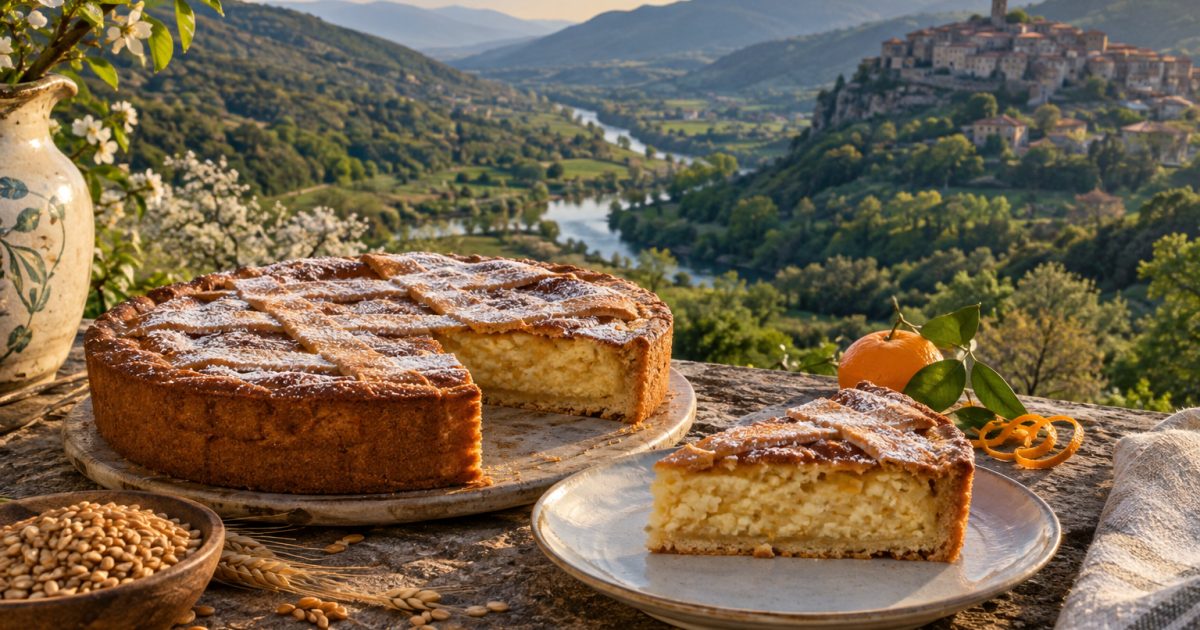
Between the Calore gorges and the villages of inland Cilento, the Neapolitan pastiera brings the spring calendar to the table, linking the Campania landscape to a dessert made of wheat, ricotta and citrus aromas.
The Calore Valley opens onto a landscape marked by water, hills, and roads that ascend to small inland towns. The Calore Salernitano River flows through a landscape of forests, rocky cliffs, farmland, and narrow valleys, while further south, the Cilento hinterland retains a rural feel far removed from the rhythms of the coast. Here, the journey extends beyond monuments and panoramas: it also passes through household pantries, ovens lit on holidays, and recipes prepared in advance.
Pastiera is a Neapolitan tradition, but its presence on tables throughout Campania speaks to a broader regional tradition. During the Easter period, the dessert becomes a symbol of anticipation and sharing. Its preparation requires time: the wheat must cook slowly, the shortcrust pastry must rest, and the filling must be mixed together without losing its consistency. These are steps suited to home cooking, where precision depends not only on the scales but also on experience.
The landscape that enters the kitchen
Inland Cilento, cuisine maintains a direct relationship with seasonality. Wheat recalls the cereal culture of the hilly areas and plains of Campania; ricotta is part of the regional cheesemaking tradition; citrus fruits, with their bright notes, break the sweetness and give depth to the filling. However, pastiera is not a synthesis of the region in the sense of a recipe born exclusively in the Calore Valley: rather, it is a Neapolitan dessert adopted and reinterpreted within the broader Campanian gastronomic heritage.
In the inland villages, the relationship with food is also evident in the layout of the houses, the small vegetable gardens, the hillside countryside, and the produce preserved for the coming months. Pastiera is part of this celebration: it's prepared in advance, left to cool, and served once the aromas have had time to meld. Its aroma, fresh from the oven, combines the fragrance of the pastry with the sweetness of the wheat and a subtle floral note.
Pastiera ingredients and steps
For a pastiera measuring approximately 24 centimeters, you'll need simple ingredients, but their quality will impact the final balance. For the shortcrust pastry, you'll need:
- 300 grams of flour;
- 150 grams of butter or lard, according to family tradition;
- 130 grams of sugar;
- 2 egg yolks and 1 egg;
- a pinch of salt.
For the filling you will need:
- 250 grams of cooked wheat;
- 200 milliliters of milk;
- 30 grams of butter;
- 500 grams of well-drained ricotta;
- 250 grams of sugar;
- 4 eggs;
- 50-70 grams of candied fruit, preferably orange and citron;
- orange blossom water, in moderate quantities;
- grated lemon zest and, if desired, a small amount of cinnamon.
We start with the shortcrust pastry. The flour should be quickly mixed with the cold butter, sugar, salt, and eggs, avoiding overheating the dough. After shaping it into a ball, it is wrapped and left to rest in the refrigerator for at least half an hour. This step makes the dough easier to roll out and reduces the risk of it breaking during baking.
In a saucepan, heat the cooked wheat with milk and butter. The mixture should become soft and creamy, without turning completely smooth: the presence of the grains is part of the typical consistency of pastiera. Once cooled, combine with the sifted ricotta and sugar. Then add the eggs, one at a time, along with the candied fruit, lemon zest, and orange blossom water.
The pastry is rolled out and lined with a buttered baking pan, leaving a clean edge. Pour the filling in, but don't go all the way to the edge, as it tends to swell during baking. Cut the remaining pastry into thin strips and arrange them in a grid pattern on the surface. Bake the pastiera in a conventional oven at about 170-180°C (340-350°F) for an hour, checking the color: it should be golden, not dark, and the center may wobble slightly before cooling.
Resting is part of the recipe. Once cooled, the pastiera acquires its aroma and firmness; for this reason, it is often prepared the day before. Powdered sugar, added just before serving, completes the appearance without obscuring the grilled pattern. When cut, the slice should reveal a moist but firm filling, with recognizable wheat grains and a crumbly pastry crust.
A slice between valley and villages
Tasted in the context of inland Cilento, pastiera invites you to slow down. It's not a dessert to be consumed absentmindedly: it demands attention to its alternating textures, from the crumbly shell to the creamy core, and to the aromas that emerge one after the other. Orange blossom water opens the mouthful, ricotta supports its softness, wheat adds a full and slightly rustic note, while candied fruit adds subtle citrus accents.
Outside of holidays, the memory of pastiera remains tied to the geography that welcomed it: the Calore River, the inland roads, the slopes of Cilento, and the villages where cuisine continues to follow the rhythm of the seasons. In this landscape, the Neapolitan recipe does not lose its identity; instead, it becomes a way to experience Campania through a homely table, a blazing oven, and the scent of spring.
Breaking News
Naples and Campania weather today, September 29: more sunshine and mild temperatures
The day began with good weather in Naples and for the most part… Read more
Car thefts and tourist robberies in Palinuro, five arrests made
Salerno - A wide-ranging offensive against predatory crime in Cilento. This is what... Read more
Naples: Seized drug dealing hub reopened; two arrests in Soccavo
Naples - It had been seized only a few months ago, but someone has apparently tried to put it back… Read more
Naples, heart failure donation at Monaldi Hospital: liver and corneas removed
A technically complex, non-cardiac donation was successfully completed at Monaldi Hospital in… Read more
The Municipality of San Tammaro is seeking a highly qualified manager for Technical Sector 2 (Urban Planning, Construction, Heritage, and Maintenance).
The Municipality of San Tammaro announces a fixed-term appointment for an EQ Manager… Read more
Naples, September 29, 1943: rain, fire, and grassroots resistance
A street scene, tanks, and grassroots resistance: Naples on September 29, 1943,… Read more

National Newspaper
Registration No. 1301 of 2016 – ROC 030531
Director: Giuseppe Del Gaudio
To contact the editorial staff click HERE |
Download our Official ANDROID APP
