Laceno, between woods and plateaus: pasta frittata in the Picentini landscape
In Laceno, where the Picentini Mountains' forests surround the Bagnoli Irpino plateau, the pasta frittata becomes a practical, convivial, and profoundly Campanian dish.

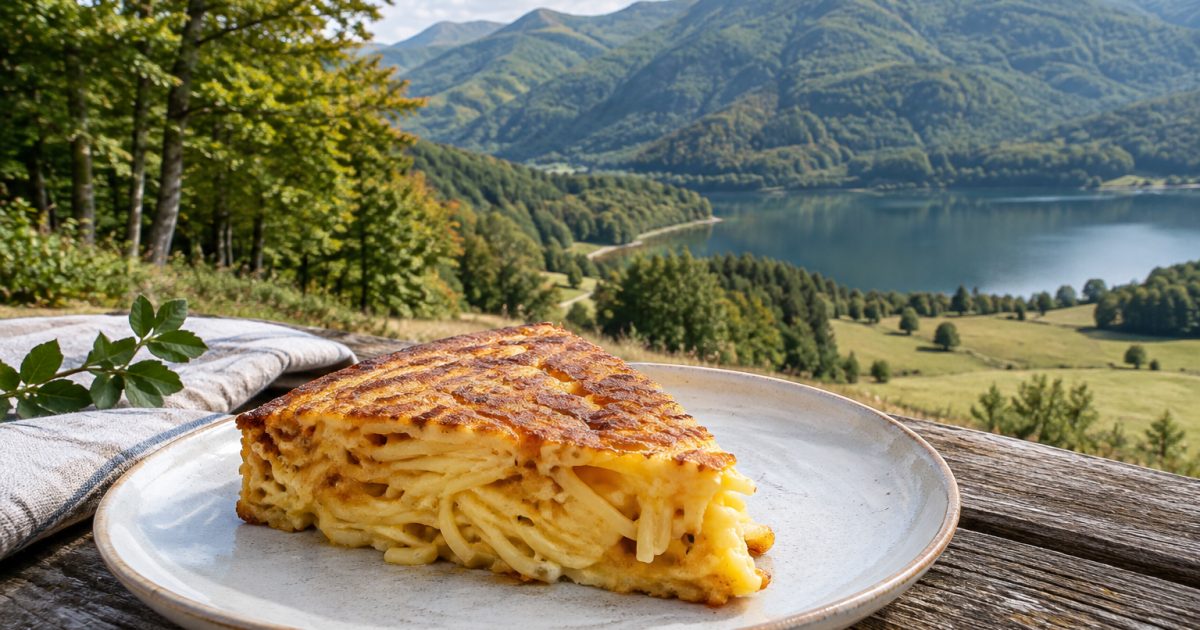
In the Laceno landscape, among beech forests, clearings, and mountain air, the pasta frittata brings with it a domestic cuisine based on recovery, moderation, and sharing.
Laceno is a plateau in the Bagnoli Irpino area, in the Avellino province, surrounded by the Picentini Mountains. Here, Campania changes pace: the mountainous profile replaces the coastline, roads climb through woods and pastures, while the cooler climate invites slower stops and food that travels well.
The landscape is marked by the presence of the lake and the large forested areas that rise toward the peaks of the massif, in an environment where water, stone, and wood create a geography distinct from that of the plains. In summer, the plateau offers trails and clearings; in the colder months, the connection with the mountains becomes more intimate, linked to the warmth of the homes and the hearty dishes.
In this context, the pasta frittata doesn't need rare ingredients to express its local flavor. It's a dish born from the clever use of leftovers, especially spaghetti or other cooked pasta, combined with eggs and cheese. Its strength lies in its texture: a golden surface, a soft yet firm interior, the aroma of the egg cooked alongside the pasta, and a slice that can be served hot, warm, or cold.
Laceno between beech forests, water and altitude
Reaching Laceno means crossing inland Campania, far from the coastal routes and densely populated landscapes. From Bagnoli Irpino, the road leads toward the plateau, while the surrounding Picentini forests open up, with beech trees predominating at higher altitudes. The view changes with the seasons: in spring, soft greens dominate, in summer the shade of the beech trees offers shelter, in autumn the ground is colored with leaves, and in winter the landscape can take on a stark and silent aspect.
Laceno Lake, with its mountainous basin, contributes to making this area recognizable. It's not just a point to be observed, but a presence that suggests a specific way of being outdoors: walking slowly, stopping, preparing a simple lunch. A well-cut pasta frittata lends itself to this gesture because it holds its shape, is easy to transport, and doesn't require any added condiments.
The connection with Campanian cuisine is therefore concrete but not exclusive. The recipe is part of regional domestic culture, from Naples to the inland areas, and changes depending on what's in the pantry. On the Picentini plateau, however, it takes on a special meaning: it's a dish for a break, for informal meals, and for a cuisine that doesn't waste.
How a compact pasta omelette is made
For four people, you'll need about 320 grams of cooked spaghetti or bucatini, four eggs, 60 grams of grated cheese, preferably Parmesan or a mix of moderately aged pecorino, black pepper, and salt to taste. You can also add 100 grams of well-drained mozzarella, cut into small cubes, or a few diced salami. These last ingredients are not essential: the most basic version remains the one with pasta, eggs, and cheese.
- Cook the pasta al dente in salted water, drain, and let it cool. If using pre-made spaghetti, it's important that it's not too seasoned or moist.
- In a bowl, beat the eggs with the cheese, a pinch of pepper, and a pinch of salt, taking into account the saltiness of the cheese and any added ingredients.
- Add the pasta to the mixture and stir thoroughly, so that the egg coats the spaghetti. Only then add the mozzarella or salami, if using.
- Heat a shallow pan with a drizzle of oil. Pour in the mixture and spread it out without pressing it down too much.
- Cook over medium-low heat for several minutes, until the bottom is set and a golden crust has formed. Flip the frittata using a flat plate or a lid, then finish cooking the other side.
The key factor is temperature. Too high a heat will burn the surface before the inside is cooked; a moderate flame, on the other hand, allows the eggs to bind the dough without drying it out. After flipping, the frittata should remain firm but not dry. Before cutting, let it rest for a few minutes: the residual heat stabilizes the slice and enhances the aromas.
For a thicker version, you can use a smaller pan, while a larger pan will yield a thinner frittata with a crispier surface. The choice depends on the occasion: the former is better served at the table, while the latter cools quickly and is convenient for an outdoor meal. In both cases, the best result comes from pasta that isn't overcooked and a balanced sauce.
A Campanian break on the roads of the plateau
This pasta frittata is a perfect accompaniment to a tour of the Laceno area because it doesn't require a complex preparation time. It can be prepared ahead of time, wrapped once cooled, and cut on the spot, along with bread, fruit, and some local produce. To preserve its texture, it's best not to wrap it while it's still hot: the steam would make the surface moist.
Its convivial atmosphere is in keeping with the unique setting of the Picentini Mountains. Here, food shouldn't compete with the view, but rather enhance the experience: a slice between a walk and a rest, the scent of eggs and cheese contrasting with the fresh air, the subtle sounds of the surrounding forest.
Between the lake, the beech forests, and the mountains of Irpinia, the pasta frittata conveys a precise idea of Campanian cuisine: simple without lacking in nuance, careful with leftovers, and capable of transforming an everyday dish into a gesture of hospitality. In Laceno, the landscape remains the protagonist, but finds a tangible form on the plate, golden and easy to share.
Breaking News
Naples and Campania weather today, September 30: sunny skies and temperatures up to 28 degrees.
It will be a day of good weather in Naples and much of Campania... Read more
Attempted murder in Cusano: The Naples preliminary investigations court grants house arrest to Nicolò Palermo.
The Naples Review Court has ordered the release from prison of Nicolò Palermo, 19,… Read more
Qualiano: Bar stealing electricity for 5 years; owner reported.
Refrigerators turned on, coffee machines running, ovens and electrical appliances powered on as normal. Everything apparently… Read more
Vanvitelli is seeking a researcher for EPIGA/EPI-GA: Epigenetics of Gastric Cancer, a 24-month contract (Naples)
The University of Campania Luigi Vanvitelli is offering a 24-month research contract in the Department… Read more
Naples: September 30, 1943, which marked the beginning of the liberation
Naples, a city in suspense: on September 30, 1943, the revolt consolidates and opens up… Read more
Fire breaks out in front of a pizzeria in Pomigliano d'Arco during the night.
Pomigliano d'Arco – Fear erupted overnight in Pomigliano d'Arco, where a fire affected a… Read more

National Newspaper
Registration No. 1301 of 2016 – ROC 030531
Director: Giuseppe Del Gaudio
To contact the editorial staff click HERE |
Download our Official ANDROID APP
