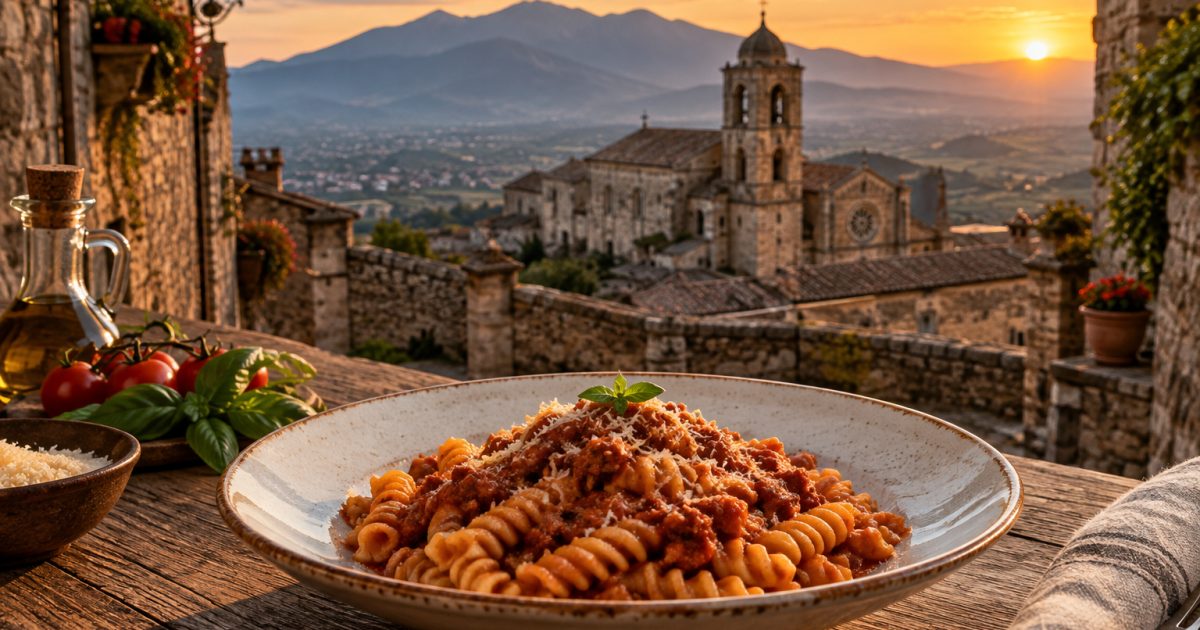
Casertavecchia, Cilento fusilli with ragù amidst medieval stone and the Campanian hills.
In the village at the foot of the Tifatini Mountains, Cilento fusilli with ragù reflect the blend of inland Campania cuisine and the serene landscape of Casertavecchia.

In the image, a detail related to the story.
Between steep alleys, stone arches, and the profile of the Tifatini Mountains, Casertavecchia offers a cozy backdrop to a pasta dish that traverses Campania: fusilli cilentani al ragù.
The village and the inland table
Casertavecchia is reached by leaving the more urban part of Caserta behind and climbing towards the medieval village, nestled on the slopes of the Tifatini mountains. The road climbs through curves and vegetation, while the view opens up over the Caserta plain. On clear days, the view reaches Vesuvius and, to the south, reveals the uninterrupted Campanian landscape: fields, towns, hills, and roads connecting regions with diverse gastronomic traditions.
The heart of the town preserves the Cathedral of San Michele Arcangelo, with its sober façade and distinctive bell tower, along with the remains of the castle and the stone houses. Here, the visit invites you to slow down. Not only to admire the architecture, but also to understand a cuisine born in contexts where the pantry had to be practical, seasonal, and capable of transforming a few ingredients into hearty dishes.
Fusilli cilentani are a traditional dish from Cilento, in the southern part of the region, but they could also find a natural home in a village in the Caserta hinterland. The handmade pasta, rough and firm, holds the sauce; the slow-cooked ragù brings the flavor of family Sundays and peasant tables to the dish. The connection isn't a recipe born in Casertavecchia, but rather a fusion of neighboring regional languages: the manual skill of rolling and shaping the pasta, tomato, meat, aromatic herbs, and patient cooking.
The shape of the fusilli holds the ragù
Fusillo Cilento is a long, twisted pasta, made by wrapping a small cord of dough around a thin iron or a special stick. Its surface isn't smooth and regular like that of industrially made pasta: it features grooves, twists, and varying thicknesses, details that become precious when it's served with ragù.
To make the dough at home, you'll need re-milled durum wheat semolina, warm water, and a pinch of salt. Some families add an egg, but the version made with just semolina and water produces a particularly firm consistency, suitable for manual work. The dough should be firm and not sticky; after resting for at least thirty minutes, covered, it is formed into thin ropes and wound around the iron, carefully unwinding them before letting them dry.
A slow ragù, without haste
For the sauce, you'll need tomato puree or pulp, onion, extra virgin olive oil, salt, and a small amount of meat. You can use a piece of beef along with a portion of pork, or you can use just pork, depending on your family's preference. The result doesn't have to be heavy: the tomato-to-meat ratio can be adjusted to keep the sauce fluid and fragrant.
- For the pasta: 400 grams of re-milled semolina, about 200 milliliters of warm water and salt.
- For the ragù: 700 grams of tomato, 300 grams of meat, a small onion, extra virgin olive oil, salt and a few basil or parsley leaves.
- To finish: grated cheese, preferably a mature caciocavallo or a hard local cheese, sprinkled in without covering the sauce.
The preparation begins with the soffritto, which should slowly wilt without over-browning. Add the meat and let it brown, then add the tomato. The ragù cooks over low heat for at least an hour and a half, preferably longer if the cut of meat is thick. The sauce should gradually reduce, becoming thick but not dry; the aroma transitions from the sweetness of the onion to the fuller notes of the meat and cooked tomato.
Meanwhile, boil the fusilli in plenty of salted water. If they're fresh, the cooking time may be shorter and depends on their thickness: it's important to taste them, as they should remain firm in the center. Once drained, transfer them directly to the pan with the ragù along with a little of the cooking water. This step helps the sauce penetrate the spirals and binds the dish. The cheese is added at the end, off the heat or with a quick stir.
On the plate, the pasta should take center stage. The ragù envelops the fusilli without overwhelming them, while its elastic texture contrasts with the smoothness of the sauce. A basil leaf, if available, adds a fresh note; elaborate garnishes aren't necessary. This is a dish that requires time, especially in cooking and preparation, not hard-to-find ingredients.
A climb that leads to flavor
Savoring a dish like this after wandering the streets of Casertavecchia means appreciating the landscape through simple gestures. The stone of the village, the silence of the squares, the view of the plain, and the hand-shaped pasta all share a common idea of hospitality: offering what the land has to offer without forcing the narrative.
As the light descends on the Tifatini hills and the village's facades change color, the ragù retains the warmth of home cooking on the plate. Fusilli Cilento adds a distinctive southern touch, connecting Casertavecchia to Cilento and, more generally, to Campania's long tradition of handmade pasta. The visit thus concludes amidst the scenery and the table, with a timeless recipe and a place that invites you to return more slowly.
Breaking News
Tennessee woman sentenced to death after 200 years: lethal injection for 18-year-old murderer Christa Pike
New York - He was only 18 when he killed a classmate in a… Read more
Naples: Cemetery gravediggers haven't been paid for months, with 50 workers on strike for three days.
They've been working without a paycheck for months, and now they've decided to stop. It's the… Read more
VEBO celebrates 25 years in Naples: creativity, customization, and new connections at the heart of weddings and design.
In Naples, VEBO, the International Fair of Wedding Favors, Home, Gifts, Christmas and Design, closes… Read more
San Giovanni, another fire at the former Bar Vittoria: two open LPG cylinders were found on the terrace.
More flames at the former "Bar Vittoria Black & White" on Via delle Repubbliche Marinare, Naples.… Read more
Naples: A 19-year-old man steals a couple's cell phone and attacks police officers.
First the theft of a tourist couple, then the violent reaction to the intervention... Read more
Remembrance at Sea: Castellammare unites the memories of fallen sailors in a national ceremony.
Castellammare di Stabia is organizing a civil commemoration to remember sailors lost at sea, uniting… Read more

National Newspaper
Registration No. 1301 of 2016 – ROC 030531
Director: Giuseppe Del Gaudio
To contact the editorial staff click HERE |
Download our Official ANDROID APP
