Vannacci's media trap: provoke, wait for a reaction, and then take center stage.
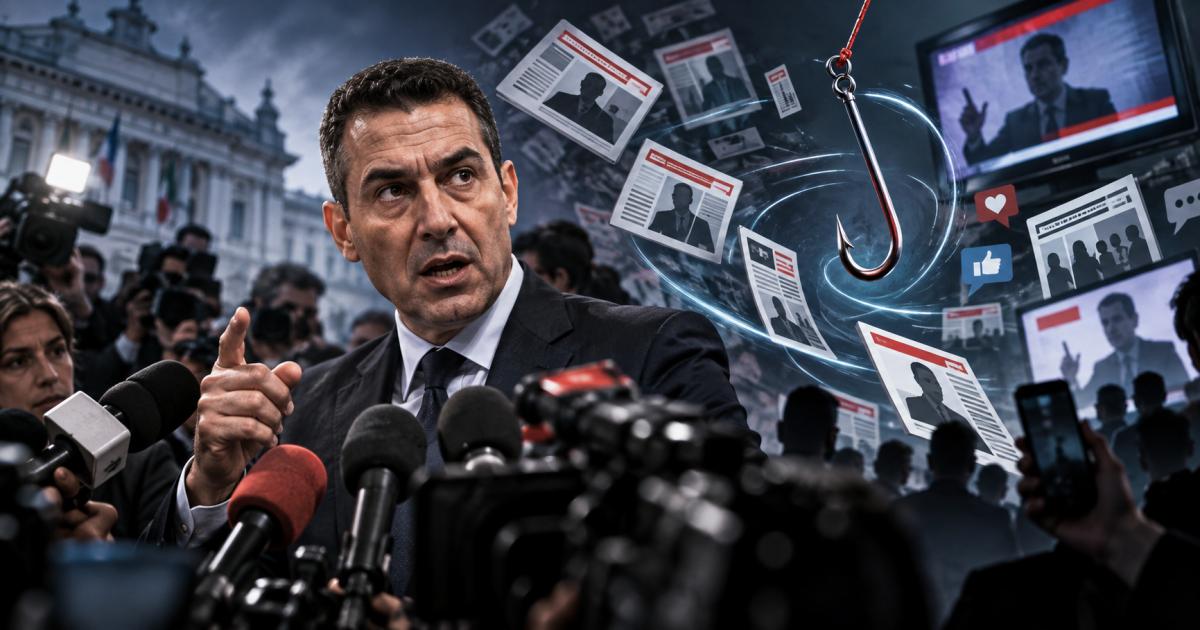
In the photo, a representative element of the story.
There's a mistake the media continues to make when Roberto Vannacci utters one of his divisive phrases: they only discuss the phrase itself. Because, observing the former general's way of communicating, the point is perhaps not just what he says , but above all what happens after he says it.
The latest episode came on September 22nd. Interviewed on Start on Sky TG24 and asked to address the controversy sparked by Antonio Tajani's previous statements, Vannacci responded: "Between a woman in a long skirt and a woman in a short skirt, I always prefer a woman without a skirt."
The phrase immediately generated headlines, reactions, and controversy. And this is where the most interesting part begins.
A sentence constructed to live after being uttered
A joke might be considered vulgar, out of place, sexist, or simply in bad taste. It's up to the listener to make their own assessment. But from a strictly communicative standpoint, it has a specific characteristic: it's extremely short, understandable without context, easily transformed into a headline, and ambiguous enough to allow for practically endless discussions.
If we take the words in isolation, they don't formulate a political theory about women. Nor is they expressing a comprehensive judgment. Everything happens through insinuation and implication.
It is what is not explicitly said that provokes the reaction.
And precisely because the meaning remains suspended between joke, allusion and provocation, whoever reacts is forced to complete that sentence, interpret it, explain it, condemn it or defend it.
In the meantime, however, he is already talking about Vannacci.
Provocation only works if someone picks it up
This is where newspapers, television stations, commentators and political opponents should probably question their role.
A media provocation requires two parties: the person who launches it and the person who decides to amplify it.
If a joke generates dozens of articles, television reports, posts, political statements, and counter-statements, the objective result is that that person takes center stage in public conversation for hours.
This doesn't mean that a politician's statements shouldn't be reported or criticized. However, it does mean distinguishing between informing people about a statement and unintentionally turning it into the dominant topic of the day.
With Vannacci this distinction becomes particularly important.
Because there's also a different way to neutralize a provocation: not necessarily by getting indignant for hours, but by taking away its drama.
For example, the sentence about women without skirts could have been answered with a counter-joke:
«If Vannacci likes women without skirts, he evidently prefers those in jeans».
An equally provocative response, but with a completely different effect: depriving the sentence of the ground on which it can grow.
Irony can be a much more effective form of communicative contrast than indignation when the initial message thrives precisely on the indignant reaction.
The paradox of journalists who amplify what they contest
And this is where a perhaps even more interesting question arises.
Is it possible that expert journalists, editors, commentators, and communications professionals have failed to understand this mechanism?
Because it's not just his supporters who are most likely to relaunch Vannacci's provocations. Very often, it's the commentators, newspapers, and analysts who are openly critical of him.
They challenge it, attack it, dismantle its words, denounce its language. But in doing so, they quote the phrase in full, transform it into a headline, repost it on social media, organize televised debates, and ask other politicians for reactions.
The result is paradoxical: those who want to reduce the effectiveness of that communication sometimes end up becoming its main multiplier.
And it is legitimate then to ask why this happens.
Do professionals who have been working in the information sector for decades really not recognize the mechanism?
Do political communication experts really not see that a provocation thrives above all on the amount of reactions it manages to produce?
Or is the problem that the contemporary media system has rules that make it almost inevitable to amplify it?
A divisive phrase generates clicks.
Generate comments.
Generate shares.
Generate replicas.
Produces material for television, websites, radio and social networks.
And then an even more complex situation can arise: the journalist can perfectly understand Vannacci's communication mechanism and, at the same time, work within a system that rewards precisely that kind of content.
This is an important distinction.
There is no need to imagine that journalists “naively fall into the trap”.
They might even recognize her very well.
The problem is that that trap produces attention, and attention today is one of the main currencies of information.
If you understand the game, why do you keep playing it?
The question then becomes even more uncomfortable.
If a journalist believes that Vannacci deliberately uses provocation to gain media coverage, why does he dedicate five articles, three social media posts, and a televised debate to the provocation?
If a communications expert claims that a phrase was designed to go viral, why does he personally contribute to making it viral?
Of course, the answer cannot simply be: “you have to ignore it”.
An elected political figure, with a significant following and a public role, must be talked about.
But telling it does not necessarily mean accepting the communicative terrain he proposes.
Journalism could report the sentence once, contextualize it, and immediately shift attention to the political consequences, the concrete proposals, the numbers, the programs.
Instead, too often the opposite happens.
The provocation becomes the news.
The reaction to the provocation becomes second news.
Vannacci's response to the reactions becomes a third piece of news.
Then comes the counter-reply.
And now a sentence lasting a few seconds occupies the debate for twenty-four or forty-eight hours.
At that point, who achieved the communication result?
The real product is attention
In contemporary political communication, attention is a resource.
A moderate and articulate statement rarely goes viral. A divisive statement, however, immediately sparks two camps.
On one side, those who say: "It's unacceptable."
On the other hand, those who reply: "Nothing more can be said."
At that point the person who uttered the sentence occupies both spaces simultaneously.
Detractors spread his name to criticize him.
Supporters spread his name to defend him.
Even those who didn't hear the original interview end up knowing what he said.
It's the old principle of notoriety applied to the social network ecosystem: a controversy can generate an amount of exposure that a normal advertising campaign could hardly buy.
Of course, we don't know how much each of Vannacci's sentences is planned in advance. But we can observe the communicative effect: many of his statements immediately become independent news stories.
The problem with considering him simply a politician like the others
There is then a second element that deserves greater attention.
Roberto Vannacci has not entered politics after a long party career.
It comes from the Armed Forces.
He was a major general, held operational and command positions and subsequently entered elective politics.
This biographical information does not automatically allow us to deduce what his behavior would be if he were to reach government positions.
It would be a simplification.
But ignoring it would be equally superficial.
Military training matters, but it is not enough to predict politics
A senior officer spends a good portion of his or her career within organizations where there are defined hierarchies, operational objectives, planning, risk assessment, and command responsibilities.
Democratic politics, on the other hand, functions through profoundly different mechanisms: mediation, Parliament, majorities, compromises, guarantee institutions, constitutional norms, and consensus.
The interesting question is therefore not to automatically imagine a general transferring military orders to Palazzo Chigi.
It's asking something more concrete:
how much of the strategic culture and method developed during a long military career Vannacci brought into his political and communication activities.
That's a different question.
And perhaps more useful.
A communication that seems to think in terms of objectives
Looking at the phenomenon from the outside, some dynamics may recall a strategic logic.
A piece of land is identified.
A move is made.
The response is observed.
The opponent's reaction is exploited.
In communication this means that even criticism can become useful.
If a hundred people attack a statement, those hundred people simultaneously contribute to distributing it.
This is one of the paradoxes of social networks: the adversary can unwittingly become the main amplifier of the message he wants to counter.
For this reason, simply defining Vannacci as a politician who "speaks to the gut of Italians" risks being an incomplete explanation.
There may certainly be a populist component to the language and themes used. But to understand its communication, we must also study the structure through which that communication gains visibility.
The question should be: who is using whom?
When a controversy erupts around a phrase by Vannacci, newspapers and television stations naturally think of reporting on Vannacci.
But it's also worth asking the opposite.
Is it Vannacci who is using that media machine?
Or are the media simply doing their job when faced with statements deemed newsworthy?
The two dynamics can probably coexist.
And this is precisely what makes the phenomenon interesting.
A provocative statement perfectly meets the criteria of contemporary information: it is short, divisive, immediately understandable and generates reactions.
As a result, it is rewarded first by traditional media and then by algorithms.
The trap of permanent indignation
The end result is a short circuit.
Those who consider Vannacci politically distant from their ideas react harshly to his words in order to oppose him.
But that same reaction can contribute to increased exposure.
Of course, this does not mean that journalists or citizens should stop criticizing statements they consider wrong.
Rather, it means choosing how to do it.
Challenging the merits of a political proposal is different from dedicating an entire day to a joke.
Analyzing a program is different from turning every provocation into a national case.
And this is where contemporary political communication shows one of its weaknesses: we often discuss exactly the topic that someone else has chosen for us.
Perhaps the real countermove is to change ground
Vannacci's communication therefore deserves to be observed without underestimating it but also without attributing almost magical powers to it.
A provocation alone does not dominate the debate.
It becomes dominant when thousands of people decide to revive it.
For this reason, the most effective response may sometimes be extremely simple.
A joke.
A smile.
A counter-provocation.
Then a question about pensions, the economy, Europe, healthcare, immigration, or foreign policy.
In short, forcing the politician to abandon the terrain of phrases constructed to go viral and move him onto one where he must concretely explain what he wants to do.
Because a provocation can be a formidable communication weapon.
But, like all traps, it works best when someone decides to fall into it.
And perhaps the greatest paradox is precisely this: those who know the mechanisms of communication best should be the first to recognize the trap. Yet, too often, it's precisely those who should know how to avoid it who give it the greatest resonance.
Breaking News
San Giuseppe Vesuviano: Drinks stolen from supermarket: arrested
State Police arrest two men, both undocumented and with criminal records, after an attempted robbery… Read more
Naples: Heroin dealer arrested at Porta Capuana
State Police arrest a 61-year-old man in the Porta Capuana neighborhood for… Read more
Afragola: Two women arrested for hiding stolen clothes in stroller
Yesterday afternoon, a 19-year-old and a 16-year-old were arrested for aggravated theft:… Read more
General Castello stops in Torre Annunziata, Castello di Cisterna and Naples
Army Corps General Rosario Castello leads a reconnaissance among the Carabinieri groups of… Read more
Buffalo milk: enhanced controls in Campania to trace the supply chain and protect consumers.
In Campania, controls on the buffalo milk and dairy product supply chain have been strengthened:… Read more
Naples inaugurates an installation to keep alive the memory of Giancarlo Siani.
In Naples, a new urban installation titled “Sine die” was presented at the Rampe Giancarlo… Read more

National Newspaper
Registration No. 1301 of 2016 – ROC 030531
Director: Giuseppe Del Gaudio
To contact the editorial staff click HERE |
Download our Official ANDROID APP