National Future, Vannacci, and that dangerous gray area of our democracy

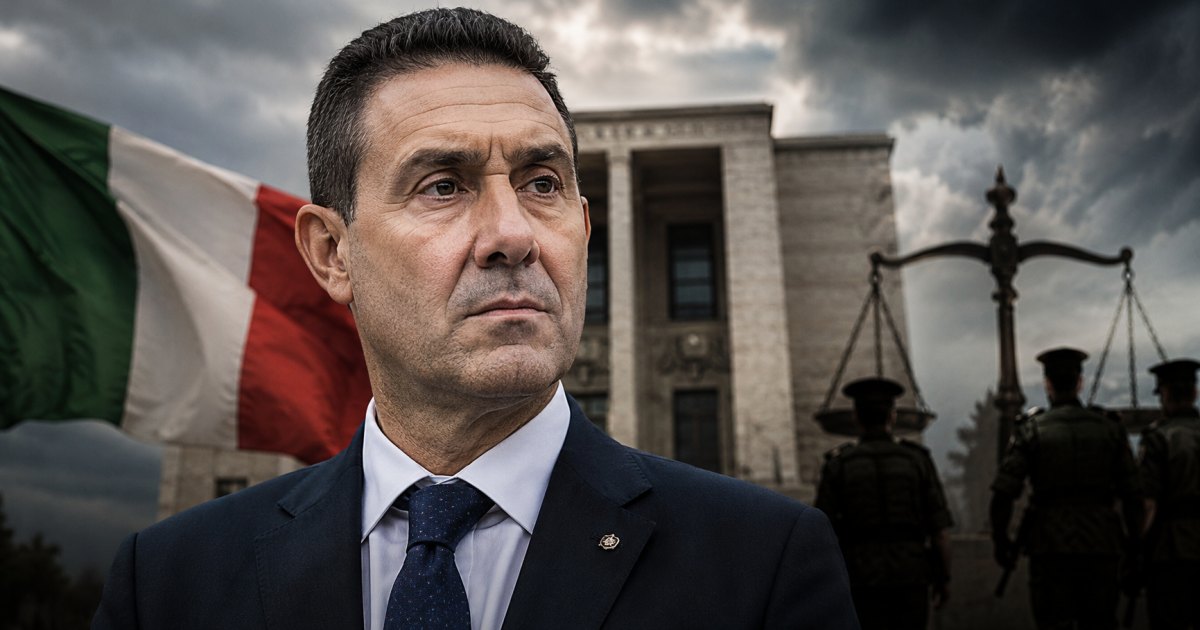
In the image, a context connected to the facts.
The news of the investigation launched by the Rome Military Prosecutor's Office into the presence of members of the Armed Forces in the organizational structure of Futuro Nazionale raises a much larger question about the political fate of Roberto Vannacci.
The investigations are, indeed, preliminary. No liability has been established, and it would be profoundly wrong to transform a judicial action into a premature verdict.
But politically we can and must ask ourselves questions.
Because the problem we face isn't just about Vannacci.
It's about us.
It concerns the ability of Italian democracy to navigate a historical phase in which many of the benchmarks that for decades had defined the terrain of normal political competition seem to have disappeared.
What the Military Prosecutor's Office is verifying
On September 3, the Rome Military Prosecutor's Office, led by Prosecutor Marco De Paolis, announced the initiation of preliminary investigations following a complaint filed by the Military Union.
Attention is particularly focused on the position of members of the Armed Forces who are allegedly present within the organizational structure of Futuro Nazionale.
According to the Prosecutor's Office's statement, the aim is to verify the possible existence of facts falling within military jurisdiction.
This is a fundamental distinction.
This does not mean that Futuro Nazionale has been declared illegal.
This does not mean that Vannacci has been found responsible for a crime.
And it does not mean that the reconstitution of the fascist party has been confirmed.
However, a complaint has also been filed with the ordinary courts, which raises, among other issues, a possible violation of the Scelba Law. It will be up to the competent magistrates to determine whether or not the elements required by law exist.
And this is precisely where things get interesting.
Democracy must also tolerate those who provoke it.
A great democracy must be strong enough to allow the existence of ideas that are radical, provocative, and even deeply unwelcome to the majority.
It's the price of freedom.
If we began to establish that an opinion can only exist when it coincides with the dominant one, we would have already ceased to be a liberal democracy.
But there is also the opposite problem.
How far can a democracy go in its tolerance without undermining the very principles that allow it to exist?
It's a question as old as modern democracies.
And today it suddenly becomes relevant again.
The Italian Constitution, moreover, builds certain protections precisely around this balance. Article 98 provides for the possibility of establishing restrictions on political party membership, among others, for career soldiers on active duty.
Not because a soldier shouldn't have political ideas.
But why do institutions exist that must remain perceived as belonging to the State and not to a political party?
It's a huge difference.
Vannacci did not arise from nothing
Furthermore, it would be too easy to dismiss Roberto Vannacci simply as an extremist phenomenon who suddenly appeared on the Italian scene.
Politically, that would be a mistake.
In just a few months, Futuro Nazionale has become a significant force in the polls. A SWG poll reported by Reuters placed it at 7,5% in early September, ahead of Forza Italia and the fourth largest political force in the country.
This means that there is a real political demand behind Vannacci.
And this question should probably interest much more than the character.
Because a segment of the Italian electorate has been searching for years for someone willing to promise a radical break with what is perceived as the system.
First there was Matteo Salvini in the “Captain” season.
Then the Five Star Movement with the message of opening Parliament "like a can of tuna."
Then Giorgia Meloni intercepted a huge portion of the protest vote and of the right that had remained outside the traditional balance.
Today, a part of that same discontent seems to be looking at Vannacci.
Profoundly different characters.
Different political histories.
But behind many of these phenomena there is probably the same question.
Change everything.
Are angry voters the problem?
No.
And this is perhaps the most serious mistake that traditional politics continues to make.
When millions of people are continually seeking an ever more radical alternative, they cannot be simply dismissed as ignorant, populist, fascist, or irresponsible.
You have to ask yourself why they do it.
A part of the population feels that their purchasing power is decreasing.
He sees public services that function worse.
Look at a policy perceived as distant.
It witnesses wars on Europe's doorstep, immigration, rapid cultural transformations, artificial intelligence, precarious employment, climate change, and an economic future that is increasingly difficult to imagine.
Into this scenario comes someone who offers simple answers.
It closes.
Expels.
Forbid.
Restore.
It punishes.
Protects.
Extraordinarily powerful words when a society is afraid.
The success of extremism almost always begins elsewhere
History should have taught us one thing.
Extremism rarely becomes important because suddenly millions of people decide to become extremists.
They become important when millions of people stop believing that the existing system is capable of protecting them.
It's very different.
And this is why focusing exclusively on Vannacci's words risks even being misleading.
Vannacci is the symptom.
The disease, if we want to call it that, could be the progressive loss of confidence in institutions, political parties, and the ability of traditional politics to solve real problems.
When that trust collapses, voters begin to experiment.
They try one.
Then another.
Then another one.
Each time pushing the boundaries of what would previously have seemed politically unthinkable a little further.
The border that slowly moves
And this is precisely the point that should concern us.
Not necessarily what is said today.
But what could become normal tomorrow.
Democracies rarely change overnight.
They change for small trips.
A word that would have been unacceptable yesterday becomes questionable.
Then acceptable.
Then normal.
Then it enters the institutional political language.
And in the end, no one remembers where the border originally was.
This is the mechanism of the so-called Overton window: what a society considers politically acceptable can progressively shift.
The question therefore should not only be:
Is Vannacci too extreme?
The question should become:
How much has our society changed for certain positions to garner millions of potential consensus today?
A strong enough democracy?
So we come to the central point.
Are we strong enough and vaccinated enough to allow even the most radical positions to enter into normal democratic debate without this producing irreversible consequences?
I want to believe so.
The Italian Republic has a robust Constitution, consolidated institutions, an independent judiciary, a system of checks and balances, and above all, over eighty years of democratic experience.
But it would be naive to think that all this works automatically.
Institutions are strong as long as a society continues to recognize them.
Constitutions are strong as long as a constitutional culture exists.
Democracies are strong as long as the majority of citizens still consider democracy the best possible system, even when it produces results they don't like.
And it is precisely this certainty that in many Western societies seems to have become less firm than in the past.
A world in which many barriers have been broken
Then there is an even bigger element.
As we have written on other occasions, we are going through an international phase that is very difficult to interpret.
Russia and Europe.
The war in Ukraine.
The competition between the United States and China.
The Middle East.
European rearmament.
The crisis of old alliances.
The technological transformation.
Economic tensions.
The return of nationalisms.
For decades we had lived within a set of habits that seemed almost immutable.
Today, many of those customs are being called into question simultaneously.
And when too many references are missing at the same time, the political space inevitably increases for those who promise order through radical solutions.
It has happened other times in history.
This doesn't mean that history necessarily has to repeat itself.
But it means that ignoring its mechanisms would be irresponsible.
The real danger is ambiguity
And here we come to the word that perhaps best describes this political phase.
Ambiguity.
Ambiguity in international relations.
Ideological ambiguities.
Ambiguity in political messages.
Ambiguity in the relationship between provocation and program.
Something extremely strong is being said.
Then it is clarified that it was a provocation.
Then the same idea is transformed into a proposal.
Then, if there is a reaction, the censorship system is blamed.
It is a very effective political technique.
Because it allows you to occupy two spaces at the same time.
That of extremism and that of institutional respectability.
And it is precisely this gray area that should be observed very carefully.
But banning ideas would be the worst answer.
Be careful though.
The answer cannot be to transform every radical position into a judicial problem.
It would be an extraordinary gift to the anti-system movements.
Politics must be fought primarily with politics.
Ideas with other ideas.
Consent with other consent.
The law intervenes when limits defined by the legal system are exceeded.
And the Scelba law, much-cited in recent hours, establishes very specific criteria for configuring the reorganization of the dissolved fascist party: therefore, a political label or a journalistic opinion is not enough.
It will be up to the magistrates to determine whether there are legally relevant facts.
Our task should be different.
Understanding what is happening to Italian society.
Why is Vannacci convincing?
Perhaps this is the question that should obsess both the majority and the opposition.
Not how to stop it.
But why does it work?
Why do thousands or millions of people find that language convincing?
Because they evidently perceive something that traditional politics is no longer able to convey.
When a citizen feels he is not being heard, he first protests.
Then he changes party.
Then he chooses who promises to bring down the system.
And then?
It is precisely that “after” that should worry us.
Because no one can know for sure where a long period of progressive delegitimization of institutions ends.
Democracies don't necessarily die by tanks.
We have a cinematic image of the end of democracies.
Soldiers in the streets.
Occupied buildings.
Parliaments closed.
Coups d'état.
But in modern history something much more subtle can happen.
A democracy can formally continue to exist while the political culture that supports it slowly changes.
Let's keep voting.
We continue to have parties.
We still have television and newspapers.
But at the same time, the idea is growing that the opponent is no longer someone to be beaten in elections, but rather someone to be eliminated politically.
And that's where the system really starts to creak.
So is the National Future the problem?
No.
It would be too simple.
Futuro Nazionale is probably one of the products of this phase.
It will be able to grow.
It may scale down.
It could enter the system permanently or disappear like many political formations born in the last thirty years.
But the question will still remain before us.
Why does a growing part of society feel the need to move further and further away from the traditional political center?
Until we seriously answer this question, someone else could come after Vannacci.
And maybe it will be even more radical.
The true antidote to extremism
Ultimately, the most effective antidote to extremism is not to censor it.
It is making their promise useless.
A state that works.
Accessible healthcare.
An understandable justice.
A job that allows you to live.
A school capable of providing opportunities.
A policy that starts talking to people instead of just talking about itself.
Borders and immigration managed with credible rules.
Security without propaganda.
Rights without ideologies transformed into weapons.
It's much more difficult than posting an indignant post against Vannacci.
But it is also probably the only truly effective solution.
The question that remains
The investigations by the Military Prosecutor's Office will take their course.
It's right that it should be this way.
If nothing illegal comes to light, it will be equally right to say so clearly.
If violations emerge, there are laws and courts to assess them.
But the political question will remain.
Can we afford this new season of ambiguity?
Can we continue to continually push the boundaries of political language, thinking that democracy is robust enough to absorb everything?
Maybe yes.
Or maybe we're doing an experiment where no one really knows the outcome.
Because the problem of chain reactions is always the same.
At first, every single step seems controllable.
The first one changes almost nothing.
The second one neither.
The third still seems manageable.
Then, suddenly, you look back and realize that the world you live in no longer resembles the one you saw ten years ago.
And perhaps this is the real question we should start asking ourselves.
Not whether Roberto Vannacci can change Italy.
But how much Italy has already changed to make Roberto Vannacci possible.
Breaking News
Gratteri on TV: "The majority's reforms are useless, they can't be implemented."
Rome - "Those who wield power don't want to be controlled." Nicola doesn't mince his words... Read more
Scafati, industrial wastewater contaminated: metalwork company seized
Potentially contaminated industrial wastewater dispersed in the soil, underground, and on the road. This is what… Read more
Caivano, Father Patriciello on the Pino Daniele Sports Center: "Today it's a wonderful place."
"I'm overjoyed." These are the words of Don Maurizio Patriciello, describing the transformation of… Read more
Favasuli: "Naples is a starting point, thanks to Catanzaro. Young players need to be given opportunities."
From Serie B to the Champions League in just a few months. Costantino Favasuli… Read more
Carosone Award: Neapolitan music, from memory to new generations, at the Arena Flegrea on September 30th
Renato Carosone returns to Naples with a grand evening dedicated to his music… Read more
Martina Carbonaro, the teacher in the classroom: "She wanted to leave Alessio, but she was afraid to tell him."
She had decided to end the relationship, but she was afraid to tell them. It's one of the… Read more

National Newspaper
Registration No. 1301 of 2016 – ROC 030531
Director: Giuseppe Del Gaudio
To contact the editorial staff click HERE |
Download our Official ANDROID APP