If it's no longer money, then what's happening to the world?
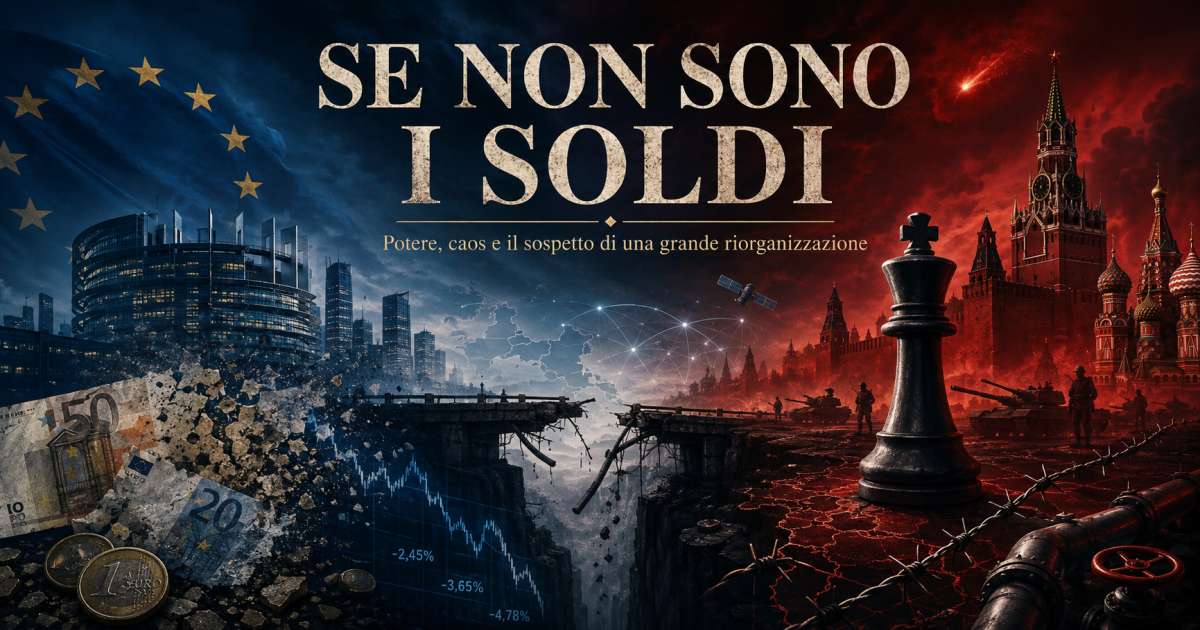
In the image, a reference to the narrated facts.
For many years we told ourselves that the modern world had found some sort of balance.
Not a perfect balance. Not necessarily fair. But convenient enough for everyone to make a major war between powers economically absurd.
Europe bought energy from Russia.
Russia sold gas and oil to Europe.
European companies were working on the Russian market.
Capital, goods, people and interests were constantly crossing borders.
The belief was simple: the more economically dependent we become on each other, the less incentive we will have to wage war on each other.
For a few decades it even seemed to work.
Then something broke.
And perhaps the most interesting question is not just why the war in Ukraine broke out or why Russia and Europe have returned to viewing each other as enemies.
The question is another:
Why would anyone be willing to destroy a system from which they profited so much financially?
When money no longer explains everything
We are used to interpreting politics through money.
Petroleum.
Gas.
Raw material.
Industry.
Armaments.
Markets.
Profits.
They certainly continue to count.
But perhaps we made a mistake: we confused a means with an end.
Money is an extraordinary instrument of power.
But what happens when you have to choose between money and power?
A very rich man might prefer to become even richer.
A state can think differently.
A state may agree to become temporarily poorer to increase its security.
It can sacrifice trade to control a territory.
It can forgo foreign investment to become less dependent.
It can spend enormous sums on armaments that produce no immediate well-being because it believes that in ten years those armaments could determine its very survival.
And then what appears economically irrational can become perfectly rational from the point of view of power.
The real scarce good may be control
Pre-war Russia was deeply integrated into the world economy.
Thinking purely in economic terms, breaking that system seemed absurd.
But a state must not only ask itself how much money it will earn tomorrow.
We must also ask ourselves who will control certain regions in twenty years.
Who will control the energy.
Who will control the technologies.
Who will produce semiconductors.
Who will own the raw materials.
Which currency will dominate trade?
What military alliances will exist.
Who will write the international rules.
And, above all, on whom will it depend for its continued existence.
At that point a word appears that we have been hearing more and more often in recent years:
safety.
Energy security.
Food safety.
Technological security.
Military security.
Infrastructure security.
Border security.
Communications security.
When safety replaces economic efficiency as the top priority, the world inevitably changes.
But let's make an extreme hypothesis
And here I would like to push the reasoning much further.
Not because there is evidence that this is the case.
But because certain questions, however extreme, can help us better understand the behavior of states.
So let's do a thought experiment.
Imagine that a very small number of great powers learn something that the rest of humanity does not.
A concrete probability that, in ten or fifteen years, a catastrophe of unprecedented proportions will occur.
It doesn't even matter which one.
It could be a sudden climate crisis.
A collapse of resources.
A gigantic volcanic eruption.
A new pandemic, vastly more serious than any known one.
A global food crisis.
An astronomical event.
A technological revolution capable of destroying millions of jobs and destabilizing entire societies.
Or something we can't even imagine today.
I repeat: I am not claiming that such information exists.
The question is simply:
If the most powerful governments on the planet knew that something huge was coming in ten years, what would they do today?
They would probably try to prepare
A government that knew of a future threat of that magnitude would hardly begin by announcing everything to the population.
Because it would immediately have to deal with financial panic, market crashes, capital flight, riots, migration, and political instability.
It would probably start with something much quieter instead.
It would try to become energy independent.
It would seek to control strategic raw materials.
It would bring back within its borders production considered essential.
It would increase military spending enormously.
It would strengthen border control.
It would build reserves.
It would protect power grids, telecommunications, satellites and infrastructure.
It would seek to control critical technologies.
It would create production systems capable of functioning even without international trade.
It would redraw its alliances.
It would seek to secure territory, energy, water and resources.
And it would likely also increase the state's ability to direct society during an emergency.
If you knew that in ten years the supermarket might no longer receive products from the other side of the world, suddenly producing everything as cheaply as possible would no longer be a priority.
It would become a priority to be able to produce it ourselves.
And here comes a strange coincidence
Let's look at the world today.
There is constant talk of strategic autonomy.
About reshoring.
Of defense of production chains.
Of energy security.
Of semiconductors.
Of rare earths.
Of critical infrastructure protection.
About cybersecurity.
Of increasing military spending.
Of border control.
Of intelligence.
Of resilience.
On preparing populations for emergencies.
NATO now openly describes an environment characterized by strategic competition, instability, and recurring shocks, and considers propaganda, sabotage, cyberattacks, and economic pressure to be part of modern hybrid threats.
All of this has public and perfectly concrete explanations: the war in Ukraine, competition between great powers, the deterioration of relations with Moscow, the growing importance of China, and the vulnerability shown by global chains in recent years.
But the thought experiment remains interesting.
Because, if there really were a major future threat, many of the preparatory policies would likely look just like what we see today.
And here comes the temptation to put two and two together.
But be careful: similarity does not mean proof
This is exactly where you need to stop for a few seconds.
Because it would be very easy to turn an interesting question into an unprovable theory.
If a government increases stocks, it can prepare for war.
If it invests in energy, it may simply want to reduce its dependence on foreign countries.
If it increases military spending, it can react to Russia.
If it protects the borders, it can worry about migration.
If it wants to produce microchips on its own soil, it may have learned the lessons of the pandemic and supply chain crises.
We therefore do not need a secret catastrophe to explain what is happening.
There are already many visible explanations.
But that doesn't make the question pointless.
It makes it perhaps even more interesting.
What if the real preparation was for a more unstable world?
Perhaps there is no single catastrophe.
Perhaps what some governments have understood before others is simply that the stable world we have known for the past few decades may be coming to an end.
And that, after all, would already be huge news.
Let's imagine that the major intelligence agencies have concluded that in the next twenty years we will simultaneously have:
climate change;
migratory pressures;
energy crises;
competition for raw materials;
artificial intelligence;
work automation;
demographic decline of some countries;
explosive population growth of others;
regional wars;
water crises;
new pandemics;
cyber attacks;
nuclear tensions.
There would be no need to know the date of the Apocalypse.
It would be enough to predict that the system will become much less stable.
At that point, preparing wouldn't be conspiracy theory.
It would be strategy.
Maybe globalization only worked in a quiet world
The economic model of the last thirty years had a fundamental characteristic:
It was extraordinarily efficient, but also extraordinarily fragile.
Produce a component in Taiwan.
Another one in Korea.
Assemble it in China.
It uses Russian energy.
Transport it with European ships.
Finance it with American capital.
Sell it worldwide.
It's a wonderful system as long as everything works.
But break three or four links in the chain and suddenly efficiency becomes vulnerability.
The pandemic gave us a first demonstration.
The war in Ukraine is another.
Tensions in the Red Sea are yet another one.
Perhaps the great powers are simply concluding that in the world to come, whoever produces at the lowest price will not necessarily win.
Whoever can continue producing when others cannot will win.
And it's a gigantic paradigm shift.
This would also explain the return of the strong state.
And here we come to another question.
Why is the allure of the strongman returning to many societies?
Why is there a growing attraction towards more vertical political models?
Why do some Europeans even look at Russia with interest?
Perhaps because an authoritarian system has a characteristic that in times of crisis can appear advantageous:
decides quickly.
A democracy must debate.
Mediate.
Vote.
Convincing public opinion.
Respect the courts.
Oppositions.
Parliaments.
A vertical regime can simply order.
This doesn't mean it's better.
In fact, it also means that he can make huge mistakes without anyone being able to stop him.
But during a perceived emergency, the ability to make quick decisions can be a powerful attraction.
And here's the disturbing point.
If a segment of the world's elite were convinced that we were entering an era of permanent crises, they might deem the political model of the past too slow to manage it.
Could this be the real battle?
Perhaps, therefore, the opposition between Russia and Europe is not just about territories.
And maybe not just money.
It could concern two different conceptions of how to organize a society facing a future considered increasingly unstable.
On the one hand, open, pluralistic, complex and inevitably slow societies.
On the other hand, vertical models that promise order, discipline, and rapid decision-making.
The issue then becomes much bigger than Ukraine.
Becomes:
Which political system is considered most suitable for the coming world?
Chaos can be functional to reorganization
So let's go back to the initial feeling.
Why does it seem that suddenly everything that once guaranteed stability is being called into question?
One possible answer is simply that several powers are trying to construct a new equilibrium.
But we can also formulate a more extreme hypothesis.
Chaos could be, at least for some individuals, functional to the transition.
To profoundly change a system, you often first have to convince people that the previous one no longer works.
A fearful society accepts sacrifices that a calm society would refuse.
Accepts greater military spending.
Accept stricter controls.
Accept financial sacrifices.
Accept industrial changes.
Accept restrictions.
Accept that the state intervenes much more deeply in the economy.
This mechanism does not prove that someone intentionally created the chaos.
A real crisis can produce exactly the same effects.
But it means that every crisis also changes power relations.
And someone, inevitably, comes out stronger.
What if money isn't the ultimate prize?
This brings us back to the question we began with.
If it's not money, what could be more important than money?
Maybe the answer is:
decide who will have access to resources when resources are scarce.
Money is essential in a world where you can buy whatever you want.
But imagine a world in which a certain resource is unavailable.
You can own one hundred billion euros.
If there isn't enough energy, that money doesn't produce energy.
If there is no water, it does not create water.
If a production chain is interrupted, it does not automatically produce semiconductors.
If a country controls an indispensable resource, suddenly that resource can be worth more than money.
In a scenario of scarcity, real power therefore becomes:
territory;
energy;
water;
food;
technology;
industry;
military force;
information;
population;
infrastructure.
Money goes back to being what it probably always was:
a tool.
Maybe no one knows the future
Of course, there is also the simpler explanation.
Nobody knows anything.
There is no catastrophe known only to governments.
There is no master plan.
There is no global control room.
There are simply competing powers, governments that make mistakes, leaders who seek consensus, industries that defend interests and states that react to the fears of the moment.
And this is probably the hypothesis we should start from until evidence to the contrary emerges.
But a legitimate question remains.
How would the world behave if those who have more information than we do believe that the future will be much worse than the present?
The answer is disturbing because it would likely seek to control energy, technology, borders, production, communications, and military capability.
Precisely the things that the new global competition is fighting over today.
It could be a coincidence due to normal geopolitical dynamics.
Most likely it is.
But it is precisely this overlap that makes the reflection interesting.
Maybe the right question is another one
Perhaps we continue to ask ourselves:
“Who is profiting from all this?”
And we are looking for an answer expressed in billions of euros.
Maybe we should ask ourselves:
who is becoming more powerful?
Who controls more energy?
Who controls more information?
Who owns the technologies?
Who produces weapons?
Who can live without imports?
Who can withstand a crisis the longest?
Who is capable of controlling their own population?
Who can decide without depending on others?
Because if we are entering a more unstable world, these elements could be worth much more than GDP.
So maybe the chaos we are observing isn't necessarily someone's plan.
It could be the noise produced by a gigantic reorganization of world power.
With states trying to gain the best positions today to face a tomorrow that they consider much less certain than we imagine.
And here remains a question to which, at least for now, no one can give a certain answer:
Are they simply preparing for each other, or are they all preparing for something?
Breaking News
Phlegraean Fields, Fico: "A specific measure has been agreed with the government."
A measure entirely dedicated to the Phlegraean Fields, with comprehensive measures to address the needs of… Read more
Campi Flegrei, Mayor Manzoni: "We will no longer tolerate humiliation. Now, only facts matter."
"We can no longer afford to waste time." The mayor of Pozzuoli, Luigi Manzoni,… Read more
Medical Device Payback: "Medtech Payback" Arrives: Broya de Lucia's investigative book
ROME. Medical device payback becomes an investigative book. The book, titled "Medtech Payback,"… Read more
Grumo Nevano: Police raid identifies 176 people and issues fines exceeding €6.000.
A territorial control raid in Grumo Nevano: identifications, seizures, and administrative sanctions for violations... Read more
Marco Travaglio tonight at the Teatro al Borgo in Casertavecchia
Marco Travaglio brings Cornuti e contenti to the Borgo di Casertavecchia as part of the 54th September at… Read more
Fire on Via Nuova delle Brecce: Dioxin levels below the reference value
Data updated yesterday morning show 0,082 pg/Nm3 I-TEQ, below the value… Read more

National Newspaper
Registration No. 1301 of 2016 – ROC 030531
Director: Giuseppe Del Gaudio
To contact the editorial staff click HERE |
Download our Official ANDROID APP