Car rental, the bill arrives after the return: when damage becomes a case

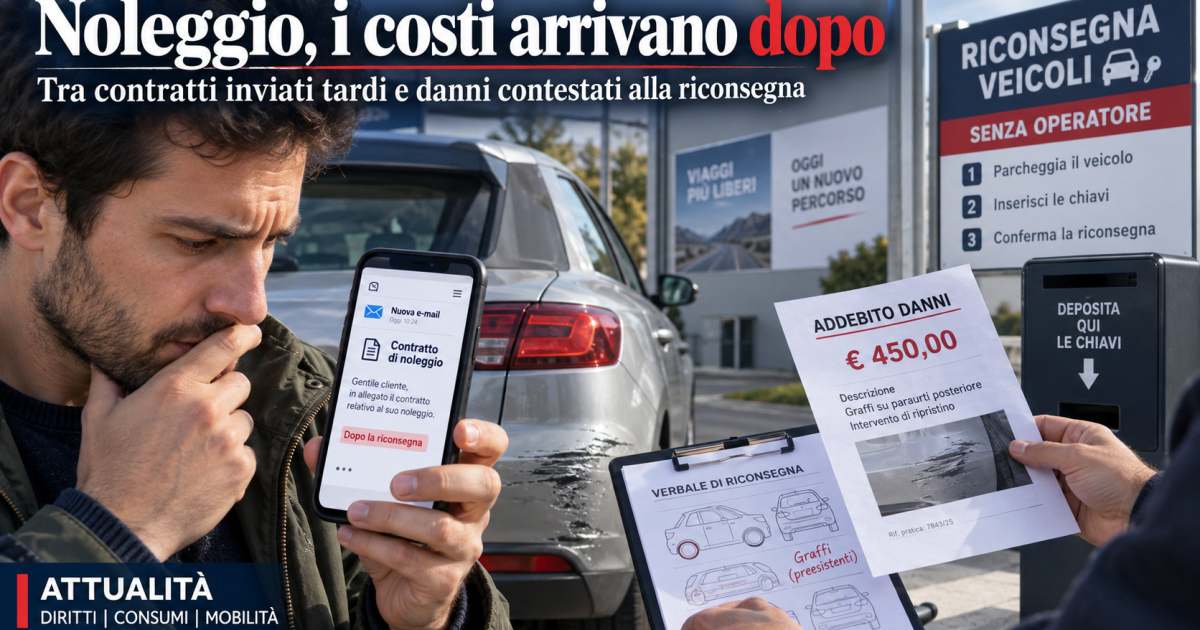
In the image, a reference to the narrated facts.
More and more readers are reporting charges received after returning cars and vans. The issue isn't challenging the companies' right to demand payment for damage actually caused, but understanding how that damage is assessed, documented, and attributed to the customer. And above all, how much the customer is actually given the opportunity to understand the contract, previous damage, coverage, and assistance procedures before leaving.
Renting a car or van should be a simple process: you pick up the vehicle, use it according to the contract, and return it when the contract expires.
Yet numerous reports reach our editorial staff from readers who describe a very different outcome: the vehicle is returned and, a few hours or days later, a notification arrives regarding alleged damage and the resulting charge.
We don't mean to imply that these charges are automatically unjustified. A vehicle damaged during a rental clearly entails liability that must be assessed according to the signed contract.
Another point worth asking is: how transparent is the entire process, from delivery of the vehicle to the subsequent notification of the damage?
The first problem arises at the start
One of the situations most frequently reported by customers concerns the moment of collection.
The consumer should be able to know exactly in what condition he is receiving the vehicle.
Scratches, dents, damaged rims, bodywork marks, or other existing defects should be easily identifiable and documented to avoid any doubts when returning the vehicle.
And instead several readers tell us about a recurring scene.
The customer sees a scratch and asks the operator:
“Is this damage already evident?”
The answer, according to the testimonies received, is often reassuring: it's already registered, there's no need to worry.
The customer trusts.
The problem arises when that reassurance remains only verbal.
The contract should arrive soon
There is another aspect, perhaps even more important, that emerges from the reports received: the delivery of the contract.
It happens, according to what we've been told, that the documentation isn't printed at the time of collection but is promised later via email.
“There are technical problems.”
“The system doesn't work.”
“Everything will arrive to you by email.”
The customer takes the vehicle and leaves, trusting.
But what happens if that email arrives hours later? And what happens, above all, if the contract is received even after the vehicle has already been returned?
This is not just about the possibility of verifying pre-existing damage.
The contract contains or should make available essential information: rental conditions, coverage, deductibles, procedures to follow in the event of a breakdown or accident, assistance details and contact numbers.
For this reason, the delivery of the documentation, whether paper or digital, should be simultaneous with the collection of the vehicle.
A contract that arrives later risks being useful only once the lease has already ended.
Without a contract, who's called?
The problem becomes even more evident when something unexpected happens during the rental.
Let's imagine a simple puncture.
The customer should be able to immediately check what the contract provides, which assistance number to call, whether the vehicle has roadside assistance, whether there are approved workshops, and what procedure to follow.
But what if the contract hasn't been delivered to him yet?
The customer risks finding himself alone in making the decision.
Call a tire dealer, perform a repair, or replace a tire thinking you've successfully solved the problem.
Subsequently, however, that choice could be challenged.
And this is where further costs and misunderstandings can arise.
Some readers report, for example, having been asked to replace not only the affected tire but also the corresponding one on the same axle, based on the condition of the vehicle or the technical criteria applied.
This does not mean that such a request is always unjustified: the need to replace one or more tyres depends on the actual conditions, vehicle specifications, wear and applicable technical requirements.
But the problem remains.
If the customer hasn't received the contractual instructions and doesn't have support contact information, how can they know in advance what procedure to follow?
A simple puncture that might have required little intervention can thus transform, at least in the customer's perception, into a much higher expense.
The contract is not a formality
And this is where the perspective changes completely.
The contract should not be considered an administrative document to be sent when the system becomes available again.
It is the tool through which the customer must know, before leaving:
- the condition of the vehicle;
- the damage already present;
- insurance coverage;
- any deductibles;
- emergency numbers;
- the procedures to follow in the event of an accident, breakdown or puncture;
- what can be done independently and what must be previously authorized.
If this information arrives later, a fundamental part of its function is lost.
The contract must remove doubts
This is precisely where the ambiguity could arise.
The customer should have the documentation relating to their rental available, be aware of any damage already present on the vehicle, and know the numbers to contact in case of an emergency, accident, or problem during the trip.
You shouldn't have to become a car rental expert to protect yourself.
The principle should be very simple: no customer should leave the rental point without having immediate access to the contractual conditions governing the vehicle they are driving.
Whether they are printed or available digitally makes little difference.
They must be there.
And they must be immediately accessible.
The problem of unattended return
Then there is a second particularly delicate moment: the restitution.
More and more services allow you to return your vehicle when the office is closed or without an operator present at the same time.
It's definitely a convenient solution.
But it inevitably introduces an element of uncertainty.
The customer leaves the vehicle believing it's in the same condition they received it in. Subsequently, someone inspects it and may detect damage.
From that moment a very simple question arises:
How can the customer verify when the damage actually occurred?
In fact, several hours can pass between the moment the customer parks the vehicle and the moment it is examined.
And it is precisely this time frame that should be managed through procedures capable of protecting both parties.
The case reported by a reader
One of the latest reports our editorial staff received concerns the rental of a van.
According to the reader, at the time of collection there was some previous damage that was reportedly noted by the operator.
However, there was no employee present at the time of the return.
The customer claims to have returned the van without causing any further damage.
Less than 24 hours later, however, he received a notification of new damage, with the related charge.
Naturally, we are not in a position to establish, on the basis of the story we have received alone, who is right.
And that's exactly the point.
A truly transparent system should allow the situation to be easily reconstructed without leaving room for conflicting interpretations.
How is damage calculated?
Then there is the problem of quantification.
When a certain amount is requested, the customer should be able to clearly understand where that amount comes from.
A repair can be quantified through different systems: estimates, price lists, appraisals, standardized damage matrices or contractually defined criteria.
It is therefore incorrect to argue that for every damage it is necessarily essential to wait for a quote from a body shop or an insurance expert's assessment.
But precisely for this reason, transparency becomes even more important.
If a charge is made within hours of returning the vehicle, the customer should be able to find out what damage was discovered, which photographs were taken, when the inspection was carried out, and what financial criteria were used to determine the amount.
What about insurance?
There is often a lot of confusion on this point too.
Having insurance coverage does not necessarily mean that all damage is covered entirely by the insurance.
There are deductibles, excesses, exclusions, limitations and different levels of coverage, which vary depending on the contract signed.
And here we come back to the same problem once again.
How can the customer really know the deductibles, exclusions and procedures if the contract is delivered to him only afterwards?
The customer should know, even before starting the vehicle, what his financial responsibility actually is and which events are excluded from coverage.
Photographs become a safeguard
Those who rent a car frequently generally develop their own procedure.
Before leaving, take pictures of the entire vehicle.
Bodywork, bumpers, wheels, windshield and interior.
He also often makes a video by slowly walking around the vehicle.
Then keep the contract, documentation and photographs.
When returning it, repeat the same operation.
And, when possible, ask that an operator immediately check the vehicle.
It is significant, however, that these precautions are often taken after a previous negative experience.
In other words, the customer learns to protect himself after having already been “burned” once.
But a well-organized system should reduce the need for these self-defenses.
A very simple procedure would suffice
Technology today would allow us to eliminate most disputes.
Upon collection, the following may be automatically delivered to the customer:
contract, photographs of the vehicle, digital map of the damage already recorded, insurance conditions and assistance numbers.
Not in a few hours.
Not when the system becomes available again.
Not after return.
Before the customer leaves.
Upon return, photographs with date and time could then be acquired.
If the inspection takes place without the customer being present, the customer may receive images of the inspection.
If new damage occurs, you may receive a complete report, including photographs, location of the damage, and the criteria used to determine the cost, before being charged. You will also have the opportunity to submit your observations.
All mapped out.
Everything verifiable.
To protect both the customer and the rental company.
No accusation, but a necessary question
This article is not intended as an indictment of the car rental industry.
Companies have every right to protect their assets and to seek payment for damages actually attributable to the customer's behavior within the limits set by the contract.
But the consumer must also be able to know exactly which vehicle is being delivered to them, what conditions they have accepted, what coverage it has, who to contact in case of problems, and in what condition they will return the vehicle.
When reports become numerous, dismissing them all as simple misunderstandings may not be enough.
Perhaps the real problem isn't whether customers are always right or rental companies are always right.
The problem is to build a procedure in which it is not necessary to trust the word of one or the other because every step is documented.
And this should start before you even turn the key in the ignition.
A contract received after the fact cannot guide a choice the customer had to make beforehand.
In 2026, with email, apps, electronic signatures, QR codes, digital photos, and real-time verification systems, it's hard to imagine essential rental documentation not being made available immediately.
Fewer gray areas, then.
More documentation.
More support.
More transparency.
Because a scratch can cost a few hundred euros.
A puncture can become a dispute.
But uncertainty about the rules costs something even more important: customer trust.
Breaking News
San Gennaro, the miracle was repeated at 10:04 am
Naples - The miracle of San Gennaro was repeated: the blood liquefied... Read more
Pozzuoli: Carabinieri raid: illegal parking garages and workplace irregularities in the Reginella district.
The Carabinieri of Pozzuoli dismantled three illegal garages in public spaces, reporting the client and… Read more
- Naples News
- Chain drive
- Flash NEWS
- Live
- live,
- Neighborhoods Naples
- Socials
- Stories
- Breaking News
- zoom meeting
Anna Grimaldi, 17, dies after being hit on the crosswalk at Capodichino. A 20-year-old man is charged with road homicide.
Naples - Anna Grimaldi, the seventeen-year-old girl who was hit by a car on September 6th, died… Read more
Naples: 21-year-old chased and stabbed on the street
Naples - Pellegrini arrived at the hospital with stab wounds to his back, after… Read more
Neighbors argue in the Spanish Quarters, knock down door and hit with a crowbar: arrested
Naples - A long-running condominium dispute, consisting of mutual accusations, arguments, and alleged incidents of damage,… Read more
- Naples News
- Chain drive
- Flash NEWS
- Live
- live,
- Neighborhoods Naples
- Socials
- Stories
- Breaking News
- zoom meeting
Secondigliano: 17-year-old Anna Grimaldi killed after being hit while crossing the street.
Naples - In Secondigliano, yet another young victim of the street is mourned. Her name was Anna Grimaldi... Read more

National Newspaper
Registration No. 1301 of 2016 – ROC 030531
Director: Giuseppe Del Gaudio
To contact the editorial staff click HERE |
Download our Official ANDROID APP