On the Naples seafront, octopus alla luciana follows the profile of Castel dell'Ovo.
Between Santa Lucia, Borgo Marinari, and the Gulf, octopus Luciana represents a simple, slow-cooked seafood cuisine deeply rooted in the city.

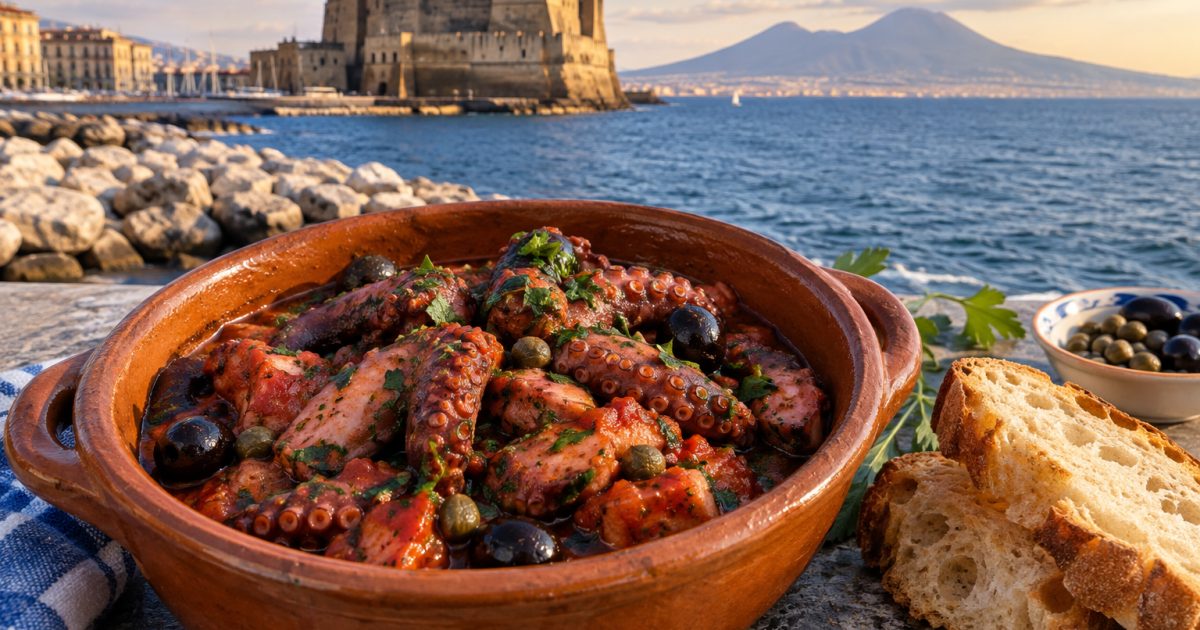
In the image, a detail related to the story.
Between Santa Lucia, Borgo Marinari, and the Gulf, octopus Luciana represents a simple, slow-cooked seafood cuisine deeply rooted in the city.
The Gulf before your eyes
Naples's waterfront leads the gaze along one of the most recognizable vistas in Campania. From Via Partenope, the sea opens up to the outline of Capri, the Sorrento Peninsula, and, on clear days, the Amalfi Coast. Opposite, Castel dell'Ovo occupies the ancient islet of Megaride, with its mass of tuff, towers, and walls that change color with the light.
At the foot of the castle, the Borgo Marinari maintains a direct connection with the port of Santa Lucia. Here, the landscape is more than just a backdrop: it's made up of boats, moorings, low rocks, salty breezes, and shifting reflections on the water. These are the same elements that help us understand the character of octopus alla luciana, a Neapolitan dish rooted in fishermen's cuisine and the need to showcase an ingredient with few available flavors.
The name actually harks back to Santa Lucia, the city's ancient seaside neighborhood. The recipe is rooted in a domestic tradition in which the octopus is cooked slowly, almost retaining its own moisture, along with tomatoes and Mediterranean aromas. It's not a dish built on complexity: its identity comes from the balance between the octopus's texture, the acidic sweetness of the tomatoes, the savory flavor of the olives and capers, and the aromatic undertone of the garlic.
A recipe born from simplicity
To prepare octopus Luciana-style, you'll need a cleaned octopus weighing about one kilogram, 400 grams of peeled or ripe cherry tomatoes, one or two cloves of garlic, black olives, desalted capers, parsley, extra virgin olive oil, and, to taste, a pinch of chili pepper. Use salt sparingly, as the olives and capers already contribute to the flavor.
- 1 cleaned octopus, about 1 kg;
- 400 g of peeled tomatoes or cherry tomatoes;
- 1-2 cloves of garlic;
- black olives and desalted capers;
- extra virgin olive oil;
- parsley and, optionally, chili pepper.
In a heavy-bottomed saucepan, heat the oil and garlic, being careful not to burn it. Add the octopus, tomatoes, olives, and capers; the parsley can be added partly during cooking and partly at the end. The pan must be tightly covered: the octopus releases its own water and cooks slowly in the resulting liquid, without needing to add much. This is one of the crucial steps in the preparation.
Cook over low heat for about 40-60 minutes, depending on the size and consistency of the octopus. A fork should be able to penetrate the thickest part without resistance, while the sauce should be reduced but not dry. If the sauce reduces too quickly, you can add a little hot water; the goal, however, is to maintain a concentrated and fragrant sauce.
Before serving, the octopus rests for a few minutes in the casserole dish. Cut into evenly sized pieces, it presents itself with the tomato clinging to the surface and a dark, glossy sauce, where the marine flavor, the vegetal note of the parsley, and the saltiness of the olives emerge. Bread is almost indispensable: it soaks up the sauce and complements the dish without overpowering it.
The flavor of Borgo Marinari
The connection between polpo alla luciana and this part of Naples isn't just the name. Santa Lucia is an area where the presence of the sea has long shaped activities, habits, and daily cuisine. Octopus, a versatile food suited to moist cooking, could be transformed into a hearty dish with preservable and readily available ingredients: tomatoes, olives, capers, garlic, and oil.
The recipe also reflects a cooking style common to many coastal areas of Campania, from the Neapolitan coast to the villages along the gulf. The proportions, the variety of olives, the use of chili pepper or parsley vary, but the logic of slow preparation remains, capable of transforming a tough mollusk into a tender and fragrant dish. In octopus Luciana-style, technique is inseparable from the landscape: the sea provides the ingredient, and the cuisine complements it with Mediterranean flavors without obscuring its identity.
The Lungomare makes this relationship clear even to those arriving for the first time. A stroll between Santa Lucia and Castel dell'Ovo allows you to observe the succession of docks, boats, and facades overlooking the Gulf. The castle, with its isolated location and connection to the mainland, introduces a historical dimension that coexists with the neighborhood's daily life. In the morning, the light highlights the pale tones of the stone and the ripples of the water; towards evening, the landscape becomes more secluded, with the profile of Vesuvius emerging across the Gulf.
A dish to be savoured slowly
Octopus Luciana-style doesn't require an elaborate presentation. It should be served hot, directly in its sauce, accompanied by rustic bread or boiled potatoes if you prefer a delicate side dish. It can also be used as a pasta sauce, especially when the cooking juices are quite abundant: in this case, the octopus is cut into pieces and the sauce is combined with the pasta using a little of the cooking water.
Its strength, however, lies in its moderation. The tomato must support the flavor of the sea, not transform it into a ragù; the garlic must flavor without overpowering; the olives and capers must add depth without making the dish overly salty. Patient cooking and fresh ingredients are more important than any addition.
Between the Borgo Marinari and the Lungomare, octopus alla Luciana finds its natural setting: a city overlooking the water, yet accustomed to transforming simplicity into gastronomic memory. After a stroll in front of Castel dell'Ovo, the dish brings the character of Santa Lucia to the table: the salty scent of the Gulf, the concentrated tomato sauce, the bread dipped in sauce, and a cuisine that continues to speak with a low, concrete, Neapolitan voice.
Breaking News
Naples, 380 kilograms of poorly preserved food seized from Panificio's bakery
Naples - Carabinieri carried out checks at a bakery on Via Funicelle, inspected along with… Read more
A search of Sessa Aurunca revealed a drug dealer with 220 grams of cocaine; a 31-year-old man was arrested.
During a house search in Sessa Aurunca, the Carabinieri found approximately 220 grams of… Read more
Maradona Stadium: CIPESS allocates €150 million; €50 million from the City Council brings the total to €200 million.
CIPESS confirmed €150 million for the redevelopment of the Diego Armando Maradona Stadium… Read more
Gricignano di Aversa: An illegal landfill site covering 700 square meters, containing approximately one ton of waste, has been seized.
The Carabinieri discovered an illegal landfill on two private parcels, with hazardous waste and… Read more
Acerra, shooting at Serd: a man and his partner in jail
The Carabinieri of the Acerra station executed, yesterday evening, a custody order… Read more
Tedér – Teatro del Rimedio in Naples presents the 2026/2027 season: big names and dialogue with the public
The event on Via Flavio Gioia, with 90 seats, offers close encounters between… Read more

National Newspaper
Registration No. 1301 of 2016 – ROC 030531
Director: Giuseppe Del Gaudio
To contact the editorial staff click HERE |
Download our Official ANDROID APP
