On the Naples seafront, pasta alla Nerano overlooks the Gulf
Between Castel dell'Ovo and the Amalfi Coast, pasta alla Nerano brings the Campanian flavor of courgettes, cheese, and basil to the Naples waterfront.

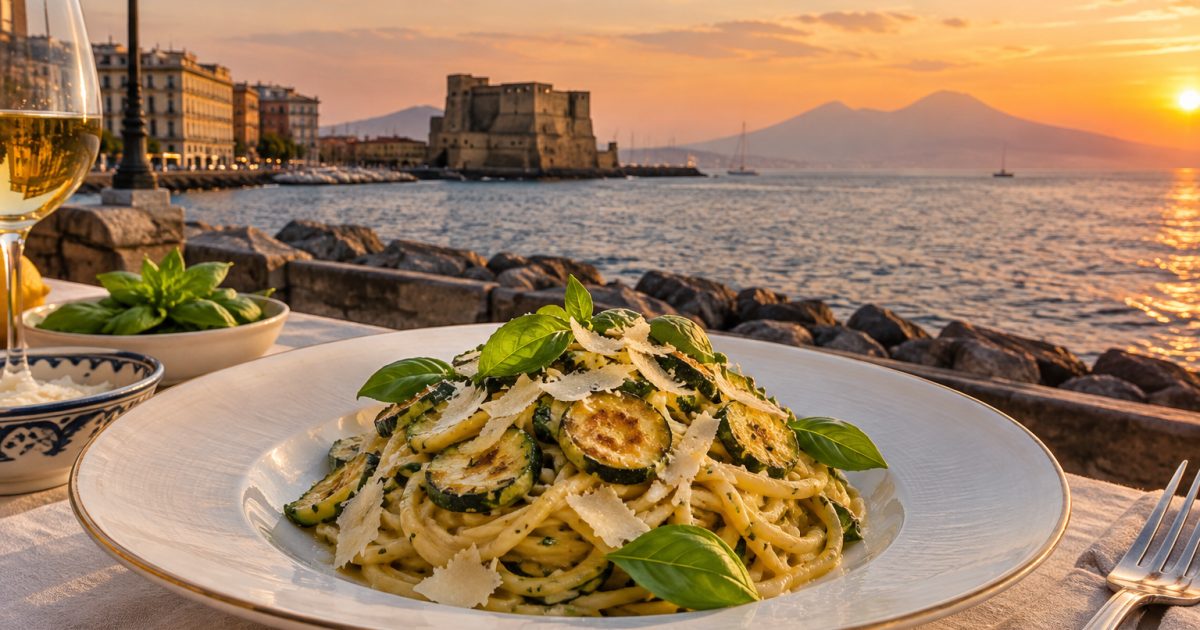
Between Castel dell'Ovo and the Amalfi Coast, pasta alla Nerano brings the Campanian flavor of courgettes, cheese, and basil to the Naples waterfront.
Naples's waterfront offers a long threshold between the city and the sea. From Via Partenope, the gaze follows the blue Gulf, past the islet of Megaride, and reaches Castel dell'Ovo, a structure built over the centuries and an unmistakable presence on the Neapolitan coast. Behind it, Vesuvius can be seen, when visibility permits, and the outline of the Sorrento Peninsula, which closes the panorama to the south.
Here, the connection with food isn't just born from the sea view. Naples also embraces the landscape through dishes that connect neighboring regions: pasta alla Nerano comes from the Amalfi Coast, specifically from the area around Nerano, a hamlet of Massa Lubrense, and connects with a city accustomed to transforming simple ingredients into distinctive dishes. Its central element isn't fish, but fried zucchini, softened by the heat of the pasta and bound with cheese.
It's a recipe that perfectly captures the essence of coastal Campania. On one side, there are the vegetable gardens of the Sorrento Peninsula, fragrant basil, and the sweetness of summer zucchini; on the other, the Neapolitan gesture of mantecatura, which seeks balance without overpowering. Looking out over Castel dell'Ovo from the waterfront, pasta alla Nerano brings a domestic dimension to the landscape: the scent of hot olive oil, the green of leaves broken by hand, the creaminess achieved away from the flame.
Castel dell'Ovo and the coast line
The route can begin from Piazza Vittoria and continue along Via Partenope, gradually drawing closer to the castle. The route is particularly visible in the morning hours, when the light highlights the hues of the water and Vesuvius emerges more clearly; at sunset, however, the profile of Megaride darkens against the sky and the waterfront takes on a more intimate feel.
Castel dell'Ovo stands on the site associated with the ancient settlement of Megaride and retains the appearance of a fortress directly overlooking the Gulf. The Borgo Marinari district at its feet adds a more tangible layer to the landscape: boats, docks, and reflections recall the daily relationship between Naples and the sea, without reducing the coast to a mere postcard.
For a gastronomic break in keeping with this scenario, pasta alla Nerano works precisely because it doesn't attempt to imitate the flavors of the sea. The dish looks to the Amalfi Coast from the agricultural side, with its vegetable gardens and crops that line the slopes. The result is delicate but not bland: the fried zucchini retains a vegetal note, the cheese adds savory flavor, and the basil lightens the overall effect.
The recipe with courgettes, cheese and basil
For four people, you'll need 360-400 grams of spaghetti or a similar long pasta shape, 700-800 grams of small, firm zucchini, about 120 grams of Provolone del Monaco, extra virgin olive oil for cooking and stirring, a few basil leaves, salt, and pepper. The traditional recipe is based on Provolone del Monaco, a stretched-curd cheese from Campania produced in the Lattari Mountains; the amount can be adjusted based on the aging process and desired intensity.
- Wash the zucchini, pat them dry, and cut them into thin, even slices. Fry them in hot oil until lightly golden, but not too dark. Drain them on paper towels and season them sparingly with salt.
- Cook the pasta in plenty of salted water until al dente. Before draining, reserve a cup of the cooking water: the starch will be essential for creating a creamy consistency.
- Transfer the pasta to a large skillet with some of the zucchini and a little of the cooking water. Stir over low heat, gradually adding the grated cheese.
- Turn off the heat before finishing the creaming. Add the remaining zucchini, the hand-torn basil, and, if desired, a very lightly ground pepper. Stir the mixture until the cheese melts without forming lumps.
The crucial step is to control the temperature. If the cheese is added over a high flame, it tends to solidify; with the residual heat from the pasta and the starchy water, however, it becomes a cream that envelops the spaghetti. Even the zucchini requires moderation: some goes into the creamy sauce, while some slices can be left whole to provide a contrast between softness and browning.
The basil is added at the end, so it retains its fragrance. No cream, butter, or other ingredients are needed to adjust the consistency. The creaminess comes from the cheese, oil, and cooking water; the character of the dish depends on the quality of the zucchini and precise frying. For a less rich result, you can fry in plenty of hot oil, making sure the slices don't absorb too much oil.
A plate of land facing the sea
Pasta alla Nerano finds a unique setting on the Naples seafront: the dish doesn't reproduce what you see, but rather expands the landscape's narrative. While the sea suggests fish, shellfish, and saltiness, the zucchini recalls the terraced fields of the Sorrento Peninsula and the painstaking work of coastal vegetable gardens. It's a meeting of two neighboring Campanias: the urban Naples and the seaward-leaning Amalfi Coast.
After the walk, the perspective changes with each stretch: the castle appears separated from the city, the gulf opens towards the peninsula and the islands, the facades of the waterfront catch the light. In this setting, a forkful of pasta alla Nerano brings the attention back to essential details: the sweetness of the zucchini, the lingering notes of the cheese, the basil, and a cream that should remain smooth, not heavy.
The value of the experience lies precisely in the alternation. Naples offers the bustle of the city and the memory of Castel dell'Ovo; the recipe instead leads to Nerano and the agricultural landscapes of the Amalfi Coast. Between the two places runs a thread of Campanian ingredients, simple techniques, and a view of the Gulf that brings the dish back to its homeland.
Breaking News
Sarno River: Regional Council unanimously approves resolution for remediation
The Sarno River becomes a strategic priority for Campania. The Regional Council has approved... Read more
Alleged mafia boss Saverio Sparandeo has been acquitted, with charges of extortion aggravated by mafia methods dropped.
Benevento - The trial for Saverio Sparandeo, 64, ended with the acquittal of… Read more
Avellino's new Partenio project has been approved: at least 22 seats and a €72 million investment.
Avellino adds another piece to the project for the new Partenio-Lombardi highway. The City Council has… Read more
Pascale, unions are agitating: "Waiting lists are blocked and overtime funds are exhausted."
State of unrest for the health sector and research staff of the National Cancer Institute... Read more
The Galleria Principe di Napoli arcade has been cleaned and sanitized, with trash and furnishings removed.
Cleaning and restoration work at the Galleria Principe di Napoli. This morning, the… Read more
Naples, "Drug Dealers Pay Protection to the Mazzarella Clan": Shocking wiretaps in the Forcella and Case Nuove squares.
Naples - It's not just a matter of direct management. In the vast and ramified empire... Read more

National Newspaper
Registration No. 1301 of 2016 – ROC 030531
Director: Giuseppe Del Gaudio
To contact the editorial staff click HERE |
Download our Official ANDROID APP
