Palinuro, the Cilento saltwater between the bread of the fields and the sea of Capo
In Palinuro, the Cilentan Acquasale tells the story of the relationship between preserved bread, coastal gardens, and the seascape, with a simple recipe built on a balance of ingredients.

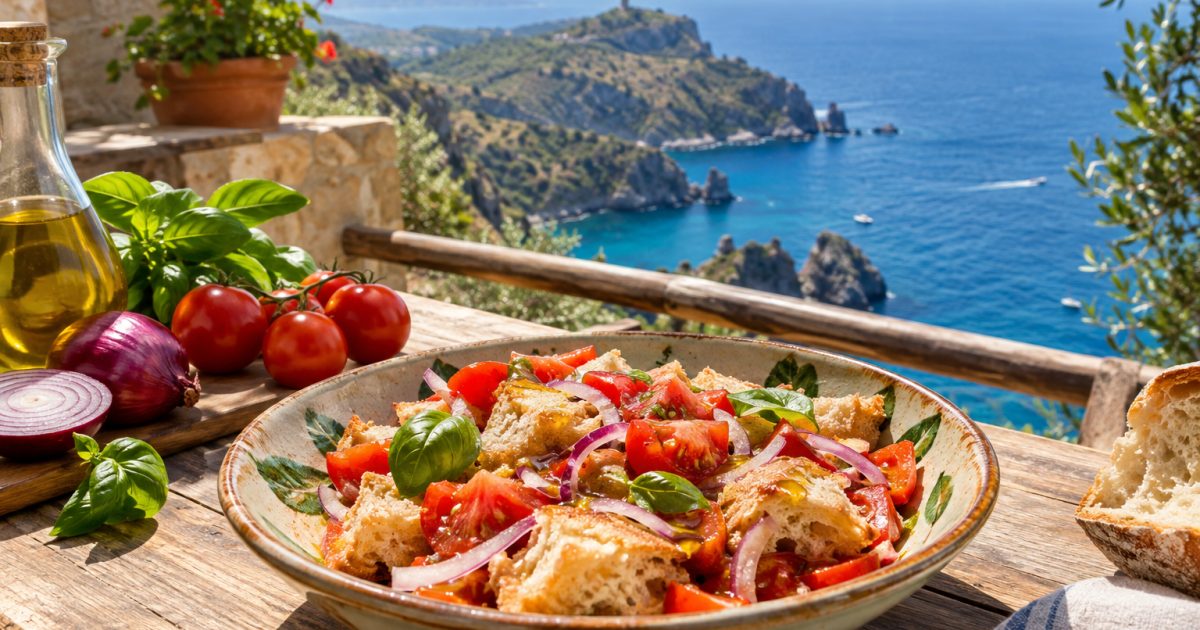
Between the Capo and the alleys of Palinuro, the Cilentan Acquasale brings together bread, tomatoes, oil and the scents of the garden in a cuisine born from moderation.
The landscape that gives meaning to the dish
Palinuro stretches out into the Tyrrhenian Sea with a compact and recognizable shape: the promontory of Capo Palinuro juts out into the sea, the rocky cliffs alternate with inlets and crevices, while the coastal paths change perspective with every bend. The water seems close even when the town retreats towards the inland roads, and the landscape maintains the connection between maritime life and a countryside of small plots of land, vegetable gardens, olive groves, and vineyards.
In this area, acquasale doesn't require rare ingredients. It's a home-made dish based on the reuse of toasted bread, or at least dry, compact bread, which was stored for longer so that it could soften with water. In Cilento, this dish is part of that everyday cuisine that transforms a few ingredients into a complete, seasonal meal. It's not a recipe exclusive to Palinuro, but here it finds a strong local connection: pantry bread, summer tomatoes, Cilento olive oil, and aromatic herbs are part of a tradition consistent with the local rural and coastal economy.
The name suggests the fundamental gesture: wetting the bread, without soaking it to the point of crumbling. Texture remains central to the experience. The bread should yield to the fork, yet still retain a firm core; the tomato adds juice and acidity, the oil binds the flavors, and the salt balances everything. It's a refreshing dish, perfect for the warmer months, when the Cilento sun ripens the vegetables and makes them more fragrant.
Bread, tomato and summer aromas
For a basic version of Cilentana acquasale, you only need a few ingredients:
- toasted bread or stale bread, preferably with a firm crumb;
- ripe tomatoes, preferably juicy and fragrant;
- extra virgin olive oil;
- salt;
- fresh basil or oregano, depending on availability and taste;
- onion, optional, chopped very thinly.
Preparation begins with the bread. If it's very hard, rinse it quickly under running water or place it in a dish with a little water on the bottom, turning it over after a few seconds. Don't leave it to soak for too long: acquasale isn't a soup, and the bread must retain its structure. Once softened, remove any excess water with a light pressure of your hands.
Tomatoes are cut into wedges or irregular pieces directly on top of the bread, thus collecting their juice. If the skin is thick, you can cut the tomato and let it rest for a few minutes with salt, then add it along with the juice it has released. This step makes the dressing more uniform without resorting to sauces or cooking.
Then add the extra virgin olive oil, the finely sliced onion, and the basil torn by hand, or a small amount of oregano. Salt should be carefully measured, especially if the bread is already salty. The acquasale should sit for a few minutes: this allows the bread to absorb the tomato and the oil to release its aromas. Before serving, it's a good idea to taste and adjust the consistency with a few drops of water, if necessary.
Familiar variations may include other garden produce or, in coastal areas, ingredients based on availability at the time. The most readable version, however, is the one built on the contrast between soft bread and fresh tomatoes. It's a dish that calls for ripe vegetables and a balanced oil, not a long list of additions.
A simple cuisine facing the Tyrrhenian Sea
Savoring Acquasale in the Palinuro area means recognizing the value of a cuisine created to avoid waste and embrace the seasons. Bread preserves the labor of grains and the oven; tomatoes bring summer light to the plate; oil introduces the constant presence of Cilento olive trees. These are common elements, but their meaning changes when they are brought back to the landscape that has accompanied them for generations.
The perfect time is during the middle of a hot day, after a stroll along the promontory or before continuing on to one of the coastal coves. No elaborate equipment is needed: just a large plate, the right amount of bread, and a few minutes of rest. The freshness of the tomato lightens the bread's density, while the herbs recall the Mediterranean vegetation that grows between the walls and paths.
When the dish arrives on the table, the landscape of Capo Palinuro becomes more than just a backdrop. It's the key to understanding that combination of simplicity and intensity: the open sea, the pale rocks, the wind, and the nearby vegetable gardens come together in a recipe that seeks balance rather than show. The Cilentan acquasale thus remains a tangible form of gastronomic memory, capable of recounting Palinuro through the taste of bread, the juice of tomatoes, and the meticulous use of olive oil.
Breaking News
Calabritto, 10,000 square meters of land seized with 1,000 cubic meters of hazardous waste.
An area of approximately 10 square meters and two buildings were seized by the Carabinieri Forestali… Read more
Sant'Antimo, police checks: 220 people identified and 87 vehicles inspected.
State Police conducted extraordinary checks in Sant'Antimo, where yesterday a… Read more
EAV reconsiders, Vesuvian and Phlegraean trains restart
Naples - After a U-turn a few hours ago, EAV has reactivated rail traffic... Read more
Paolantoni at Feltrinelli: 'Despite Me,' fifty years of stage presence in one book
Francesco Paolantoni brings his autobiography to bookstores. Friday, October 9th, at 6:00 PM, at Feltrinelli… Read more
Pozzuoli, Church of the Angel, the Court sets the hearing for October 27th.
The Court of Naples, Sixth Civil Section, has set the hearing on October 27, 2026, on… Read more
Naples: Hundreds rally in Scampia against the Camorra
Naples — Hundreds of students, citizens, and representatives of the third sector marched this morning… Read more

National Newspaper
Registration No. 1301 of 2016 – ROC 030531
Director: Giuseppe Del Gaudio
To contact the editorial staff click HERE |
Download our Official ANDROID APP
