Football has reached the end of the line: when business devours passion
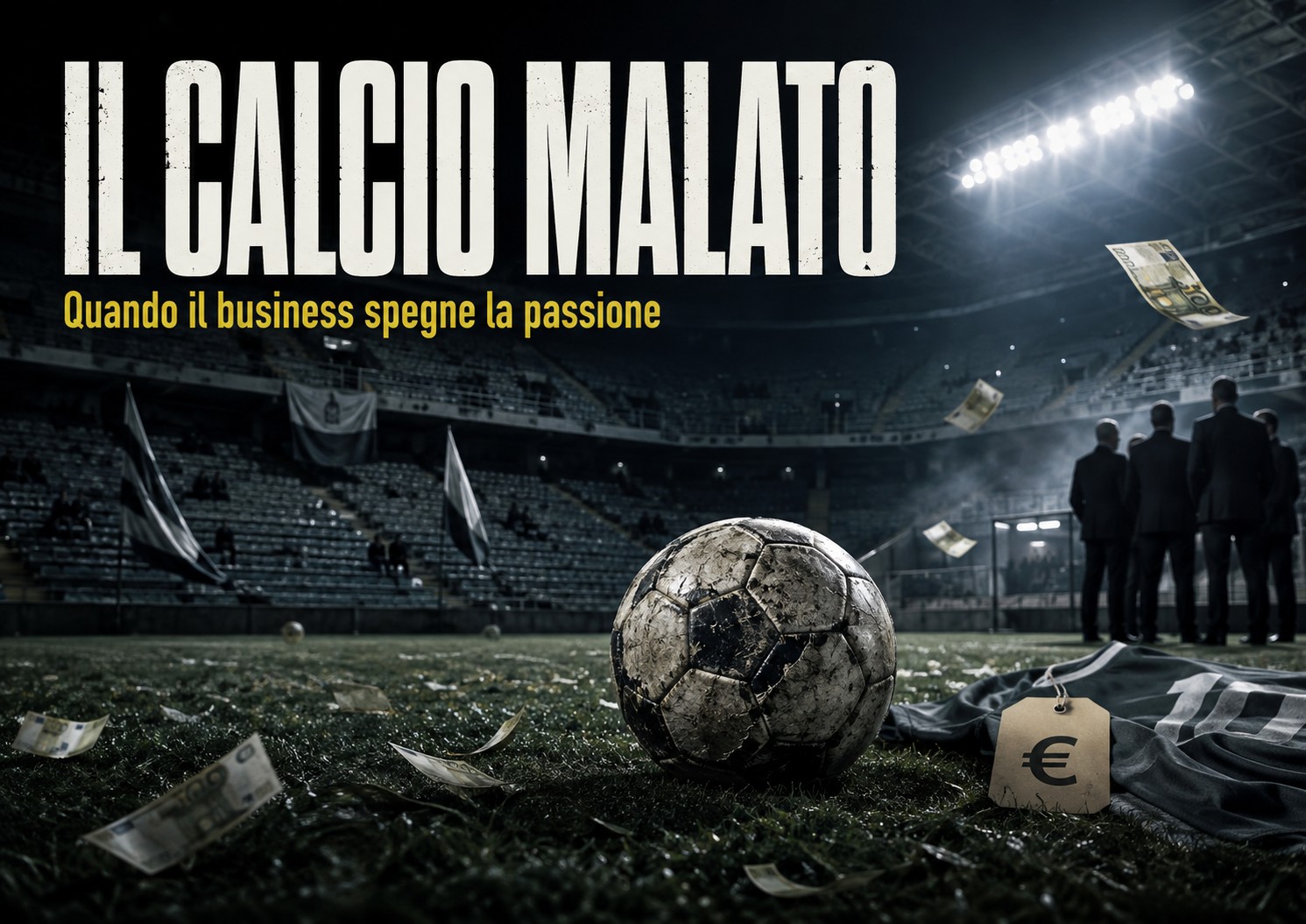
In the image, a detail related to the story.
Something's broken in football. And in Italy, perhaps more than anywhere else, that crack has now become a chasm.
You can feel it in the simplest things. In the lack of desire to shout "goal." In the excitement that has faded. In the Monday morning discussions that aren't what they used to be. In the fan who follows their team almost out of habit, but often without that fever that used to transform ninety minutes into a part of their week.
It's not just nostalgia.
It is the consequence of a process that has lasted years: football has progressively stopped being first and foremost a sport and has become above all a business.
And when money, instead of being a tool, becomes the main goal, sooner or later something loses its soul.
Italian football has long been on a slow decline, one that isn't just about international results, stadiums, or technical quality. It's a much deeper impoverishment: cultural, social, and emotional.
There are companies transformed into small personal kingdoms, presidents who seem like overbearing bosses impossible to question as long as the toy continues to generate money, managers who think only in terms of capital gains, agents, intermediaries, sponsors, television rights, and revenue.
Then there are the footballers.
Twenty-year-olds who can earn amounts of money that a normal person wouldn't even accumulate in several lifetimes.
And this is where the issue becomes more delicate.
There's nothing wrong with rewarding talent. Those who possess exceptional qualities, put on a show, and generate enormous revenue deserve to be paid a lot. But there's a question that modern football no longer seems willing to ask: is there a social responsibility associated with such enormous wealth?
Does earning three million euros a year instead of two, for those already at that level, really change the quality of life?
Probably much less than that million could change the lives of hundreds or thousands of other people.
It could support research. Fund a hospital department. Help a school. Create scholarships. Support associations. Restore dignity to families in need. Fund sports facilities in poor neighborhoods. Allow children who can't afford it to play sports.
It's not about expecting a footballer to hand over his earnings to the community.
It's about recovering a much simpler concept: the awareness of one's own good fortune.
There are, of course, footballers who donate to charities, support organizations, and use their fame for important causes. It would be profoundly unfair to ignore them.
But too often what contemporary football showcases is a different model: cars costing hundreds of thousands of euros, watches, villas, holidays, ostentatious luxury, advertising contracts, and a constant pursuit of monetization.
As if the only goal was to accumulate as much as possible during the few years of a career.
Meanwhile, a policeman can risk his life for a normal salary.
A doctor spends an entire night in the emergency room trying to save people.
A worker enters a factory every morning without knowing whether that factory will still exist in a few months.
A teacher has the education of dozens of children in his or her hands and often works with insufficient resources.
They are very different jobs and it would be pointless to compare them economically in a simplistic way.
But the disproportion between the social value of certain professions and the wealth produced by football should at least force us to reflect.
Because a great footballer could become something much more important than a rich athlete.
It could become a point of reference.
A person who says: “I've been lucky. My talent has given me so much. Now I want to give something back.”
At that moment he would stop being perceived as a character belonging to a distant world and would return to being part of the community.
And perhaps this very distance is one of the reasons why football is less exciting.
Once upon a time, the champion seemed extraordinary, but at the same time he seemed to belong to the same society as the fan.
Today many protagonists seem to live inside a bubble.
The fan pays the television subscription.
Pay the ticket.
Pay for the trip.
Pay for the shirt.
Pay for the merchandising.
And we keep hearing that that is the price necessary to sustain modern football.
Then maybe you get to the end of the month having to deal with bills, mortgage, groceries, children and salaries that don't grow.
It's difficult to build belonging when economic distance becomes a chasm.
And it's difficult to talk about popular football when an official shirt can turn into a significant expense for a family.
For a father or mother, buying a team shirt for their child is not simply buying a product.
It's giving him a sense of belonging.
It's telling him: “These are our colors.”
Why not imagine more accessible merchandising then?
The premium jersey can continue to exist. But alongside it, there could be a more affordable official line, made with less expensive materials but still dignified and authentic.
Sweaters, scarves, and gadgets designed to suit every budget.
Don't implicitly force a family to choose between spending a large sum of money or buying a counterfeit product.
This would also be common sense.
A very simple word, which has become almost revolutionary in modern football.
To understand how much the relationship between football and people has changed, just step into a bar.
Until a few decades ago, Monday mornings were almost a supplement to the championship.
We were arguing.
We were discussing.
We analyzed the missed penalty, the missed goal, the coach, the team.
You could talk about a match for hours.
Today we hear people say much more often:
“It's always the same story.”
Or:
“I couldn’t even see it properly because the streaming was freezing.”
It almost seems like a joke, but inside that sentence there is a perfect picture of contemporary football.
Once upon a time, you might not have watched the match at all.
You listened to it on the radio.
Yet a voice, some background noise and imagination could convey more emotion than many modern matches watched in high definition.
Because technology can improve the image.
It cannot create passion.
That comes from a sense of belonging.
It comes when you feel that that team represents something of you.
When you recognize in the footballers, the club and the stadium a piece of your city and your community.
The real problem, then, is not just economic.
It's cultural.
It's the mentality of the entire system.
Because even the most enlightened president can find himself trapped in a mechanism that continually demands new revenues.
The prosecutor wants to make money.
The footballer wants to earn money.
The footballer's family wants to maximize the contract.
The company wants to increase turnover and value.
Televisions want subscriptions.
Sponsors want visibility.
Platforms want users.
Each one, taken individually, can even have its own logic.
But by putting all these interests together, a system is created in which the fan risks being considered above all a customer.
And that's where football loses.
Because the fan is not just any customer.
Customers change supermarkets when they find better prices.
Fans often remain attached to their team for life.
And this very loyalty has too often been taken for granted and transformed into something to be monetized.
Tickets, season tickets, shirts, pay-TV, platforms, packages, away matches.
Always something to pay.
Always a new revenue stream to chase.
Always a growth percentage to present.
But until when?
A system can grow economically while dying emotionally.
And this is perhaps the greatest risk in Italian football.
There is no need to artificially return to the past.
That football will not return and it probably would not even be possible to recreate it.
However, we need to recover what worked in the past: a sense of proportion, closeness to people, respect for fans, the social value of sport.
Above all, common sense is needed.
We need companies capable of saying that not everything that can be monetized necessarily has to be.
Footballers capable of understanding that being champions also means being watched by millions of kids.
Managers capable of understanding that a football team is not just a company.
Sports institutions capable of creating rules that make the system more sustainable.
And we also need more aware fans.
Why do we often continue to complain about modern football while simultaneously fueling its every excess?
We demand purchases worth one hundred million.
We want the great champion.
We demand huge salaries just to convince him to sign.
Then we report the system when it presents us with the bill.
Change must start with us too.
We must return to asking societies not just for victories, but for identities.
Not just champions, but respect.
Not just trophies, but belonging.
And above all, we must demand from politics and sports institutions rules that restore balance to an environment that seems to have forgotten the very meaning of the word sport.
Football isn't dead yet.
If it were, it wouldn't make us so angry.
We wouldn't feel nostalgic.
We wouldn't argue about what should be.
We probably still have time.
But Italian football has come very close to the end of a model.
Continuing to squeeze the same system in the hope that it will produce more and more money only further alienates people.
We need to change our mentality before we even change regulations.
Remember that behind every budget there are fans.
Behind every shirt sold there is a child who dreams.
Behind every bend there is a community.
Behind every goal there should still be someone willing to get up from the couch and shout.
Because the moment we sit back and think, “It’s always the same old story,” when our team scores a goal , the problem will no longer be knowing who won the championship.
We will have lost something much more important.
We will have lost football.
Breaking News
A bouncer was mauled by a gang outside a nightclub and died in hospital. A manhunt is underway in Sangineto.
Sangineto - A summer night of fun and music transformed into a… Read more
Angela Celentano 30 years of mysteries, her parents Hope sustains the passing of time
Vico Equense - "Hope sustains the passing of time. Today marks 30 years without… Read more
Nola, dog locked in the sun at the gas station
A medium-sized dog was reported locked in a metal cage exposed to… Read more
Santa Maria di Castellabate celebrates 125 years of La Stuzza, the historic seaside palio.
On August 14th, “La Stuzza” returns, the traditional race on the slippery pole that has been… Read more
'Private' beaches in Casal Velino Marina: Borrelli (AVS) questions the Municipality and Coast Guard.
A new scandal has erupted regarding the management of state-owned maritime property along the Campania coast.… Read more
Fuel, Guardia di Finanza controls strengthened: 20 tons seized and 265 reported.
In the first five months of 2026, the Guardia di Finanza intensified its surveillance activities… Read more

National Newspaper
Registration No. 1301 of 2016 – ROC 030531
Director: Giuseppe Del Gaudio
To contact the editorial staff click HERE |
Download our Official ANDROID APP