In the Calore Valley, Sorrento-style gnocchi meet the landscape of inland Cilento.
Among the gorges, olive groves, and villages of inland Cilento, gnocchi alla sorrentina brings to the table a Campania made of tomatoes, fiordilatte, and domestic gestures.

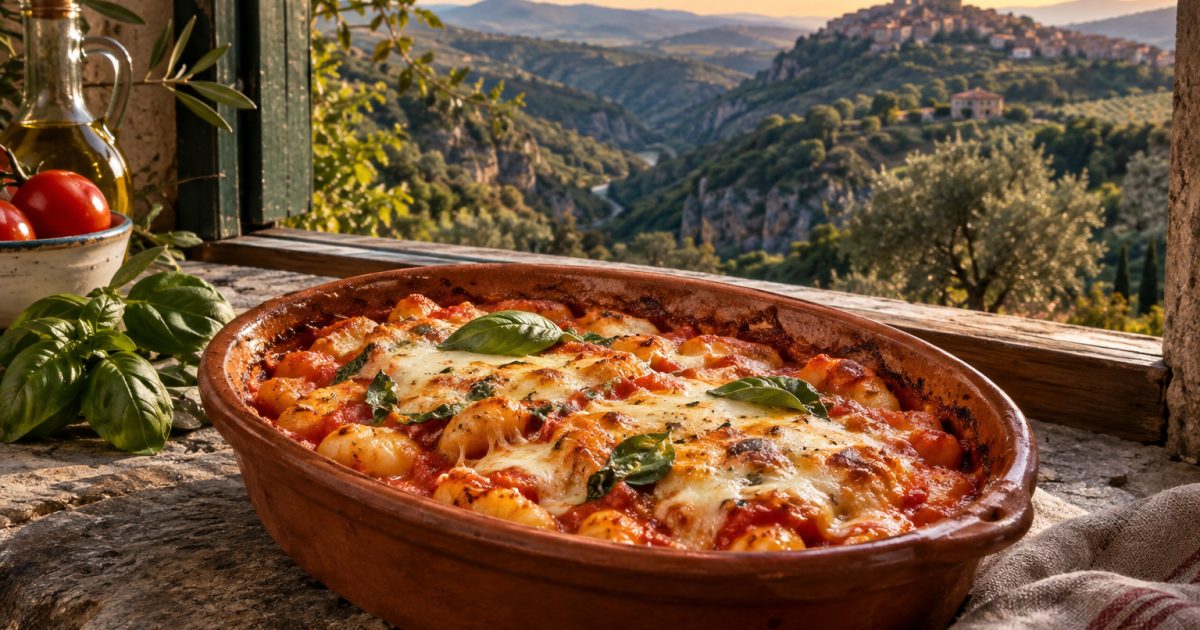
In the image, a reference to the narrated facts.
Among the gorges, olive groves, and villages of inland Cilento, gnocchi alla sorrentina brings to the table a Campania made of tomatoes, fiordilatte, and domestic gestures.
Heat, between rock, water and olive groves
The Calore Valley opens in the heart of the Cilento hinterland, far from the coastline but not far from the agricultural traditions of Campania. The Calore River flows through a landscape of ravines, wooded slopes, and small hilltop towns, while the Alburni Mountains mark the horizon with stark yet luminous silhouettes. In this part of the province of Salerno, the landscape changes rapidly: wilder areas alternate with fields, vegetable gardens, olive groves, and houses clustered along the valley roads.
Food follows the same scale as the region. Homemade recipes rely on a few ingredients, chosen for their availability and prepared without fuss. Bread, handmade pasta, legumes, garden vegetables, extra virgin olive oil, and cheeses speak to a cuisine built on seasonality and patience. Even a dish born in another part of the region can find a familiar language here, if it maintains its connection to everyday life.
Gnocchi alla sorrentina actually originates from the Sorrento Peninsula, but it belongs to a widely recognizable Campanian tradition: potato dough, tomato sauce, fiordilatte cheese, and oven-baked. In the Calore Valley, they're a dish perfect for cool days, when the warmth of the kitchen blends with the warmth of the terracotta, and the scent of basil accompanies the humid landscape of ravines and woods.
A Campanian recipe made of balance
For four people, you'll need about a kilogram of floury potatoes, 250-300 grams of flour, an optional egg, 700 grams of tomato puree or pulp, 300 grams of mozzarella, 60 grams of Parmigiano Reggiano or aged grated cheese, extra virgin olive oil, salt, and a few basil leaves. The egg isn't essential: it can help bind the dough, but a quick kneading process will yield soft gnocchi even without it.
The potatoes should be boiled in their skins, starting with cold water, until the flesh is tender in the center. After draining, peel them while still warm and mash them directly on the pastry board. It's important not to overwork them: when they become sticky, they require more flour, and the gnocchi risk losing their lightness. Then, add a pinch of salt and the flour, a little at a time, until the dough is smooth and slightly elastic. If using egg, it should be incorporated before the flour.
Divide the dough into small loaves, cut into small pieces, and, if desired, roll each gnocchi over the prongs of a fork or a special gnocchi ridger. The ridges hold the sauce better, but they're not mandatory. The gnocchi should be placed on a lightly floured surface, without overlapping, and cooked in boiling salted water. When they rise to the surface, they're ready to be removed with a slotted spoon.
The sauce requires gentle cooking. Heat the oil in a pan, possibly adding a clove of garlic, which should be removed before adding the tomato. Season with salt sparingly and simmer for about twenty minutes, until the sauce loses its most obvious acidity and acquires a velvety consistency. Add the basil toward the end or directly to the pan with the gnocchi, so it retains a more distinct aroma.
Once drained, the gnocchi are tossed with some of the sauce and transferred to a baking dish. Alternate well-drained mozzarella, more tomato, and Parmesan, avoiding overdoing it: the result should be creamy, not heavy. The final cooking takes place in a preheated oven, around 200°C (400°F), for 10-15 minutes. A final few minutes under the grill helps to create a golden brown surface, but the gratin should not dry out the center.
The oven on, the taste of Sunday
The tricky part of this recipe lies in the balance between moisture and consistency. If the mozzarella is too wet, it will release water into the pan; therefore, it's best to cut it ahead of time and let it drain. The sauce shouldn't be too runny either. Gnocchi, on the other hand, need to be cooked quickly: soaking them too long in water makes them fragile and can cause them to fall apart in the oven.
The dish arrives at the table when the cheese is still stringy and the tomato has formed a thin crust around the edges. The aroma is that of essential Campania cuisine: floury sweet potato, warm sauce, green basil, milky fiordilatte, and the savory notes of the aged cheese. No elaborate garnishes are needed; just a few fresh leaves and a drizzle of oil, carefully added.
In the Cilento hinterland, a similar dish can also be paired with a bitter salad or seasonal vegetables, which lighten the texture of the dish. Bread can be left out: the sauce should be just enough to coat the gnocchi, not turn into a rich gravy.
A table that leads back to the valley
Gnocchi alla sorrentina doesn't erase the differences between the Sorrento peninsula and the Cilento hinterland. Rather, they bring them into dialogue, using ingredients familiar throughout the region. Tomatoes evoke vegetable gardens and summer preserves, olive oil conveys the character of the olive groves, and the oven evokes a sense of domestic conviviality.
After lunch, the Calore Valley once again asserts itself with its diversity: the water flowing through the gorges, the pale stones, the lushly landscaped slopes, and the villages lining the internal roads. It's a landscape to be explored slowly, allowing the dish to linger in the memory not as an isolated interlude, but as part of a rural Campania, concrete and capable of uniting diverse territories around the same gesture: kneading, seasoning, sharing.
Breaking News
Where to watch France vs. Italy: schedule, TV channel, and streaming
Where to watch France vs. Italy? The match between the Italian national team and France is on... Read more
Naples, the €10 million fake tech empire: cash and secret chats emerge.
Naples – The investigation into the massive network of counterfeit electronic and stage equipment discovered continues… Read more
Mercogliano: A pregnant woman in her ninth month dies after being taken ill at home with her baby.
Avellino - A 32-year-old nurse, nine months pregnant, died, along with her… Read more
Naples, Roberto Bolle and Carolyn Smith are the faces of Human Faces: art in the fight against cancer.
Roberto Bolle is the new face of Human Faces – Art for Life. The star of… Read more
Afragola, man arrested for alleged abuse of 14-year-old granddaughter
Afragola - He allegedly took advantage of the moments he was alone at home to… Read more
Mafia boss Giuseppe Del Prete arrested: he was hiding in the false bottom of a closet in Forcella.
Naples - His time on the run ended at dawn, in the heart of the territory he considered… Read more

National Newspaper
Registration No. 1301 of 2016 – ROC 030531
Director: Giuseppe Del Gaudio
To contact the editorial staff click HERE |
Download our Official ANDROID APP
