S. Maria la Carità, an exotic snake abandoned on the road: CITES Carabinieri intervene.

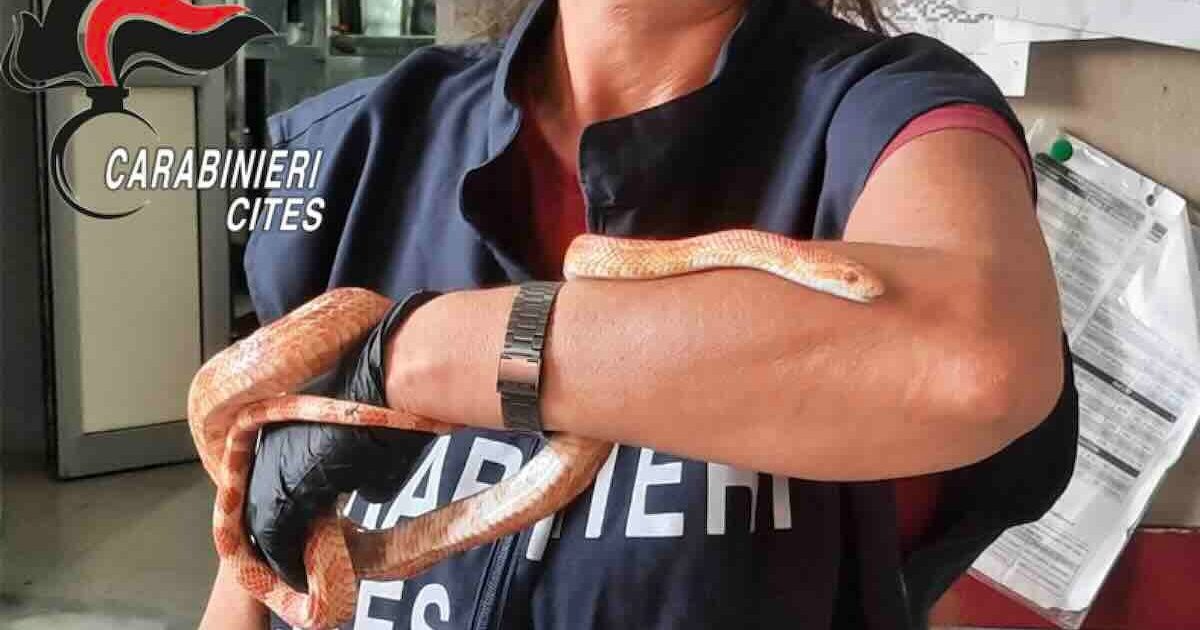
Fear and disbelief have gripped the outskirts of the municipality of Santa Maria la Carità in recent days, where a motorist suddenly encountered a completely unexpected visitor. An exotic snake was found abandoned on the roadway, amidst heavy traffic.
The alarm was raised by the Fire Brigade of the Castellammare di Stabia detachment, who immediately reported the presence of the animal to the Carabinieri CITES Unit in Naples, responsible for the protection of protected species and international trade in wild fauna and flora.
The specialized unit's military personnel intervened quickly to secure the area and recover the reptile. The living specimen, approximately one meter long, was identified as a Pantherophis guttatus, commonly known as the corn snake. This non-native species, native to North America, is widely available on the terrarium market but completely unrelated to the local fauna.
Initial investigations revealed that the snake lacked any identification system, such as the microchip required for legally owned exotic animals, making it even more difficult to reconstruct its provenance or identify its actual owner.
The animal was immediately seized and transferred to a specialized facility, where it will receive the necessary care and undergo all necessary health checks. Meanwhile, the Carabinieri are continuing their investigation to identify those responsible for this reckless act.
An episode that recalls other recent cases
This incident, which echoes the recent discovery of a ball python abandoned in a bag in the countryside outside Castel Volturno just a week ago, dramatically highlights an issue that is too often overlooked: the abandonment of exotic animals. Very often, reptiles, amphibians, or small mammals are purchased on the wave of enthusiasm, perhaps underestimating the true ethological and management needs of these creatures.
Caring for an Exotic Pet: Skills and Responsibilities
Caring for an exotic animal isn't simply about providing it with an occasional meal. It requires specific skills, adequate space, expensive equipment—such as heated enclosures with controlled humidity—and a thorough understanding of current regulations. When the novelty wears off, or when the animal grows and management costs increase, people unfortunately succumb to the temptation to illegally dispose of it.
This behavior is not only vile and cruel, often condemning the animal to certain death from starvation or the unsuitable temperatures of our climate, but it is also a punishable offense. Article 727 of the Italian Criminal Code provides for a prison sentence of up to one year or a fine of €1.000 to €10.000 for anyone who abandons pets or animals that have acquired habits of captivity.
In addition to the criminal penalty, the abandonment of exotic species represents a potential danger to the local ecosystem and public safety, with the risk of accidental introduction of alien species that could alter the environmental balance of the area.
Breaking News
The Granatello di Portici port takes center stage in Venice with the CIPS project.
A short film celebrating the Bourbon port of Granatello di Portici will be presented at the Mostra… Read more
Messages exchanged between Sorbillo and Di Battista: I'll come visit you soon.
Naples - Gino Sorbillo also encourages Alessandro Di Battista, exchanging messages on social media between… Read more
Naples, Pascale researchers remain unemployed: "There will be no extension."
Naples - For months they had been working in the same laboratories where new… Read more
Campi Flegrei, the government is open to the special law. Piantedosi: "No magic wand, just concrete answers."
Naples - A structural response for a fragile territory that can no longer live on… Read more
Pagani, cancer patients lined up from dawn, chaos at Tortora: "We need orderly access."
Pagani - Patients forced to arrive at the hospital in the early hours of the morning, long waits... Read more
McTominay reassures Napoli: "See you soon, it won't take long."
"See you soon, Naples. I won't be long." This is the message Scott posted... Read more

National Newspaper
Registration No. 1301 of 2016 – ROC 030531
Director: Giuseppe Del Gaudio
To contact the editorial staff click HERE |
Download our Official ANDROID APP