When politics opens the door to violence: a lesson from fascism

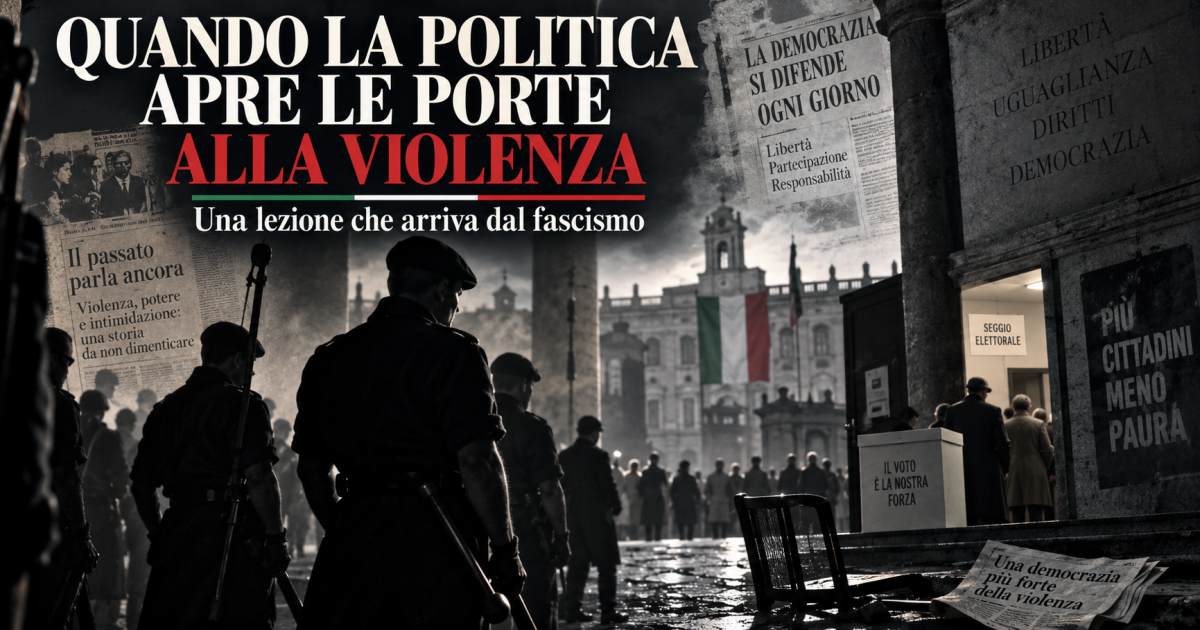
In the photo, a detail of the story.
History never repeats itself exactly the same way. But some patterns can recur. And precisely for this reason, knowing what happened in Italy in the 1920s can also be useful for more closely observing certain phenomena in contemporary politics.
When recounting the rise of Italian fascism, one often tends to focus almost exclusively on Benito Mussolini, the March on Rome, and the subsequent construction of the dictatorship.
But even before fascism became a state, there was something that contributed enormously to its affirmation: squadrismo.
Between 1920 and 1922, fascist squads carried out attacks, devastation, punitive expeditions, intimidation, and murders against socialists, trade unionists, local administrators, journalists, and political opponents.
Historical studies describe this violence not as a marginal phenomenon, but as one of the central elements of the rise of the fascist movement.
And here arises a reflection that also concerns the present.
They weren't all outcasts
We must avoid historical simplification.
The squadristi were not simply an army made up of criminals, murderers, or people on the margins of society.
Historical research reveals a much more complex reality: local fascist organizations could include landowners, students, employees, artisans, workers, war veterans, and people perfectly integrated into their communities.
This perhaps makes the story even more disturbing.
Because it shows that a society doesn't have to suddenly be populated by criminals for political violence to develop.
It is enough that violence begins to be tolerated, justified or transformed into an acceptable instrument to achieve a political goal.
At that point, very different people can feel authorized to overcome limits that, until recently, they considered insurmountable.
When the violent becomes useful
However, within the squadrismo there were also individuals with a history of extremely serious violence.
It is enough to remember Amerigo Dumini, a member of the fascist squadrism and leader of the group that kidnapped and killed Giacomo Matteotti in June 1924.
Or various local squadrismo leaders, protagonists of attacks, punitive expeditions and intimidation.
The fundamental political problem then becomes another.
What happens when a movement discovers that certain people, precisely because they are aggressive, intimidating, or willing to go beyond certain limits, can become useful?
This is where history should make us reflect.
Because it's one thing to have questionable people infiltrate a political organization.
It can happen to virtually any major party or movement.
When there are thousands of members, supporters, and local organizations, it is impossible to know anyone's personal history in advance.
And in fact, the truly significant behavior comes later: when facts emerge that are incompatible with democratic principles, an organization can distance itself, expel those responsible, and clearly reaffirm its limits.
It would be completely different, however, to consider that aggression as a political resource.
The words of leaders are never harmless
And this is where the discussion becomes relevant.
When a new political formation presents itself as the "bad guys," the tough guys, those who don't respect political correctness and who finally "scare," the message can be interpreted very differently from what the person who delivers it imagines.
For a manager it can simply be a slogan.
For a voter it can mean protest.
But for someone else it might sound like:
“There's finally room for me here too.”
And this is exactly the point that every political leader should ask himself.
Because there's always a huge difference between a sentence uttered in front of a microphone and how that sentence is received in the suburbs, in tough neighborhoods, or within groups that already have their own culture of intimidation and violence.
Politics doesn't just control what it says.
You also have to ask yourself who those words might attract.
The aggregations that should make us reflect
In recent months, public debate has seen several reports and political complaints regarding the presence, around movements and organizations, of people from environments considered violent, extremist, or related to crime.
Each individual case must of course be verified.
Being photographed with someone, participating in a demonstration, or declaring your support for a political party does not automatically prove that you have a connection to organized crime.
And above all, one fundamental principle applies: as long as a person does not commit a crime, he has the same political rights as any other citizen.
You can join a movement.
He can demonstrate.
He can campaign.
He can publicly support a candidate.
We cannot build a democracy in which someone loses their rights simply because of their reputation or their associations.
But the political problem begins when the phenomenon no longer concerns a single person.
When several individuals known in the same area for violent behavior, a history of crimes against the person or for associations with criminal circles begin to systematically gather around the same political organization, the question becomes inevitable.
Not necessarily a legal question.
But certainly a political question.
Why?
What attracts them?
What message are they interpreting?
And above all: what function could they assume in the territory?
The most delicate point is the elections
This is where perhaps the most serious risk emerges.
Let's imagine a neighborhood in which some people are known to everyone.
Not necessarily because they formally belong to a criminal organization.
But because they have a reputation for being violent.
Because they were the protagonists of attacks.
Because they exercise a capacity for intimidation that is recognized by the community.
Now imagine that, during an election campaign, those same people suddenly become very visible in their support for a particular party.
Posters.
gazebo.
Rallies.
Constant presence in the area.
And finally, election day.
When being in front of the polling station is enough
Here the issue becomes extremely delicate.
It is not always necessary to make a threat to exert pressure.
Sometimes a presence is enough.
Think of the average person who arrives at their polling station and finds four or five people they know perfectly well standing outside the entrance.
He knows who I am.
He knows what reputation they have.
He knows what happened in the past.
And he also knows publicly which candidate or movement they support.
No one necessarily has to approach her.
No one has to tell her:
“You have to vote on this.”
The pressure could already be psychological.
It could simply arise from the question:
“Did they see me come in? Will they know who I voted for? If they find out I'm supporting others, will I have problems?”
Of course, the vote is secret.
But fear rarely follows the rules of constitutional law.
And that is precisely why the problem of voter intimidation is so historically important.
The rules governing political-mafia electoral exchange and the related case law consider the use of intimidation, typical of mafia organizations, to be central to obtaining electoral consensus.
The Court of Cassation recalled that, when a mafia organization comes into play, what also becomes relevant is the ability to gain votes by exploiting that subjugation and intimidating power.
This does not mean that every suspicious presence in front of a polling station constitutes a crime.
This means, however, that the freedom to vote does not consist merely of having a pencil in your hand in a voting booth.
It also means being able to go and vote without fear.
This is where the past gets interesting
And this is why the historical comparison with squadrism, despite all the necessary differences, becomes interesting.
The squadristi did not always have to intervene physically.
In certain communities it was enough to know who they were.
Their reputation preceded them.
The violence committed the day before also produced effects the following day, without the need to repeat it continuously.
Controlling a territory can work just like this.
Violence builds reputation.
Reputation creates fear.
Fear creates obedience.
And obedience can produce apparent consent.
It is this mechanism, much more than simple political affiliation, that should interest us.
Crime and political consensus
Unfortunately, Italy is very familiar with this problem.
Over the years, anti-mafia investigations have documented incidents in which criminal organizations attempted to influence electoral contests.
A parliamentary report by the DIA, discussing, for example, the investigations into Sant'Antimo, described how local elections were influenced by clan interference, a vote-buying campaign, and the buying and selling of preferences.
It is therefore not journalistic fantasy to argue that the capacity for territorial control can also be transformed into the capacity for political influence.
It's something the Italian state has been fighting for decades.
And this is precisely why any party should be extremely cautious when groups of people capable of exercising that kind of influence appear around its territorial structures.
Not because being known to the police or having a criminal record automatically makes someone a mafioso.
But why should democratic politics have an interest in maintaining the greatest possible distance from any form of consensus built on fear?
The responsibility lies above all with the leaders
And this is where the initial problem comes back.
A leader cannot control everyone who spontaneously decides to vote for him.
It would be absurd to expect that.
A candidate cannot prevent a person with a criminal record from putting a cross on his symbol.
And he can't know the biography of every sympathizer.
But there is a huge difference between receiving a vote and building a territorial political structure.
When someone becomes a referent.
When organizing groups.
When he presides over a neighborhood.
When you bring tens or hundreds of people to events.
When he becomes recognizable as a local representative of a movement.
At that point, a political force has a duty, first of all to itself, to know who it is allowing into its organization.
Because the question can't just be:
“How many votes does it bring us?”
It must also be:
“How does he bring them to us?”
When consensus has a price
This is the real watershed.
A party can have very strong ideas on immigration.
It may be against the European Union.
It can be far right or far left.
It can be populist, conservative, socialist, liberal or anti-system.
All this belongs to normal democratic dialectics.
The problem arises when consensus is no longer gained through ideas but through pressure.
When a person votes, it's not because they're convinced.
But why is he afraid?
When a merchant displays a political symbol, it is not because he supports it.
But because he thinks it is more prudent to do so.
When an entire family avoids declaring their preferences because in the neighborhood "everyone knows" who's in charge.
This is no longer normal political competition.
It is a territory in which democracy and intimidation are beginning to dangerously overlap.
The lesson of squadrism
This is one of the most important lessons we can learn from the years of the rise of fascism.
Squadrist violence was not confined to a few isolated incidents.
It helped dismantle local communities, trade unions and opposing political structures.
The punitive expeditions created fear.
Fear changed the balance of power.
And the progressive normalization of violence helped make possible what a few years earlier would have seemed unacceptable.
This step is essential.
Because what starts out as an informal group can become an organization.
What starts out as intimidation can become a method.
What is initially tolerated because it is politically convenient may become increasingly difficult to control.
History cannot be copied
Of course, it would be wrong to argue that any contemporary populist, radical, or anti-establishment movement is automatically comparable to fascism.
It would be historically superficial.
The Italy of 1921 is not the Italy of 2026.
The institutions are different.
Society is different.
The political system is different.
There exists a democratic Constitution, a judiciary, law enforcement, information pluralism, and tools of control that were profoundly different in the Italy of the squadrismo.
History rarely returns in the same clothes.
But it can re-propose similar human and political mechanisms.
The desperate search for the enemy.
The transformation of the opponent into someone who does not deserve respect.
The glorification of the strong man.
The idea that rules are just obstacles.
The belief that a little violence is acceptable if it serves one's cause.
And finally, the willingness to welcome questionable people because they can be useful in gaining consensus.
It is on these elements that it is worth keeping our attention high.
The problem is not being “bad”
Presenting yourself as “ugly, dirty and bad” can even be a communication provocation.
The problem arises when that provocation stops being just communication and begins to become an implicit criterion for political recruitment.
Because there are people who are just waiting to feel empowered.
People who might interpret political aggression not as a metaphor but as a method.
And there are areas where personal reputation counts for a lot.
Where everyone knows everyone.
Where it is enough to see a few people in front of a gazebo or a polling station for a citizen to immediately understand who they are supporting.
This is precisely where a political leader should be even more cautious.
Because maybe nobody ordered anything.
Maybe no one asked for intimidation.
Maybe no one made any agreement.
But if the language used by that movement has led certain people to believe that this is finally the political place where their way of exercising power is welcome , a problem still exists.
At least politically.
The risk is all there
And perhaps this is the true historical anniversary we should be questioning.
Don't necessarily wait for someone to formally form a team.
Don't wait for the attack.
Don't wait for a verdict.
The question must be previous.
What kind of people are we attracting into politics?
And especially:
Why do they feel drawn to that message?
A mature democracy should be able to ask this question without automatically turning it into a criminal charge.
Because political prevention and criminal responsibility are two completely different things.
To convict someone, you need evidence.
To worry about a political dynamic, however, it is enough to observe what is happening and ask where it might lead.
And it is especially in working-class neighborhoods and the most vulnerable areas that this attention becomes fundamental.
Because there, politics doesn't just exist on talk shows.
He lives on the streets.
In the bars.
In condominiums.
In personal relationships.
In knowledge.
In reputation.
And also in fear.
This is why leaders should understand that opening doors indiscriminately does not just mean increasing the number of supporters.
It also means taking responsibility for what those supporters will do in the name, or ostensibly in the name, of that movement.
Italian history has already shown us how dangerous it can be to realize something only afterwards.
Remembering this does not mean claiming that fascism is automatically returning today.
It means something much simpler:
understand the mechanisms through which violence can enter politics before politics ends up considering it normal.
Breaking News
Temporary plan in the Phlegraean Fields for Ischia-Procida connections during construction work at the Port of Pozzuoli.
A temporary solution reorganizes connections between Ischia, Procida, and Naples for the next few days,… Read more
Striano, High Impact Checks: 138 people identified and 16 motorists fined.
Extraordinary high-impact checks in Striano, where the State Police carried out a… Read more
Castel Volturno remembers the 2008 massacre: "And now let's shut down the CPR."
Eighteen years after the massacre of September 18, 2008, Castel Volturno returns to remember the… Read more
Lanciano, Fortuna Loffredo's three children separated from their father: lawyers seek clarity.
An urgent formal notice has been sent to the main state institutions requesting clarification on the removal… Read more
A1 Highway Patrol: Money and jewelry hidden in cars: Four Campanians reported, thousands of euros worth of stolen goods recovered.
Two checks along the A1 motorway, two suspects and a haul that includes 77 thousand euros in… Read more
"100 Years of Passion," the film about Napoli's century begins: in theaters in January
A century of Napoli history becomes a film. It's called "100 Years of Passion"... Read more

National Newspaper
Registration No. 1301 of 2016 – ROC 030531
Director: Giuseppe Del Gaudio
To contact the editorial staff click HERE |
Download our Official ANDROID APP