Borgo Marinari, fried pizza between the tuff of Castel dell'Ovo and the Gulf
In the small village at the foot of Castel dell'Ovo, fried pizza tells the story of Naples through dough, ricotta, pepper, and the landscape of its bay.

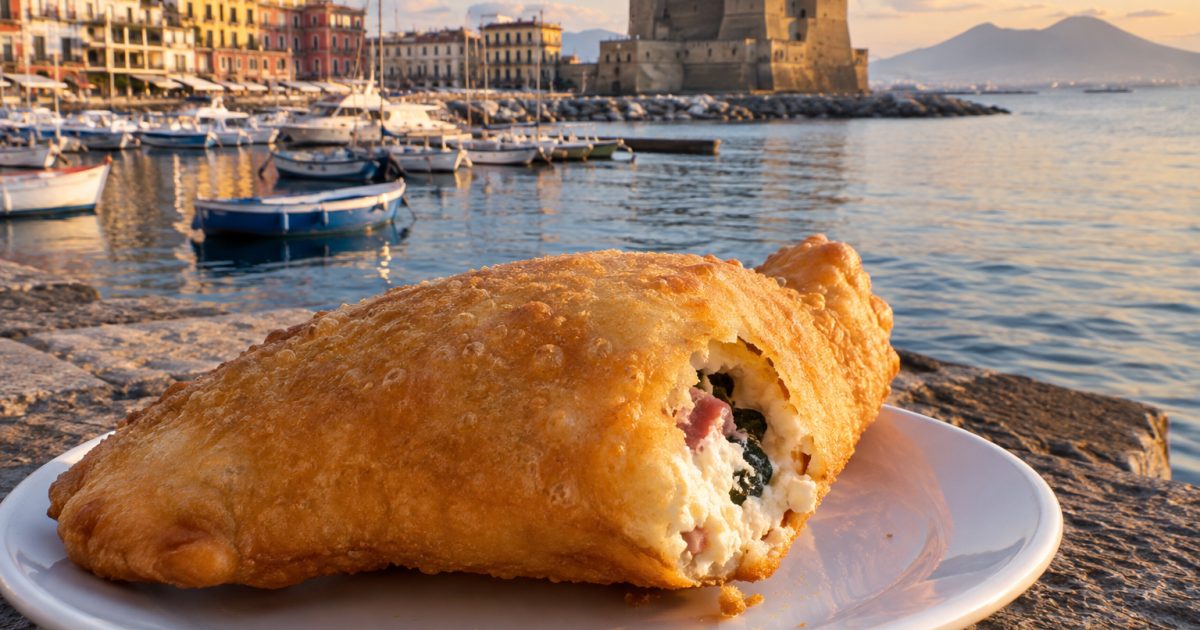
At Borgo Marinari, fried pizza meets the skyline of Castel dell'Ovo, docked boats, and the salty air of the Gulf of Naples.
Borgo Marinari is located on the islet of Megaride, connected to the mainland by a short road and nestled at the foot of Castel dell'Ovo. Here, Naples changes pace: the traffic of the waterfront remains nearby, but between the low houses, docks, and piers, the view opens out over the water. On one side, the city skyline of Santa Lucia can be seen; on the other, the gulf stretches toward Posillipo and, on clear days, the outline of the hills of the Sorrento peninsula.
Fried pizza is part of the history of Neapolitan popular cuisine and wasn't specifically born among the stones of Borgo Marinari. However, its connection to this place is direct on a cultural level: the dish is one of the most recognizable expressions of the city's gastronomic tradition, one that has transformed simple ingredients into a complete, warm, and accessible dish. In the seaside landscape of Megaride, its rustic character finds a coherent setting: the aroma of the golden dough mingles with the humidity of the harbor, while the soft filling recalls the home cooking of Neapolitan homes.
The village and Neapolitan street food
Fried pizza is primarily a craft. The dough disc is rolled out, filled, and folded into a half-moon shape or shaped into smaller shapes, then immersed in hot oil. During frying, the surface swells unevenly, forming tiny bubbles and crispier areas. The result isn't as uniform as a commercially produced product: each piece retains the traces of the movement used to close and seal it.
Its success in Neapolitan cuisine is also linked to the ability to use inexpensive and readily available ingredients. The most traditional stuffed version may include ricotta, cracklings, provolone, or salami, with a sprinkling of black pepper. There are also variations with tomato, mozzarella, or escarole, but the principle remains the same: a leavened dough casing encloses a flavorful filling and is cooked quickly.
In the Borgo Marinari neighborhood, fried pizza engages with a different part of the local tradition: seafood and simple dishes enjoyed by the water. It doesn't necessarily contain fish, and it doesn't need to be transformed into a seafood specialty to fit the landscape. Its presence is interesting precisely because it brings to the waterfront a fragment of the working-class Naples of the urban hinterland, made up of bakeries, alleyways, and everyday cooking.
How to make Neapolitan fried pizza
For four stuffed fried pizzas, you'll need about 500 grams of soft wheat flour, 300 milliliters of water, 10 grams of salt, 3 grams of fresh brewer's yeast, and a pinch of sugar to help with the rising process. For the filling, use 300 grams of well-drained ricotta, 100 grams of cracklings, 80 grams of semi-spicy provolone, black pepper, and, if desired, a little thinly sliced Neapolitan salami. You'll also need peanut oil or another suitable frying oil.
- Dissolve the yeast in the water, gradually add the flour and incorporate the salt once the dough has already taken on consistency.
- Work the dough until it becomes smooth and elastic, then cover it and let it rise for about two hours, or until it has increased significantly in volume.
- Divide the dough into four pieces, shape them into balls, and let them rest for another 30-45 minutes. This step makes it easier to roll them out without tearing.
- Mix the ricotta with the pepper and provolone; add the cracklings and salami, but don't overdo the salt, as the ingredients are already flavorful.
- Roll out each ball into a disk about 20 centimeters thick, spread the filling on one half, leaving the edge free, then close and seal carefully by first pressing with your fingers and then folding the edge over.
- Fry one pizza at a time in plenty of oil at about 170-175°C (340-350°F). Flip it when the lower side is golden brown and puffed up, then finish cooking the other side.
- Drain on paper towels and wait a few minutes before serving: the filling will remain very hot and the ricotta will need to settle.
The oil temperature is crucial. If it's too low, the pasta absorbs fat and becomes heavy; if it's too high, the surface browns before the inside is cooked. At home, you can test it with a small piece of dough: it should rise surrounded by bubbles, without burning quickly. The filling should also be used sparingly: too much makes it difficult to seal and can cause the pasta to open during frying.
Fried pizza should be enjoyed hot, but as soon as it's removed from the oil. The first bite should be met with a thin, flaky crust, followed by the softness of the ricotta, the more intense flavor of the cracklings, and the pungent aroma of the pepper. It's a distinct, almost contrasting texture that explains the dish's popularity in Neapolitan cuisine: a few recognizable elements, combined in a hearty preparation.
At Borgo Marinari, the route continues along the quay and around the walls of Castel dell'Ovo. The light changes on the facades, the boats barely move, and the gulf echoes with muffled sounds. In this setting, fried pizza doesn't become a seafood dish, but remains what it is: an urban, popular, and Neapolitan specialty, capable of bringing the warmth of street food to a landscape suspended between the city and the water.
Breaking News
Accenture is seeking a Cyber Defense Expert for security consulting in Naples, Bari, Milan, Rome, and Turin.
Accenture is seeking a Cyber Defense Expert for a security consulting role. Full-time position in various… Read more
Arzano, widespread checks in shops: fines and seizures
Tight controls are being implemented in the Arzano area, where in recent days the Carabinieri have intensified operations… Read more
Camorra: Supreme Court overturns seven Pagnozzi clan convictions
The legal case surrounding the Pagnozzi clan returns once again to the judges of… Read more
Accident on the Telesina state road: one dead, two injured
One person died and two others were injured in a car accident on… Read more
Illegal campsite seized in Palinuro
An entire campsite of approximately 8 square meters has been seized in Palinuro,… Read more
Palinuro, the Cilento saltwater between the bread of the fields and the sea of Capo
In Palinuro, the Cilentan salt water tells the story of the relationship between preserved bread, coastal gardens, and the seascape… Read more

National Newspaper
Registration No. 1301 of 2016 – ROC 030531
Director: Giuseppe Del Gaudio
To contact the editorial staff click HERE |
Download our Official ANDROID APP
