Naples, Domenico Caliendo's death, the Court of Appeal: 'Bergonzoni acted in subjugation of Oppido'
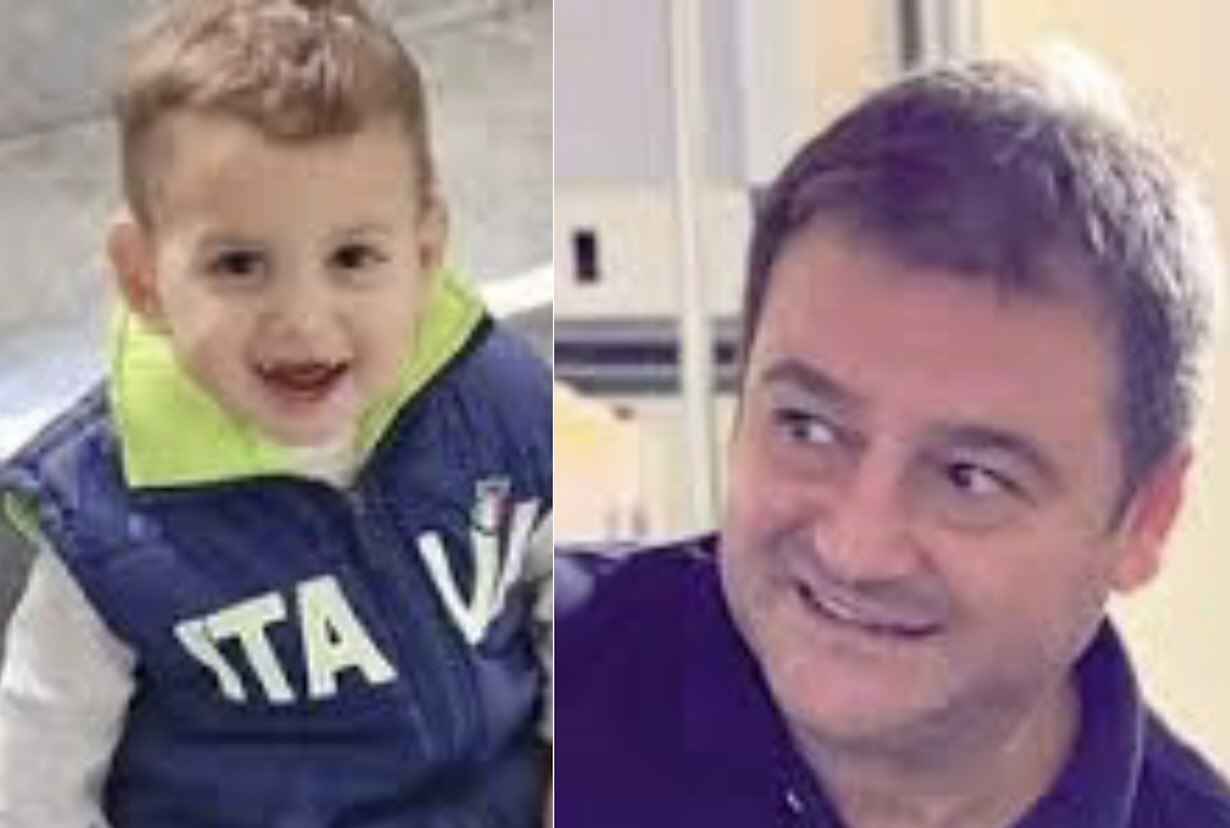
Guido Oppido and little Domenico Caliendo
Naples – The decision of the Eighth Section of the Naples Review Court introduces a factor that will weigh heavily in the judicial reconstruction of the death of Domenico Caliendo, the two-and-a-half-year-old boy who died on February 21st after the failure of a heart transplant performed on December 23rd at the Monaldi Hospital.
The judges overturned the precautionary medical disqualification order against Emma Bergonzoni, the young cardiac surgeon who was in the operating room that day alongside the head surgeon, Guido Oppido, the first operator in the delicate procedure. Oppido's disqualification, however, remains in effect.
The issue is not the existence of the forgery alleged by the Prosecutor's Office. The appeal filed by Bergonzoni's defense attorneys, Vincenzo Maiello and Emanuele Raimondo, did not challenge the falsity of the passages in the surgical report alleged by the defendants. The issue before the preliminary hearing court, rather, concerned the existence of the precautionary measures against the cardiac surgeon.
"She didn't act to protect herself."
The judges' reasoning focuses precisely on the individual position of the young doctor.
According to the preliminary investigations court, Bergonzoni allegedly contributed to the false report "not to protect his own personal situation," but to conceal any liability on the part of the first operator, liability that will in any case have to be determined in the trial on the merits.
An important distinction. For the judges, therefore, the cardiac surgeon's conduct cannot be interpreted separately from the specific professional relationship she had with Oppido and the circumstances under which the document was drafted.
Bergonzoni, the judges emphasized, was 33 years old and was working alongside Oppido for the first time in a heart transplant. The head surgeon, on the other hand, had a higher rank and more experience. Furthermore, the young cardiac surgeon had also been his student.
A set of circumstances which, according to the Court, determines a situation of particular professional subjection.
The hierarchical relationship and the role of student
The ordinance highlights the age and experience gap, but above all the different positions occupied by the two doctors within the hospital organization.
On one side, the head physician and first operator, on the other, a young doctor who assisted him in the operating room. Added to this is the personal and professional relationship that developed over the years of training.
It is on the basis of this scenario that the Review Court deems it "legitimate to conclude" that Bergonzoni acted "under the impulse of a condition of subordination and subjection peculiar to the figure of Dr. Oppido", consciously adopting a reconstruction agreed upon with the head physician.
A reconstruction which, according to the judges, "protected Oppido above all."
The report and the responsibility of the head physician
There is another significant point in the decision. Even though he did not physically sign the surgical report, Oppido remains, according to the Court, primarily responsible for the accurate reporting of the surgery he directed.
The head physician, in fact, would have acknowledged the authorship of the content of the document.
This aspect assumes particular importance in assessing the responsibilities contested by the Prosecutor's Office. The report is therefore considered not only as the result of the young cardiac surgeon's work, but as a document primarily attributable to the doctor who directed the operation.
The decisions on the intervention were not up to Bergonzoni
The preliminary investigation also examines the role actually played by the 33-year-old during the operation.
Bergonzoni, the judges pointed out, was not responsible for deciding the timing of the surgery. It was not her responsibility to decide when to initiate extracorporeal circulation, or CEC, or when to proceed with clamping the aorta.
This is an important step because it delimits the operational responsibilities of the young cardiac surgeon compared to those of the first operator.
The operation, which resulted in the death of Domenico Caliendo, is described by the Court as characterized by "a series of concurrent offenses." But Bergonzoni's position must be evaluated in light of the specific functions she was assigned to perform in the operating room.
An episode considered exceptional
Even from a precautionary perspective, the Review Court excludes that the contested conduct can be considered the manifestation of a general propensity on the part of the cardiac surgeon to falsify the reality of the interventions in which she takes part.
According to the judges, the forgery would have occurred in an exceptional situation, determined above all by the "inability to oppose the directions and wishes" of someone who was superior to her due to authority and the existing professional relationship.
In other words, the Court did not find that the young doctor posed any autonomous professional danger that would justify continuing the ban.
The suspension of Oppido changes the precautionary scenario
This is precisely where the decision to cancel the measure comes in.
The suspension from Oppido's service, already ordered as part of the investigation, is considered sufficient to prevent the recurrence of the conditions which, according to the reconstruction of the
Upon re-examination, they would have pushed Bergonzoni to participate in the drafting of the fake.
Since the presence of the head physician in that hierarchical and professional position has disappeared, according to the judges, the concrete risk of repetition of the conduct accused of the young cardiac surgeon has also disappeared.
For this reason the ban from practicing the profession is cancelled.
The legal proceedings surrounding Domenico's death
The decision is part of the investigation launched by the Naples Prosecutor's Office into the death of Domenico Caliendo, who died on February 21 after a heart transplant performed at the Monaldi Hospital on December 23.
The case remains open regarding the determination of responsibility. The preliminary investigation court, in fact, has not absolved Bergonzoni of the charges and has not definitively established responsibility for the child's death. It merely assesses the legitimacy and necessity of the precautionary measure against him.
And the distinction between liability to be ascertained on the merits and the prerequisites for precaution represents one of the central points of the ruling.
Oppido's ban, however, was upheld. For Bergonzoni, the precautionary framework changed radically: the judges acknowledged her involvement in the medical report, but placed it within a hierarchical and professional relationship in which, according to their reconstruction, the young doctor assumed a subordinate position to the chief physician.
Breaking News
Fausto Lamparelli is the new police commissioner of Naples
Naples - Fausto Lamparelli will be the new police commissioner of Naples. Married and with a son,… Read more
She died after surgery at the Cardarelli Hospital. Consultants ruled out medical negligence: "Diligent and prudent conduct."
Naples – No professional liability has emerged against the head physician Felice Pirozzi and the… Read more
Castellammare, a tilted elevator and parking on Monte Solaro: the administrative mystery surrounding the PUT bypass.
Castellammare - A battle against concrete or institutional distraction? All the unresolved issues of Lot III... Read more
Ranucci, the Court rejects the appeal: no reinstatement at Report
Two weeks after the hearing, the Rome Labor Court rejected the urgent appeal... Read more
SuperEnalotto: No 6s in the October 9nd draw, jackpot at €38,8 million
Superenalotto, here's the winning combination: 18 - 35 - 44 - 56 - 76 - 82 Number… Read more
10eLotto Winning Numbers for Today, October 9, 2026
In this evening's 10elotto draw, the following numbers were drawn: 04 – 10 –… Read more

National Newspaper
Registration No. 1301 of 2016 – ROC 030531
Director: Giuseppe Del Gaudio
To contact the editorial staff click HERE |
Download our Official ANDROID APP
