Palinuro and Capo Palinuro: babà among sea caves, cliffs, and the scent of citrus fruits.
At Capo Palinuro, the Neapolitan babà meets the Cilento landscape: a soft dessert, soaked in rum and citrus, to be enjoyed while gazing out over the Tyrrhenian Sea.

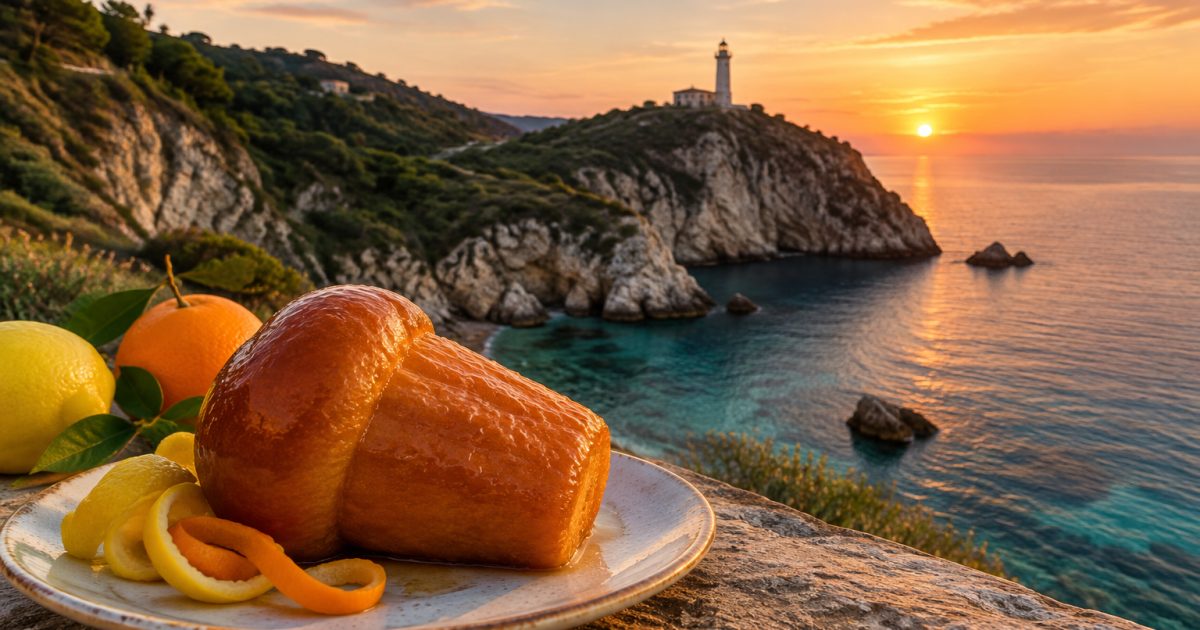
In the image, a context connected to the facts.
Between the lighthouse of Capo Palinuro, the cliffs, and the blue of the Tyrrhenian Sea, the babà brings a sweet memory of Naples to the Cilento coast, made of leavened dough, rum, and citrus fruits.
Palinuro stretches out into the sea, its landscape changing at every turn: on one side, the promontory, punctuated by inlets and rocky cliffs; on the other, the town, nestled between the harbor, steep roads, and sudden openings to the horizon. Cape Palinuro is the point where the coast reveals its wildest character, with the lighthouse overlooking the promontory and the sea caves accessible, in the right seasons, by boat.
Here, food cannot be separated from the landscape. The fresh fish, inland vegetables, extra virgin olive oil, and Cilento produce express a cuisine rooted in availability and simplicity. The babà, on the other hand, follows a different trajectory: it is a dessert deeply associated with Neapolitan tradition, yet also finds a natural interpretation along the Cilento coast. Its porous structure holds the syrup like rock holds seawater in the caves of the promontory; the citrus aroma recalls the gardens of Campania, while the rum adds a warm, lingering note.
The promontory where the sweet looks at the sea
The best time to observe Cape Palinuro is when the light is not yet vertical. In the morning, the sea changes from turquoise near the coves to a deeper blue offshore; in the afternoon, the cape's walls cast sharp shadows, and the outline of the lighthouse becomes a landmark. A stroll near the promontory, or a stop on Palinuro's seafront, helps you grasp the connection between the town and the sea, without reducing it to a mere postcard.
Baba fits into this scenario by contrast. It's neither dry nor crunchy: it requires time, moisture, and a well-distributed syrup. Served at room temperature, it offers a soft and supple texture, with a shiny surface and a saturated but not mushy center. This is where the balance lies: the syrup must penetrate deep into the batter without overpowering the flavor.
In Campania, babà can be prepared in individual molds or in a larger cake mold to be cut. In Palinuro, a version enriched with lemon or orange zest doesn't need to claim local origin to be authentic: the citrus fruit simply needs to be a fresh presence, not a dominant aroma. Rum also needs to be used carefully, especially if the dessert is served after a seafood meal.
How to make a soft and well-soaked baba
The recipe requires patience rather than complex techniques. The dough must develop an elastic texture, while the syrup should be poured while the cake is still warm, so as to facilitate absorption without breaking the structure.
- For the dough: 250 grams of strong flour, 3 medium eggs, 60 grams of soft butter, 25 grams of sugar, 8 grams of fresh brewer's yeast, a pinch of salt and 30-40 grams of milk, to be added gradually.
- For the syrup: 500 milliliters of water, 220 grams of sugar, the thin zest of an unwaxed lemon, the zest of half an orange, and about 100 milliliters of rum. The amount of rum can be reduced or partially replaced with water if the dessert is intended for children.
- To complete: a little apricot jelly or a smooth jam, optional, to glaze the surface.
Dissolve the yeast in the lukewarm milk and add it to part of the flour. After a few minutes, add the eggs, one at a time, then the sugar and salt. Add the softened butter in several batches, waiting until it's fully absorbed before adding the next batch. The resulting dough should be very soft, elastic, and slightly sticky.
After an initial rise in a covered bowl, the dough is transferred to the buttered molds, filling them a little more than a third full. The second rise is complete when the dough reaches the top. In a conventional oven at 180°C, small molds typically take 20-25 minutes; a larger mold may need more time. The baba is ready when it is golden brown and dry in the center.
To make the syrup, boil water, sugar, and zest briefly, then let the syrup cool before adding the rum. The cake, unmolded and still warm, is pricked with a toothpick and slowly drizzled, turning it several times. Don't pour it all in at once: the gradual absorption prevents the bottom layer from becoming excessively moist. A light glaze completes the preparation, while the custard or whipped cream, if used, is optional and not necessary.
A sweet break along the Cilento coast
The babà tastes best after a few hours of resting, when the syrup has spread and the citrus aromas have blended with the rum. It's a dessert best served slowly, perhaps after a stroll between the center of Palinuro and the sea, or at the end of a day spent exploring the promontory and its coves.
In the landscape of Capo Palinuro, babà becomes not a local specialty, but a meeting of Campanian regions. Its identity remains Neapolitan; the context changes the way it's enjoyed. The soft crumb, the bright syrup, and the citrus zest accompany the gaze back to the lighthouse, the rocks, and the open profile of the Tyrrhenian Sea. In Palinuro, even a familiar dessert can find a different rhythm: the slow rhythm of the coast, between a fading light and the sea that continues to move beneath the promontory.
Breaking News
Naples: Star of the Match raises €40.000 for the Autonomy Gym.
The second edition of the Star of the Match Charity Dinner, promoted by Euronics Tufano together… Read more
Mondragone, drunk and drugged while driving, flees the carabinieri checkpoint, arrested after a chase
A chase through the streets of Mondragone ended last night in Piazza Conte,… Read more
Naples: Metropark at Central Station: More than a quarter of passengers report unsafe rides.
A FlixBus survey of Italian bus stations, conducted between June and August 2026 on 871 participants, highlights… Read more
Giugliano Hospital launches 'pink pathway'
At Giugliano Hospital, the Pink Pathway, a protocol of the… Read more
Agerola Municipality is seeking two full-time Technical Instructors.
The Municipality of Agerola is initiating the permanent employment of two Technical Instructors in the Public Works and… Read more
The Warrior of Books: Presentation of the book on Guerriera Guerrieri at the Campania Libri Festival in Naples
In the book La guerriera dei libri by Vincenza Alfano, Guerriera Guerrieri, director of… Read more

National Newspaper
Registration No. 1301 of 2016 – ROC 030531
Director: Giuseppe Del Gaudio
To contact the editorial staff click HERE |
Download our Official ANDROID APP
