Taburno and Sannio Benevento: eggplant parmigiana among vineyards, vegetable gardens, and hills
In the Taburno landscape, eggplant parmigiana finds a rural setting: tomatoes, basil, and cheese tell the story of the season in Campania's vegetable gardens.

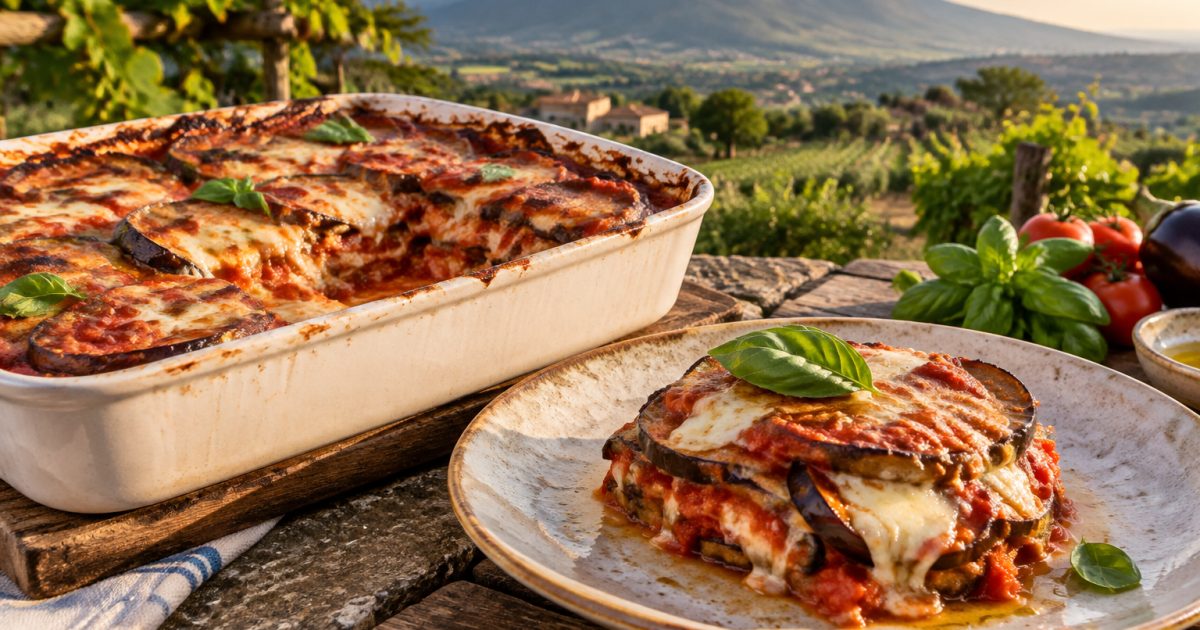
In the photo, a representative element of the story.
Between the hills of Taburno and the villages of Sannio Benevento, the aubergine parmigiana ideally accompanies the slow rhythm of the Campania countryside.
The Taburno landscape at the table
The Taburno-Camposauro massif dominates a landscape of slopes, vineyards, small cultivated plots, and roads that wind through the greenery before reaching villages and countryside. The mountain's profile changes with the light: sharper in the morning hours, softer as the sun sets behind the hills. All around, the countryside retains a tangible dimension, linked to harvests and home cooking.
It is in this context that eggplant parmigiana finds an evocative pairing, not a declaration of origin. The dish shouldn't be presented as a specialty necessarily born in the Taburno area: its history is part of a broad and varied southern tradition, with variations found in Campania and other southern regions. Here, however, its structure blends well with the agricultural landscape: eggplant, tomato, basil, and cheese compose a dish reminiscent of summer vegetable gardens, warm-season preserves, and shared lunches in the shade.
The Sannio Benevento area also suggests a precise moderation in eating. Eggplant parmigiana is rich, but it doesn't have to be heavy: it depends on the quality of the eggplant, the amount of oil absorbed during cooking, and the balance of the sauce. Served warm, in a modest portion and with a few freshly torn basil leaves, it can accompany a country table without overpowering the rest of the meal.
Eggplant, tomato and basil
For a baking dish serving four or six people, you'll need about 1,2 kilograms of eggplant, 700 grams of peeled tomatoes or tomato puree, 300 grams of well-drained mozzarella, 80 grams of grated cheese, a small onion, fresh basil, extra virgin olive oil, salt, and, for frying, vegetable oil. The quantities may vary depending on the height of the baking dish and the thickness of the slices.
The eggplants should be washed, dried, and cut lengthwise into slices about half a centimeter thick. If they have a lot of seeds or particularly watery flesh, they can be salted for thirty minutes, then quickly rinsed and dried thoroughly. This step isn't always essential, but it helps control moisture and the bitterness of some varieties.
The sauce is made by gently sautéing the onion in a little oil, without browning it. Add the tomato and salt, then cook for about twenty minutes, until the sauce is smooth but not watery. The basil should be added towards the end, so it retains some of its aroma. A sauce that's too thin would make the parmigiana unstable; one that's too dry would fail to bind the layers together.
Eggplant slices can be fried in hot oil, a few at a time, until lightly golden. After cooking, transfer them to absorbent paper, without overcrowding them. There's also a drier, more delicate baked version: brush the slices with a little oil and bake at around 220°C (425°F), turning once. Frying provides a softer, more filling texture; baking allows the vegetable flavor to emerge more fully.
To assemble the pan, spread a thin layer of sauce on the bottom, followed by a layer of eggplant, more tomato, diced mozzarella, grated cheese, and a few basil leaves. Continue in this manner until all the ingredients are used up, finishing with sauce, cheese, and a light sprinkling. It's important not to overdo the mozzarella: if you use too much or too little, it will release water during cooking.
The parmigiana bakes in a conventional oven at 190 degrees Celsius (375 degrees Fahrenheit) for about 35-40 minutes. The surface should be golden brown, while the edges should show a slight reduction in the sauce. Before cutting, it's best to let it rest for at least twenty minutes. This step allows the layers to settle and enhances the contrast between the tender eggplant, the tangy tomato, and the stringy cheese.
A pan in the garden season
In its connection with the Samnite landscape, parmigiana is especially important for its composition. It doesn't seek out foreign ingredients or complex techniques: it brings to the table a synthesis of recognizable products, patiently crafted. Tomatoes add depth and color, basil adds a green, balsamic note, and cheese softens the sauce and binds the texture.
It's a dish that changes depending on when it's served. Freshly baked, it's hot, fragrant, and difficult to portion precisely. After a few hours, it firmes up; the next day, the flavors are more integrated, and the slice holds its shape better. In summer, it can be accompanied by a salad of crispy leaves or raw vegetables, balancing the softness of the pan. On a Sannio table, the bread can collect any sauce left on the plate, a simple, waste-free custom.
The best time to imagine it is at the end of a bright day, when the fields change color and the vineyards follow the contours of the hills. The parmigiana arrives on the table still warm, while the Taburno landscape reminds us that regional cuisine is often born from the encounter between what the land offers and the time needed to transform it.
Thus, the dish becomes an edible frame of the Benevento countryside: not a postcard, but a blend of aromas, textures, and domestic gestures. Among vegetable gardens, vineyards, and hillsides, the eggplant parmigiana conveys the concrete character of a Campanian cuisine capable of giving depth to everyday ingredients.
Breaking News
An invitation to reading comes to life: a video of a library with Seedance 3.0.
On a bookcase table there is a closed book, a lit lamp and two… Read more
Monaldi Hospital inaugurates new heart transplant and innovative cardiac surgery procedures department
A department dedicated to heart transplants has been inaugurated at the Monaldi Hospital in Naples and… Read more
From cover to music teaser with Seedance 2.5
The single cover is ready, the song already has its sound, but it's missing… Read more
Cervinara, accused of forgery in receiving citizen's income: acquitted
The Avellino Court acquitted AM, 65, from Cervinara, of the charge of false certification… Read more
Maurizio de Giovanni's Passione evening sold out in Naples.
An evening event was held at the La Porta del Parco Auditorium in Bagnoli, featuring… Read more
Murder in Caivano on New Year's Eve 2002: Man arrested in Maremma, sentenced to 12 years and 9 months
Grosseto — A murder committed on January 1, 2002, in Caivano, in the Neapolitan hinterland. A man… Read more

National Newspaper
Registration No. 1301 of 2016 – ROC 030531
Director: Giuseppe Del Gaudio
To contact the editorial staff click HERE |
Download our Official ANDROID APP
